All about dinosaurs, fossils and prehistoric animals by Everything Dinosaur team members.

Everything Dinosaur’s work with photoshop and other platforms.

9 10, 2021

Over a Hundred Rare Theropod Tracks Studied in New Research

By |2024-07-27T16:53:43+01:00October 9th, 2021|Categories: Adobe CS5, Dinosaur and Prehistoric Animal News Stories, Dinosaur Fans, Main Page, Palaeontological articles, Photos/Pictures of Fossils|0 Comments

Scientists writing in the on-line, open access, academic journal “PeerJ” have reported upon the discovery of over 100 dinosaur fossil footprints. The footprints represent theropod dinosaurs and they vary in size indicating that a variety of meat-eating dinosaurs co-existed in the late Early Jurassic of Yunnan Province, China.
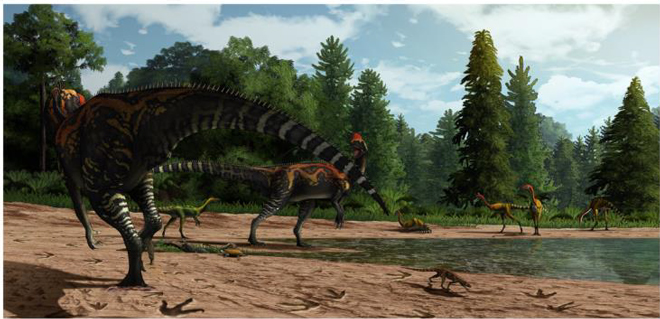
Yunnan theropods life reconstruction.
A life reconstruction depicting the lakeside palaeoenvironment with a variety of different theropods visiting the location. Picture credit: Yu Chen.

Yunnan Province Dinosaurs

Yunnan Province in south-western China is famous for its dinosaur fossils, the majority of which are body fossils, but there have been several published papers detailing track sites and more trace fossils from this province are due to be reported upon. The theropod assemblage track site is located close to the village of Xiyang, Jinning County in central Yunnan. The strata in which the tracks are located come from the Lower Jurassic Fengjiahe Formation and represent a lakeside environment (lacustrine). The reddish mudstone deposits that contain the tracks also preserve mud cracks that suggest the area was subject to droughts. The palaeoenvironment is believed to have been humid and warm (sub-tropical to tropical).

Theropod Tracks

The tracks have been known about for twenty years, but only recently has the site been extensively studied. Unfortunately, several prints had been lost to erosion prior to detailed analysis.

Yunnan theropod track site.
An overview of the track site with (A) an aerial photograph showing the track-bearing outcrop and (B) a line drawing showing the distribution of the theropod tracks. Morphotype A is highlighted in blue, morphotype B is highlighted in green and the single track of morphotype C is shown in red. Note scale bar equals 1 metre. Picture credit: Li et al.

Solitary Coelophysoid and Tetanuran Theropods

The Xiyang track site preserves 120 exposed footprints made by solitary theropod dinosaurs as they visited the lakeside. It is the largest theropod track site in terms of the total number of prints found, described to date from Yunnan. The prints have been assigned to three broad groups based on their size, they indicate that a variety of theropods were present in the ancient ecosystem including coelophysoid as well as larger tetanuran theropods.

The largest print from the site (XIY-48) measures 39 cm long and 40 cm wide. Large claw marks are associated with each digit of this print. Fossils of the six-metre-long theropod Sinosaurus triassicus (formerly Dilophosaurus sinensis), are known from this area. Sinosaurus fossils from Lower Jurassic Fengjiahe Formation have been found around 500 metres away from the track site, it has been speculated that the largest print could represent a track made by a Sinosaurus, although as it is a footprint, it has been assigned to the ichnogenus Kayentapus.
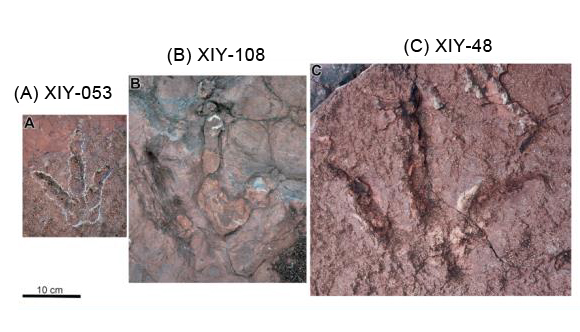
Yunnan track site theropod footprints.
Photographs showing examples of the three different footprint morphotypes associated with the Yunnan track site. Not scale bar equals 10 cm. Picture credit: Li et al.

Classifying the Footprints

Although the size of any tracks left can be influenced by many factors, the research team conclude that at least three different kinds of theropods were visiting the site frequently. The three groups of prints that the tracks have been classified into are:

  1. Morphotype A (>8 cm to <21 cm) resembling the ichnogenus Grallator.
  2. Morphotype B (>27 cm to<30 cm) identified as the ichnospecies Kayentapus xiaohebaensis.
  3. Morphotype C (39 cm) an isolated print referred to the ichnogenus Kayentapus.
Line drawings comparing theropod footprints.
Line drawings comparing theropod tracks from the site with those from the Jurassic of China. XIY-053 is morphotype A (A), whilst (B) is XIY-108 morphotype B and (C) is morphotype C. Grallator yemiaoxiensis is shown (D), Kayentapus xiaohebaensis is (E) and (F) is Kayentapus hopii. Note scale bar = 10 cm. Picture credit: Li et al.

Large Predator Dinosaurs Rare in the Early Jurassic

In Yunnan, the majority of dinosaur fossils from Lower Jurassic rocks represent sauropodomorphs. Whilst the tracks of sauropodomorphs can be mistakenly identified as theropod prints, the researchers who include Hongqing Li of Yunnan University and Claire Peyre de Fabrègues (Department of Biology, Indiana University of Pennsylvania, USA), as well as colleagues from Yuxi Museum (Yunnan Province) and the Chinese Academy of Sciences are confident that this site provides a useful record of the diversity of meat-eating dinosaurs present in this region during the late Early Jurassic

Large terrestrial predators (animals in excess of five metres in length), are rare in Early Jurassic ecosystems. Large tracks are scarce at this site, but not absent. Carnivorous dinosaurs of all sizes presumably co-existed in this palaeoenvironment and were regular visitors to the lakeside in search of food or potential prey.

The scientific paper: “The largest theropod track site in Yunnan, China: a footprint assemblage from the Lower Jurassic Fengjiahe Formation” by Hongqing Li, Claire Peyre de Fabrègues, Shundong Bi, Yi Wang and Xing Xu published in PeerJ.

Visit the Everything Dinosaur website: Dinosaur Models and Toys.
8 10, 2021

A Little Token of Appreciation from Wild Past

By |2024-07-27T14:50:19+01:00October 8th, 2021|Categories: Adobe CS5, Dinosaur Fans, Everything Dinosaur News and Updates, Main Page, Photos|0 Comments

In May of this year (2021), the excellent Wild Past Tethyshadros pair arrived at Everything Dinosaur. This dinosaur figure set featured two models of the dwarf hadrosauroid from north-eastern Italy, which was formally named and described in 2009.

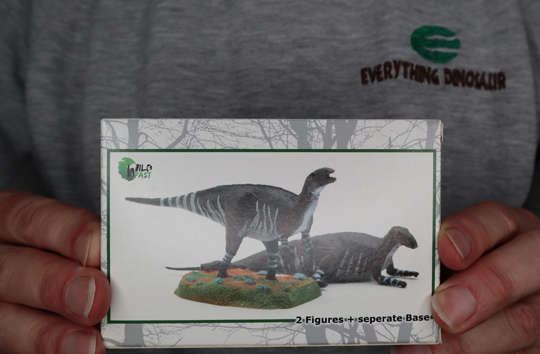
Wild Past Tethyshadros packaging
The front of the Wild Past Tethyshadros box. Whilst unpacking the Tethyshadros pair, a cardboard box was found inside one of the cartons. It turned out not to be part of the packing material to help protect the figures, but inside the box Everything Dinosaur team members found a little surprise. Picture credit: Everything Dinosaur.

Picture credit: Everything Dinosaur

As team members unpacked these models, a small cardboard box was discovered inside one of the cartons. At the time, this was thought to be part of the packing material, the box being thoughtfully added to ensure the boxes containing the 1:35 scale Tethyshadros models were fully protected. It was put to one side in our warehouse and remained unopened.

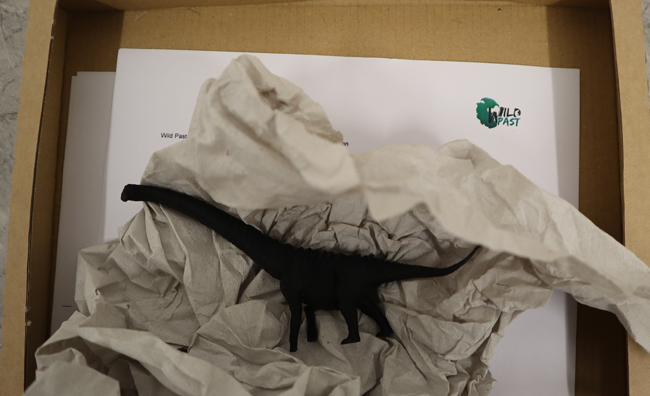
A team member came across the box this morning, curious as to what it might contain, it was carefully opened and inside a small model of the dwarf titanosaur Magyarosaurus was discovered.

Wild Past Magyarosaurus dinosaur model box.
The box containing the Magyarosaurus model was thought to be additional product packaging protection in the Wild Past Tethyshadros pair consignment and the model was not discovered until this morning.  Picture credit: Everything Dinosaur.

Picture credit: Everything Dinosaur

A Magyarosaurus Figure

Stefan, the German entrepreneur behind the Wild Past brand had included the little model as a gift, a token of appreciation for the support and assistance provided by Everything Dinosaur.

A note from Stefan accompanying the Magyarosaurus model was also discovered, the note said:

“Additionally, to the delivery I send you a small thank you for your ongoing support. It is our little 1:35 Magyarosaurus resin model. Hope you like it”.

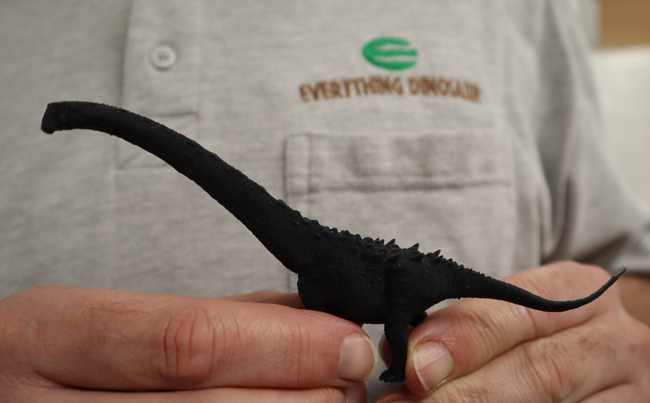
Holding the Wild Past Magyarosaurus dinosaur model.
The Wild Past Magyarosaurus dinosaur model, a little token of appreciation sent to Everything Dinosaur.  Picture credit: Everything Dinosaur.

Picture credit: Everything Dinosaur

Dwarf Titanosaur from the Hateg Basin

The Magyarosaurus genus has one certain species assigned to it (M. dacus), although slightly larger fossil material has been assigned to a second species – Magyarosaurus hungaricus but these fossils might represent a separate taxon. The beautiful model demonstrates the skill and creativity of Wild Past. The team members at Everything Dinosaur were delighted to receive their gift.

A spokesperson from Everything Dinosaur commented:

“It was very kind of Stefan to include this token of appreciation amongst the Tethyshadros models. We have emailed him and thanked him for his gift and apologised for the tardiness of our response. We did not open the box containing the model and his note until this morning”.

To view the range of Wild Past figures in stock at Everything Dinosaur, including the Wild Past Tethyshadros pair: Wild Past Prehistoric Animal Models and Figures.

The Everything Dinosaur website: Dinosaur Toys.

7 10, 2021

A New Dinosaur Called Pendraig milnerae – “Chief Dragon”

By |2024-07-27T14:45:35+01:00October 7th, 2021|Categories: Adobe CS5, Dinosaur and Prehistoric Animal News Stories, Dinosaur Fans, Main Page, Palaeontological articles, Photos/Pictures of Fossils|0 Comments

Scientists have described the oldest theropod dinosaur from the UK. The dinosaur has been named Pendraig milnerae, the scientific name honours the dinosaur’s Welsh roots and recognises the contribution of Dr Angela Milner, who sadly passed away last August.

Everything Dinosaur recently blogged about the naming of two spinosaurids described from fragmentary fossils found on the Isle of Wight. The trivial name of one of these theropods, Riparovenator milnerae, also honours Dr Milner.

To read Everything Dinosaur’s recent blog post about the two newly described spinosaurids: Two New Spinosaurids from the Isle of Wight.

Ironically, the remains of Pendraig were already ancient fossils when the Isle of Wight spinosaurids roamed. The Pendraig fossils come from limestone fissure fills of the Pant-y-ffynnon Quarry in the Vale of Glamorgan (Wales). This infilled material, deposited in Carboniferous limestone is difficult to date, but it is thought that these fossils are between 215 and 201 million years old (late Norian, latest occurrence possibly late Rhaetian).

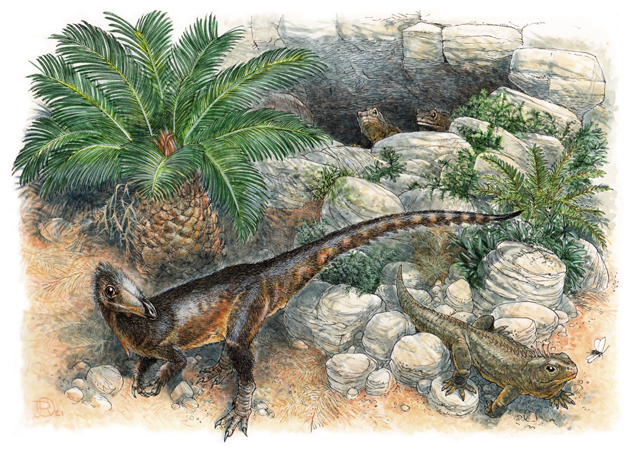
Pendraig milnerae life reconstruction.
A life reconstruction of Pendraig milnerae among the fissures of Pant-y-ffynnon with three individuals of the rhynchocephalian lepidosaur Clevosaurus cambrica for company (Late Triassic). Picture credit: James Robbins.

Misplaced Theropod Fossils

Writing in Royal Society Open Science, the researchers from the London Natural History Museum, the University of Birmingham and National Museums Scotland describe Pendraig milnerae based on an articulated pelvic girdle, sacrum and posterior dorsal vertebrae, and an associated left femur and by two referred specimens, comprising an isolated dorsal vertebra and a partial left ischium.

Co-author of the paper, Dr Susannah Maidment (London Natural History Museum), explained that the fossil material had been stored in a draw that contained crocodylomorphs. It was Dr Milner who was able to find the fossils within the vast Natural History Museum collection and to retrieve an unpublished PhD paper that had referred to them as part of a wider review of archosaurian remains associated with South Wales.

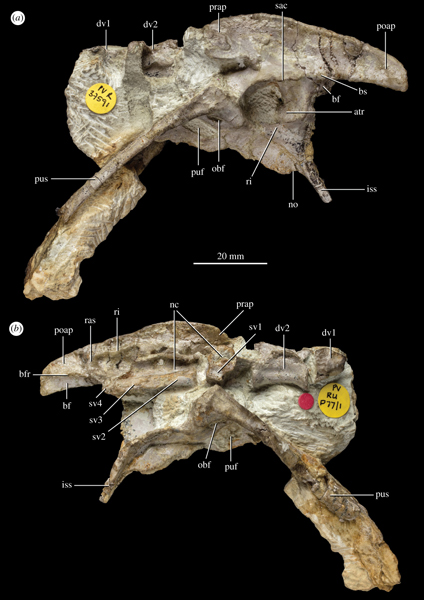
Pendraig milnerae pelvis and vertebrae.
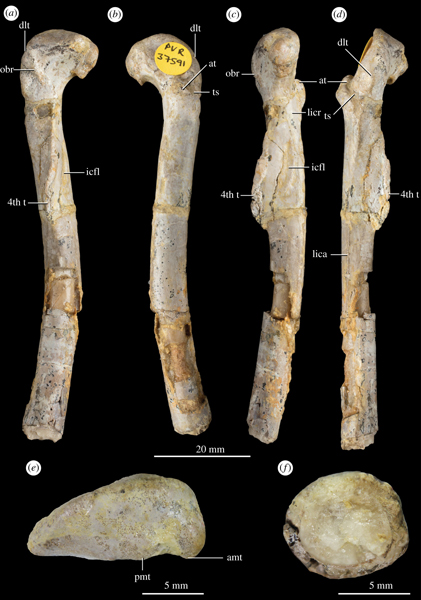
Holotype fossil of Pendraig milnerae (NHMUK PV R 37591) the articulated pelvis and vertebrae (a) left lateral view and (b) right lateral view. Picture credit: Spiekman et al.

Welsh Dinosaurs

A phylogenetic analysis indicates that was a P. milnerae non-coelophysid coelophysoid and it represents the first-named, unambiguous theropod from the Triassic of the UK. The genus name translates from Middle Welsh as “chief dragon”. During the Late Triassic, the dinosaurs were not the dominant terrestrial animals that they were later to become. Discoveries of Triassic-aged theropods can help palaeontologists to better understand the evolution of these important tetrapods, the dinosaur lineage that led directly to modern birds.

Wales might be associated with dragons, but dinosaur discoveries are extremely rare in this part of the UK. Previously, only two dinosaur genera have been named – Pantydraco (P. cauducus) a basal sauropodomorph from a limestone fissure infill from the Pant-y-ffynnon Quarry and the coelophysoid Dracoraptor (D. hanigani) which was named and described in 2016 from fossils found near the Welsh town of Penarth.

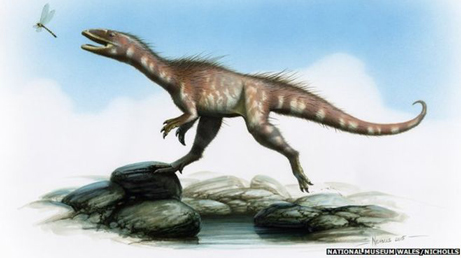
Dracoraptor hanigani.
An illustration of the coelophysoid theropod dinosaur from Wales Dracoraptor hanigani. Picture credit: Bob Nicholls.

An Insular Dwarf

The palaeoenvironment in which Pendraig lived was most likely an archipelago and species that live on small islands with limited resources can become smaller than their mainland relatives due to a phenomenon known as insular dwarfism.

Measuring around 75 cm to a metre in length P. milnerae was indeed small, a characteristic that it shares with a number of other vertebrates known from the same deposits.

Lead author of the paper, Dr Stephan Spiekman (London Natural History Museum), explained:

“Because the fossil reptiles from this area, including Pendraig, are all quite small-sized, we used statistical analyses to investigate whether Pendraig might have been an insular dwarf. The results indicate that Pendraig is indeed small, even for a theropod of that time period, but not uniquely so”.

Analysis of the fossil bones, indicate that the material does not represent a juvenile or very young animal. However, the fossils do represent an animal that was probably not fully grown when it died.

Views of the left femur of Pendraig.
Various views of the holotype femur of Pendraig milnerae from the Late Triassic of Wales. Picture credit: Spiekman et al.

The researchers conclude that Pendraig may have been a dwarf form but as some other coelophysoid taxa also show a similar size reduction (based on femur bone length comparisons), it is not possible to say with certainty that this little Welsh, Triassic dinosaur was indeed an insular dwarf.

Dr Spiekman added:

“With this in mind, we need more evidence from more species to investigate the potential for island dwarfism in this area during that time, but if we could prove it, it would be the earliest known occurrence of this evolutionary phenomenon”.

The scientific paper: “Pendraig milnerae, a new small-sized coelophysoid theropod from the Late Triassic of Wales” by Stephan N. F. Spiekman, Martín D. Ezcurra, Richard J. Butler, Nicholas C. Fraser and Susannah C. R. Maidment published in Royal Society Open Science.

Visit the Everything Dinosaur: Dinosaur Toys.

5 10, 2021

New Species of Horned Dinosaur from New Mexico

By |2024-07-27T14:10:54+01:00October 5th, 2021|Categories: Adobe CS5, Dinosaur and Prehistoric Animal News Stories, Dinosaur Fans, Main Page, Palaeontological articles, Photos/Pictures of Fossils|0 Comments

A new species of horned dinosaur has been named and described from fossils found in New Mexico. The dinosaur has been named Sierraceratops turneri and it was distantly related to Triceratops.

The new horned dinosaur classified as a member of the Chasmosaurinae, roamed New Mexico approximately 72 million years ago (latest Campanian–Maastrichtian). Sierraceratops adds to the diversity and disparity of the Chasmosaurinae in the Late Cretaceous. This discovery provides supporting evidence for the hypothesis of Laramidian endemism – the idea that species were restricted to specific regions. Together with Sierraceratops, the Hall Lake Formation dinosaur fauna suggests that the latest Cretaceous of southern Laramidia was characterised by endemic clades and distinct dinosaur communities.

Sierraceratops turneri life reconstruction
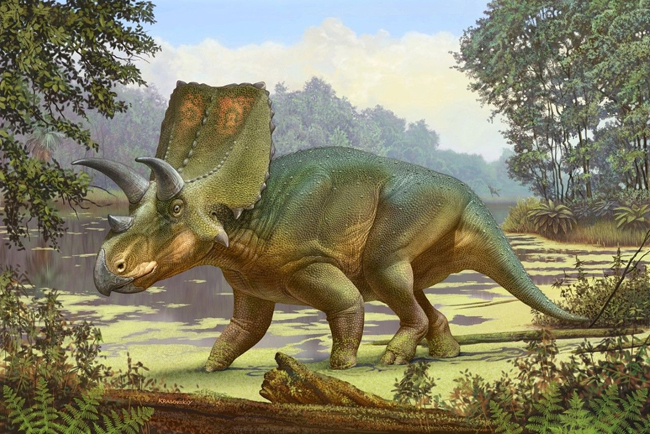
A life reconstruction of the newly described chasmosaurine Sierraceratops turneri. If you look carefully, just above the tail you can see a tyrannosaur approaching in the background. Picture credit: Sergey Krasovskiy.

From Sierra County, New Mexico

The first fossil material associated with this new horned dinosaur, was discovered in 1997 by Greg H. Mack of New Mexico State University whilst undertaking a geological survey. Most of the fossils were collected from the surface, having already weathered out of the surrounding rock, but a field team from the New Mexico Museum of Natural History was despatched and additional fossils were found. The remainder of the fossil material that led to the naming of Sierraceratops was excavated between 2014-2016 by other field teams sent out to the site by the New Mexico Museum of Natural History.

The fossils include elements from the skull and jaws, along with two neckbones (cervicals), two dorsal vertebrae, the sacrum, scapulocoracoid, the ilium and limb bones. The genus name honours Sierra County where the fossils were found, whilst the species name is a tribute to Mr Ted Turner, the founder of the Cable News Network (CNN) who owned the land where the fossils were collected.

Distinct Dinosaur Regional Communities

Phylogenetic analysis suggests that Sierraceratops is a sister taxon to Bravoceratops and Coahuilaceratops, forming part of a clade endemic to the southwestern United States and Mexico. Sierraceratops adds to the diversity and disparity of the Chasmosaurinae in the Late Cretaceous and provides supporting evidence for the hypothesis of Laramidian endemism. Dinosaur fossils from the Hall Lake Formation suggest that the dinosaur biota of southern Laramida was characterised by distinct dinosaur communities. Similar types of dinosaurs could be found in other areas, but the genera were distinctive.

Ceratopsian distribution in Laramidia.
The discovery of Sierraceratops supports the theory that there were distinct dinosaur communities in Laramidia during the Late Cretaceous. Sierraceratops fossil location is marked by the white star and the red horned dinosaur image. It is shown in context with other ceratopsid fossil discoveries. Picture credit; University of Bath with additional annotation by Everything Dinosaur.

Recent Discoveries of Horned Dinosaurs from New Mexico

New Mexico has proved to be a happy hunting ground for new ceratopsid discoveries in recent years. For example, some of the authors of the Sierraceratops paper also worked on the publication describing Menefeeceratops (M. sealeyi), from the Menefee Formation. Menefeeceratops roamed New Mexico some 10 million years before Sierraceratops evolved. As Menefeeceratops has been classified as a member of the Centrosaurinae and Sierraceratops is regarded as a chasmosaurine, these two horned dinosaurs were only distantly related.

To read Everything Dinosaur’s article about Menefeeceratops: Menefeeceratops – the Oldest Centrosaurine.

Sierraceratops turneri – Tyrannosaurs and Titanosaurs

Based on a comparison with better-known chasmosaurine fossil specimens, Sierraceratops is estimated to have measured around five metres in length. Its skull would have been around 1.5 metres long. The scientists behind this research, including Dr Nicholas Longrich (senior lecturer in the Department of Biology and Biochemistry at the University of Bath), predict that several more new dinosaurs will be described from Laramidia.

Sierraceratops shared its lush, floodplain and swamp environment with other dinosaurs including giant titanosaurs and predatory tyrannosaurids. It also highly likely that Sierraceratops was contemporaneous with other plant-eating dinosaurs such as hadrosaurids and ankylosaurids. Fossil evidence for both armoured dinosaurs and duck-billed dinosaurs have been found in other Hall Lake Formation sediments but their stratigraphical relationship to the Sierraceratops material remains undetermined.

Sierraceratops compared in size to other dinosaurs from New Mexico
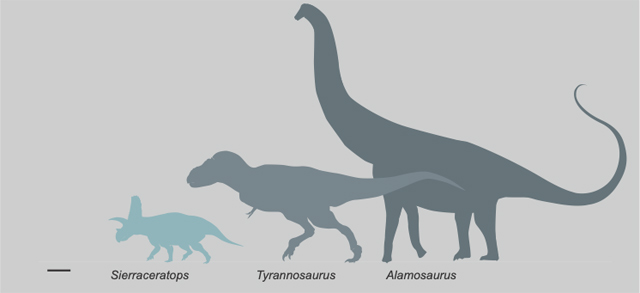
Size comparison of typical dinosaur fauna associated with southern Laramidia. Note scale bar = 1 metre. Picture credit: Dalman et al.

Everything Dinosaur acknowledges the assistance of a media release from the University of Bath in the compilation of this article.

The scientific paper: “Sierraceratops turneri, a new chasmosaurine ceratopsid from the Hall Lake Formation (Upper Cretaceous) of south-central New Mexico” by Sebastian G. Dalman, Spencer G Lucas, Steven E. Jasinski and Nicholas R. Longrich published in Cretaceous Research.

The Everything Dinosaur website: Dinosaur Models and Toys.
4 10, 2021

New Dino Hazard Irritator challengeri Model in Stock

By |2024-07-27T13:00:48+01:00October 4th, 2021|Categories: Adobe CS5, Dinosaur Fans, Everything Dinosaur News and Updates, Everything Dinosaur Products, Main Page, Photos of Everything Dinosaur Products|0 Comments

The excellent Dino Hazard Irritator challengeri dinosaur model is in stock at Everything Dinosaur. The replica of a Brazilian dinosaur, created by a Brazilian design team has reached our warehouse and prehistoric animal model collectors can now acquire this figure from a 5-star rated supplier.

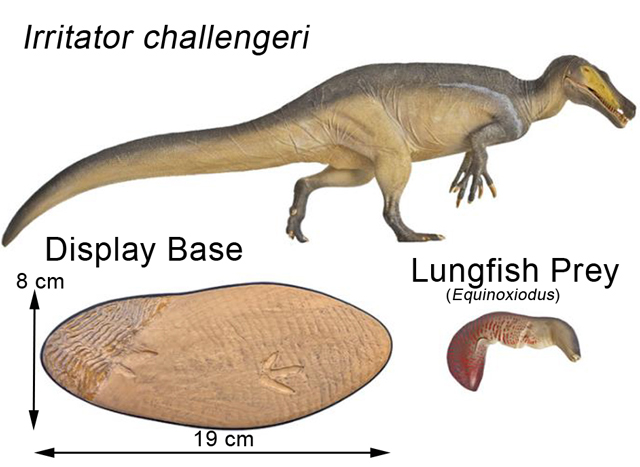
Dino Hazard Irritator with Prey

The theropod Irritator challengeri is associated with the Romualdo Formation whilst the lungfish (Equinoxiodus alcantarensis) is associated with the geologically younger Alcântara Formation.  Picture credit: Everything Dinosaur.

Picture credit: Everything Dinosaur

Product Testing

Team members at the UK-based company secured a sample of this dinosaur figure which then went into product testing with the independent product testing company Eurofins. The figure may be designed for collectors over 14 years of age and it might be marketed as a 14+ figure but Everything Dinosaur prudently took the decision to get this model assessed under the General Product Safety Directive, before committing to stocking it. After all, consumer safety and the well-being of our customers are matters that Everything Dinosaur takes very seriously.

We documented our testing work on the Dino Hazard Irritator challengeri figure in a series of posts and YouTube videos.

YvY Figures Irritator challengeri dinosaur model

Everything Dinosaur team members are working on a YouTube video that will explain the steps that they have to take to ensure a dinosaur model has been properly tested before it can be placed on the market.  Picture credit: Everything Dinosaur.

Picture credit: Everything Dinosaur

A 1:20 Scale Theropod Model

The impressive theropod model measures around 37 cm in length and the optional display base is approximately 19 cm long and 8 cm in width at its widest part. YvY Figures who are the company behind the Dino Hazard brand state that the Irritator figure is in approximately 1:20 scale.

Dino Hazard Irritator challengeri box contents

The Dino Hazard Irritator challengeri is supplied with an optional display base and a lungfish prey item.

Optional Display Base

Whilst there is much to be admired in the details on the display base, the model does not sit well in the footprints. Everything Dinosaur advises that if collectors want to display this figure on the base, then steps are taken to ensure that the figure is permanently fixed to the base. It should be noted that the dinosaur model was designed with the appropriate weight distribution and it can stand without the base.

Displaying the Dino Hazard Irritator challengeri dinosaur model

The Dino Hazard Irritator challengeri dinosaur model can be displayed on or off its base. If the model is displayed on its optionla display base then Everything Dinosaur recommends that this figure is glued to the base.  Picture credit: Everything Dinosaur.

Picture credit: Everything Dinosaur

Dino Hazard Irritator challengeri Model

A spokesperson from Everything Dinosaur stated:

“This is the first prehistoric animal figure under the Dino Hazard brand, more figures are planned including an excellent Carcharodontosaurus model. We have offered our assistance to YvY Figures and already provided them with advice to help get this second project off the ground and running. As for the Dino Hazard Irritator challengeri model, we are delighted to act as a legal importer and distributor for this excellent figure”.

For the time being, the Dino Hazard Irritator has been placed in the W-Dragon section of the Everything Dinosaur website, this has been done until YvY Figures have more models in their inventory so we can provide a dedicated product section for the Dino Hazard brand.

To view the W-Dragon figures and the new Dino Hazard Irritator model: Find the Dino Hazard Irritator Model Here.

Visit the Everything Dinosaur website: Dinosaur Toys.

3 10, 2021

PNSO to Add a New Livyatan Model

By |2024-07-27T12:39:29+01:00October 3rd, 2021|Categories: Adobe CS5, Dinosaur Fans, Everything Dinosaur News and Updates, Everything Dinosaur Products, Main Page, Photos of Everything Dinosaur Products, Press Releases|0 Comments

PNSO are to add a model of the giant, prehistoric, toothed whale known as Livyatan to its mid-size model range. The figure, Requena the Livyatan is likely to be in stock at Everything Dinosaur sometime in mid to late November.

PNSO Requena the Livyatan model close view of the head
A close-up view of the head of Requena the Livyatan.

PNSO Requena the Livyatan

Named and described in 2010 (L. melvillei), Livyatan is known from the Pisco Formation of Peru, although isolated fossil teeth indicate that it may have ranged over much of the Southern Hemisphere. The species name honours the American author Herman Melville who wrote “Moby Dick”, an epic story of the quest to hunt a giant, white sperm whale. The novel was first published in October 1851, now almost exactly 170 years later, PNSO have introduced a replica of this huge cetacean, one of the largest predators of all time.

PNSO Requena the Livyatan model
PNSO Requena the Livyatan prehistoric whale model anterior view.

Livyatan Model Measurements

The new PNSO prehistoric whale figure measures an impressive 32 cm in length. The tip of the small dorsal fin stands some 8.5 cm off the ground. Given the curve of the body of the model, PNSO state that the actual length of the figure is over 36.5 cm. Livyatan is only known from skull material and isolated teeth. Palaeontologists are not sure how big this prehistoric whale from the Miocene Epoch was. Size estimates vary between 13.5 metres and 18 metres long.

PNSO does not publish a scale for their mid-size models, however, based on the stated curved length of the model, team members at Everything Dinosaur estimate that the PNSO Requena the Livyatan replica is between 1:36 and 1:49 scale.

PNSO Requena the Livyatan measurements
The PNSO Requena the Livyatan model measures 32 cm long and the model is 8.5 cm high.

In Stock at Everything Dinosaur November 2021

A spokesperson from Everything Dinosaur confirmed that they had known about this model for a while. However, they wanted PNSO to make the official announcement before commenting.

The spokesperson added:

“We have known about PNSO model plans for some time. It is wonderful to have a replica of a prehistoric whale added to the PNSO model range, especially since this company has already produced a model of the contemporaneous prehistoric shark Otodus which is better known as Megalodon.”

PNSO Requena the Livyatan model
The PNSO Requena the Livyatan prehistoric whale model.

Supplied with Support Stands

The PNSO Requena the Livyatan model is supplied with two transparent support stands to help this prehistoric whale figure to be displayed.

The spokesperson from Everything Dinosaur added, that they had received requests from many prehistoric animal model collectors to lobby for more prehistoric mammals to be added to ranges. The addition of a Livyatan replica, the first mainstream model of this giant, prehistoric whale to have been produced, is exactly what many model collectors have been looking for.

The PNSO Requena the Livyatan model is likely to be in stock mid to late November 2021.

PNSO Requena the Livyatan model box
PNSO Requena the Livyatan packaging.

PNSO Age of Dinosaurs Prehistoric Animal Models

To view the range of PNSO prehistoric animal models available from Everything Dinosaur: PNSO Age of Dinosaurs.

Visit the Everything Dinosaur website: Everything Dinosaur.

30 09, 2021

A New Dinosaur Book “Dinopedia” by Darren Naish

By |2024-07-02T22:46:37+01:00September 30th, 2021|Categories: Adobe CS5, Book Reviews, Dinosaur Fans, Main Page|0 Comments

Renowned dinosaur expert Darren Naish has produced a pocket guide to all things dinosaur. Entitled “Dinopedia” it’s a reader-friendly compendium packed full of facts about the Dinosauria. It is a handy A-Z updating dinosaur fans and those with a general interest in natural history on the fascinating and ever-changing world of dinosaur research.

The book has the feel of a real labour of love, the author sharing his passion for palaeontology with the general reader. Even the horned dinosaur on the front cover seems to be smiling.

Dinopedia front cover illustration
The front cover of Dinopedia features a horned dinosaur. Picture credit: Everything Dinosaur.

Picture credit: Everything Dinosaur

Princeton University Press

Published by Princeton University Press (UK release scheduled for October 5th, American release scheduled for November 30th, 2021), this is another in a long line of publications from this publisher with close links to the academic world. Darren himself is the author of many books, several on the bookshelves of Everything Dinosaur, but “Dinopedia” is a little different.

The hand-drawn illustrations give this compendium a very personal feel, as does the binding which is a figured cloth design, the binding decorated with embossed images and text. It takes the reader back to a simpler time, before the internet and cyberspace when textbooks were the only source of reference.

Subtitled “A Brief Compendium of Dinosaur Lore”, Darren gently guides the reader through the diverse and eclectic world of the Dinosauria. He outlines the different types of dinosaur focusing on the family or subfamily level of taxonomy with only a few specific genera such as Archaeopteryx and Deinonychus having specific entries. After all, these two theropods play an important role in helping to understand how our perceptions about dinosaurs have altered and this is a key theme of this book, the author providing an insight into how our understanding of dinosaur evolution has changed in recent times.

Drawing of a heterodontosaurid dinosaur
One of the illustrations by Darren Naish for his compendium of dinosaur-themed facts and figures “Dinopedia”. The hand-drawn figures give the book a very personal feel.

Dinosaurs and Popular Culture

As well as outlining the contribution made to palaeontology by a number of scientists, the author discusses the cultural impact of the Dinosauria. Sandwiched between a reprise on the ornithopod Iguanodon and an explanation of the K-Pg mass extinction event there is an entry dedicated to the film “Jurassic Park” which spawned a whole new generation of dinosaur fans.

The book is an ideal stocking filler for those obsessed with the “terrible lizards”, and we at Everything Dinosaur recommend it. “Dinopedia” would make a wonderful Christmas gift.

For more details about “Dinopedia” and to pre-order/purchase visit: Princeton University Press and search the website for “Dinopedia” or the author “Darren Naish”.

27 09, 2021

Volcanoes Helped to Power the Rise of the Dinosaurs

By |2024-07-02T22:26:55+01:00September 27th, 2021|Categories: Adobe CS5, Dinosaur and Prehistoric Animal News Stories, Dinosaur Fans, Main Page, Palaeontological articles, Photos/Pictures of Fossils|0 Comments

The rise of the dinosaurs which led them to dominate terrestrial ecosystems for more than 150 million years was driven by environmental change caused by intense volcanism over 230 million years ago. That is the conclusion in a new study published today in the ” Proceedings of the National Academy of Sciences” (PNAS).

The Late Triassic Carnian Pluvial Episode (CPE) led to a huge rise in global temperature and humidity. This dramatic change had a significant impact on the development of animal and plant life, which was still recovering from the greatest mass extinction event known in the fossil record which had occurred at the end of the Permian, some 20 million years earlier.

The rise of the dinosaurs was powered by intense volcanic activity.
Ecological changes following intense volcanic activity during the Carnian Pluvial Episode 230 million years ago paved the way for dinosaurs to become the dominant terrestrial fauna. Picture credit: University of Birmingham.

The Evolution of Modern Conifers

The researchers, including experts from the University of Birmingham, discovered four distinct pulses of volcanic activity during this time in the Late Triassic. The most likely source of this volcanism being the Wrangellia Large Igneous Province, remnants of which can still be seen in Alaska, British Columbia and the Yukon (western North America).

Jason Hilton (Professor of Palaeobotany and Palaeoenvironments at the University of Birmingham’s School of Geography, Earth and Environmental Sciences), a co-author of the study, explained:

“Within the space of two million years the world’s animal and plant life underwent major changes including selective extinctions in the marine realm and diversification of plant and animal groups on land. These events coincide with a remarkable interval of intense rainfall known as the Carnian Pluvial Episode.”

One of the major groups of plants to benefit from the dramatic climate change were cone-bearing seed plants (conifers). Ferns also benefitted and show an increase in numbers, range and species. Other archosaurs such as crocodyliforms show an increase in diversity and mammaliaforms, insects and turtles seem to have thrived as a result of this climate change.

Rising Carbon Dioxide Levels Driving Climate Change

Professor Hilton added:

“Our research shows, in a detailed record from a lake in North China, that this period can actually be resolved into four distinct events, each one driven by discrete pulses of powerful volcanic activity associated with enormous releases of carbon dioxide into the atmosphere. These triggered an increase in global temperature and humidity.”

The scientists discovered that each phase of volcanic activity coincided with widescale disruption to the global carbon cycle. The higher levels of carbon dioxide produced led to major climate changes with a hotter, wetter climates predominating. The ancient lake deposits reveal that it became deeper but oxygen levels in the lake reduced and stifled animal life.

Geological events from a similar timeframe in Europe, Argentina, eastern Greenland, Morocco and North America, among other locations indicate that increased rainfall resulted in widespread expansion of drainage basins converging into lakes or swamps, rather than rivers or oceans.

Co-author of the paper, Dr Sarah Greene (Senior Lecturer in the School of Geography, Earth and Environmental Sciences, University of Birmingham) added:

“Our results show that large volcanic eruptions can occur in multiple, discrete pulses demonstrating their powerful ability to alter the global carbon cycle, cause climate and hydrological disruption and drive evolutionary processes.”

Pollen spores and algae from the Carnian Pluvial Episode (China)
Example pollen, spores and algae from the Carnian Pluvial Episode in China that record climate and environmental change following massive volcanism. Individual specimens range from 20 to 120 μm in size. Picture credit: University of Birmingham.

The research team investigated terrestrial sediments from the ZJ-1 borehole in the Jiyuan Basin of North China. They used uranium-lead zircon dating, high-resolution chemostratigraphy, palynological and sedimentological data to correlate terrestrial conditions in the region with synchronous large-scale volcanic activity in North America.

Everything Dinosaur acknowledges the assistance of a media release from the University of Birmingham in the compilation of this article.

The scientific paper: “Volcanically-driven lacustrine ecosystem changes during the Carnian Pluvial Episode (Late Triassic)” by Jing Lu, Peixin Zhang, Jacopo Dal Corso, Minfang Yang, Paul B. Wignall, Sarah E. Greene, Longyi Shao, Dan Lyu and Jason Hilton published in Proceedings of the National Academy of Sciences (PNAS).

Visit the Everything Dinosaur website: Everything Dinosaur.

26 09, 2021

William Updates his Exclusive Allosaurus Review

By |2024-07-02T22:21:38+01:00September 26th, 2021|Categories: Adobe CS5, Dinosaur Fans, Everything Dinosaur Products, Main Page, Product Reviews|0 Comments

Earlier on this year (summer 2021), knowledgeable dinosaur model fan and collector William sent into Everything Dinosaur his review of the recently introduced PNSO Allosaurus dinosaur replica (Paul the Allosaurus). William emailed to let us know that he wanted to add some additional comments about this new for 2021 theropod figure.

As always, Everything Dinosaur team members do their best to help and support their customers so we have published his Allosaurus themed comments on our blog.

PNSO Paul the Allosaurus dinosaur model
The stunning PNSO Paul the Allosaurus (anterior view). This PNSO theropod figure has proved to be very popular with dinosaur fans and model collectors and it has attracted rave reviews.

William’s PNSO Allosaurus Comments

William wanted to add:

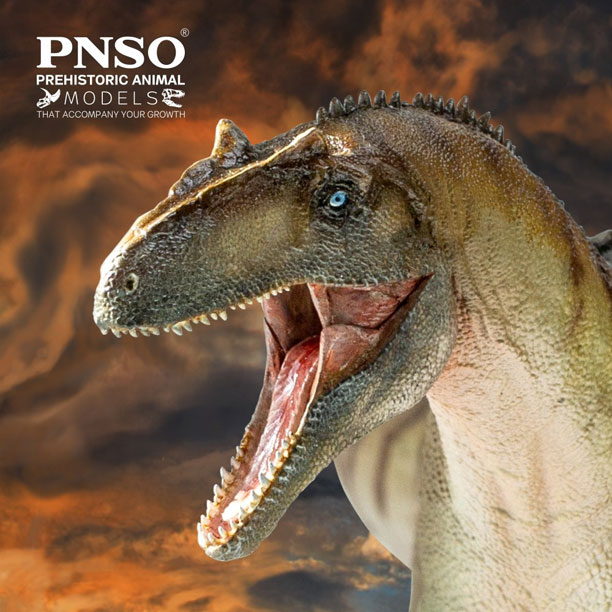
“Paul’s head crest is the best of the best of any present-day Allosaurus model. Paul’s articulated jaw opens into a nice wide maw displaying his highly detailed mouth with tongue, teeth and nasal passages. The texture and execution of the skin folds around each of his glacier blue eyes makes each stand out even more in a great way.”

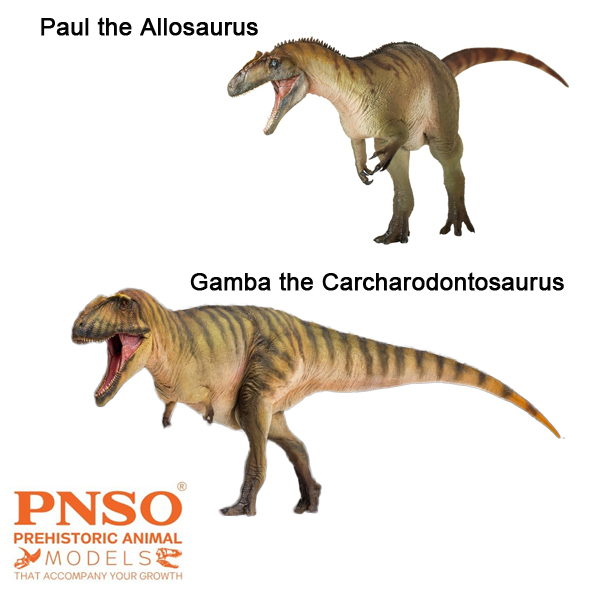
PNSO Allosaurus and Carcharodontosaurus dinosaur models
PNSO theropod models (top) Paul the Allosaurus and (bottom) Gamba the Carcharodontosaurus. William has reviewed a number of recent PNSO model introductions including Paul the Allosaurus and Gamba the Carcharodontosaurus.

To read William’s earlier review of the PNSO Allosaurus model: PNSO Paul the Allosaurus Reviewed.

Dinosaur Replica Attracts Rave Reviews

William is not the only Everything Dinosaur customer to have raved about the PNSO Allosaurus figure. For example, collectors @carlandhelen51 praised this figure commenting:

“I`ve been waiting for an accurate Allosaurus to compliment my 1/35th scale dinosaurs for a few years now, and wow, does this PSNO Allosaurus tick all the boxes! It is exceptional. I am so pleased with this model I can`t tell you! This is my eighth PSNO model and certainly won`t be my last. PSNO are definitely leading the way in creating accurate scale models so far.”

Everything Dinosaur has received several reviews from customers, all logged and verified by the independent ratings company Feefo.

PNSO the Allosaurus dinosaur model Feefo reviews
The PNSO Paul the Allosaurus dinosaur model has received 5-star customer reviews.

Full of praise for the PNSO figure, collector William added:

“In truth, this the first Allosaurus model that I really wished to add to my little collection, yes Paul is that great example of the Allosaurus family.”

Customers praise the PNSO Allosaurus dinosaur model
Some of the typical Feefo customer reviews for the PNSO Allosaurus dinosaur model. This new for 2021 theropod model has attracted high praise.

A spokesperson from Everything Dinosaur thanked William and all the Allosaurus review contributors and exclaimed:

“PNSO have produced lots of exciting new models and figures this year. The great news for collectors is that we have still to announce all the new PNSO figures for 2021. We hope to update fans of the PNSO prehistoric animal model range in the very near future.”

To view the current range of PNSO prehistoric animal models and figures in stock at Everything Dinosaur: PNSO Age of Dinosaurs.

Visit the award-winning Everything Dinosaur: Everything Dinosaur.

25 09, 2021

New Prehistoric Times Magazine Issue 139

By |2024-07-02T22:20:32+01:00September 25th, 2021|Categories: Adobe CS5, Dinosaur and Prehistoric Animal Drawings, Dinosaur Fans, Magazine Reviews, Main Page|0 Comments

Time to take a sneak peek at the front cover of the forthcoming edition of the quarterly magazine “Prehistoric Times”. It features a close-up view of the head of the African spinosaurid Suchomimus on the front cover.

Team members at Everything Dinosaur are grateful to magazine editor Mike Fredericks for sending us an image of the front cover of the next edition (issue 139) of this popular magazine.

Prehistoric Times magazine (issue 139)
The front cover of the next issue of “Prehistoric Times” magazine (issue 139) features a close-up view of the head of the spinosaurid Suchomimus. Picture credit: Mike Fredericks.

Issue 139 (Fall/Autumn 2021)

As well as Phil Hore’s articles on Suchomimus and placodonts (Henodus), we can look forward to the next instalment of Jon Lavas’s long-running series highlighting the work of the influential Czech artist Zdeněk Burian. In issue 139, the focus will be on Burian’s illustrations of Stegosaurus.

Stegosaurus stenops threatened by a pair of Antrodemus valens.
The classic depiction of a Late Jurassic scene by Burian (1950). Everything Dinosaur team members wonder whether this iconic image of the armoured dinosaur Stegosaurus will feature in issue 139 (fall/autumn 2021)? Picture credit: Zdeněk Burian.

The front cover text hints at an article by the talented polymath Tracy Lee Ford on dinosaur feathers. At this time, team members at Everything Dinosaur do not know whether dinosaur feathers are the subject of his regular “how to draw dinosaurs” feature of if this is an especially commissioned piece focusing on the various integumentary coverings associated with the Dinosauria. The article is bound to be most informative and we look forward to issue 139 dropping through our letter box sometime in the next few weeks.

To learn more about “Prehistoric Times” magazine and to subscribe: “Prehistoric Times” magazine.

Go to Top