All about dinosaurs, fossils and prehistoric animals by Everything Dinosaur team members.
22 01, 2026

New Research Postulates Giant, Prehistoric Kangaroos Could Still Hop

By |2026-01-22T07:30:00+00:00January 22nd, 2026|Categories: Palaeontological articles|0 Comments

Researchers studying the fossilised remains of giant, prehistoric kangaroos have concluded that even marsupials weighing more than two hundred kilograms were not too big to hop. This new study, published in the academic journal “Scientific Reports” challenges the long-held view that these giants were walkers rather than hoppers. The research team examined fossils of short-faced kangaroos (Sthenurinae). During the Pleistocene some of these kangaroos evolved giant, robust forms. Their method of locomotion remains controversial. Did humans encounter walking giant short-faced kangaroos or did they witness a sthenurine hopping?
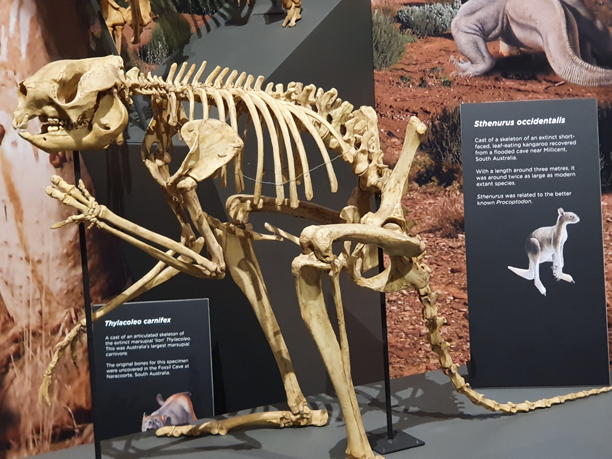
Cast of the skelton of Sthenurus occidentalis. Was this a hopping stenurine?

Cast of a sthenurine skeleton (Sthenurus occidentalis) in the South Australian Museum. Picture credit Megan Jones.

Picture credit: Megan Jones

A Sthenurine Hopping Hypothesis

The Sthenurinae are a subfamily of the Macropodidae. The Macropodidae is a large family of marsupials that includes kangaroos, wallabies and their relatives. The largest extant kangaroo is the red kangaroo (Osphranter rufus). Males can weigh as much as ninety kilograms and stand 1.6 metres tall. They are the largest terrestrial mammal native to Australia and the largest living marsupial. However, during the Pleistocene, much larger kangaroos evolved.  For example, whilst small, wallaby-sized sthenurines are known, other taxa were much larger than living kangaroos. The sthenurine Procoptodon goliah is thought to be the biggest kangaroo that ever existed.  Males stood around two metres tall and weighed perhaps as much as two hundred and forty kilograms.
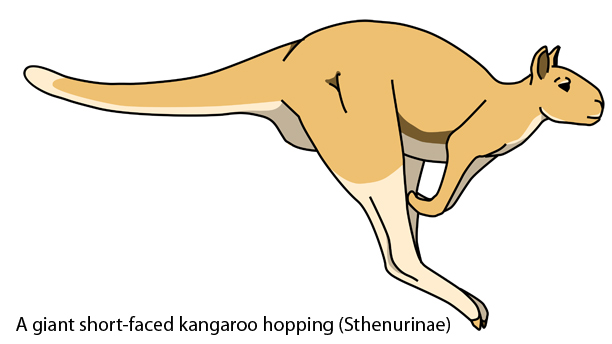
Life reconstruction of a sthenurine hopping.

Reconstruction of a giant short-faced kangaroo (sthenurine) hopping. Picture credit: Megan Jones.

Picture credit: Megan Jones

Earlier studies suggested that hopping would become mechanically impossible above a body weight of a hundred and fifty kilograms. Those conclusions were largely based on studies of extant kangaroo skeletons.  The anatomy of modern kangaroos was simply scaled up.

To read a blog post from 2014 that looked at evidence for walking locomotion in largest members of the Sthenurinae: Giant Kangaroos Made for Walking.

This new study involved scientists from The University of Manchester, in collaboration with the University of Bristol and the University of Melbourne.  These researchers took a different approach.  Measurements taken from the skeletons of extant species were compared with the fossil remains of extinct species.  The researchers conclude that giant kangaroos may have been capable of hopping.  Indeed, early Australians could have observed a sthenurine hopping.

Lead Researcher Megan Jones, (The University of Manchester) explained:

“Previous estimates were based on simply scaling up modern kangaroos, which may mean we miss crucial anatomical differences. Our findings show that these animals weren’t just larger versions of today’s kangaroos, they were built differently, in ways that helped them manage their enormous size.”

Examining the Two Limiting Factors for Hopping

The research team examined two potential limiting factors for hopping, the strength of the foot bones and the ability of the ankle to anchor the powerful tendons that power hopping.  The analysis demonstrated that giant, short-faced kangaroos had shorter, robust foot bones capable of withstanding landing forces and their heel bones were broad enough to support much thicker tendons.

However, Pleistocene giant kangaroos probably did not bounce across the landscape like modern red kangaroos.

Co-author Dr Katrina Jones (Bristol University), stated:

“Thicker tendons are safer, but they store less elastic energy. This likely made giant kangaroos slower and less efficient hoppers, better suited to short bursts of movement rather than long-distance travel. But hopping does not have to be extremely energy efficient to be useful, these animals probably used their hopping ability to cross rough ground quickly or to escape danger.”
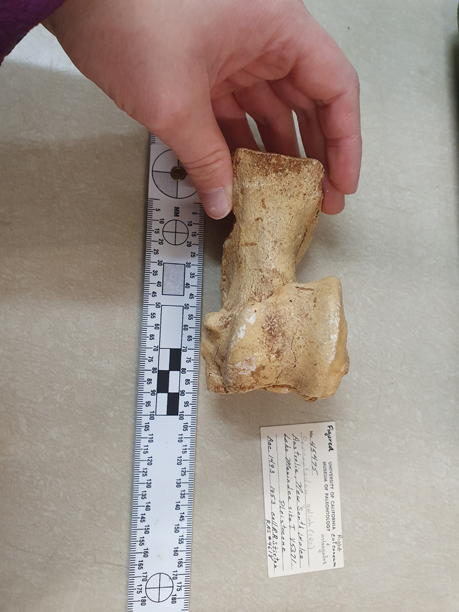
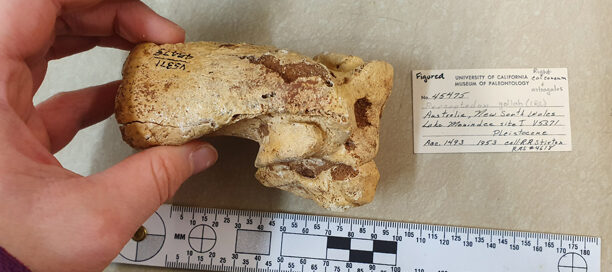
Giant short-faced kangaroo heel bone.

Heel bone (calcaneum) of the largest kangaroo species, Procoptodon goliah. P. goliah stood over two metres tall and had an estimated body mass of 240 kilograms, almost three times the size of the largest living kangaroos. Picture credit: Megan Jones/UCMP.

Picture credit: Megan Jones/UCMP

A Range of Locomotion Strategies Identified

The fossil analysis also reveals a range of locomotion strategies adopted by extinct kangaroos.  Some giants may have mixed hopping with other forms of movement, including bipedal walking and moving around on all fours.  Sthenurine hopping may have just been one part of a broader “movement repertoire”.  The research implies different ecological niches for prehistoric kangaroos.

Fellow researcher and co-author Dr Robert Nudds, Senior Lecturer in Evolution, Infection and Genomics at The University of Manchester commented:

“Our findings contribute to the notion that kangaroos had a broader ecological diversity in prehistoric Australia than we find today, with some large species grazers like modern kangaroos while others were browsers – an ecological niche not seen in today’s large kangaroos.”

The research provides the most comprehensive assessment to date of the mechanical feasibility of hopping in giant extinct kangaroos.

Everything Dinosaur acknowledges the assistance of a media release from The University of Manchester in the compilation of this article.

The multi-award-winning Everything Dinosaur website: Models and Replicas of Prehistoric Mammals.

17 01, 2026

New Arrivals at Everything Dinosaur

By |2026-01-20T15:01:32+00:00January 17th, 2026|Categories: Beasts of the Mesozoic Models|Tags: , , |0 Comments

Exciting news for collectors everywhere. New stock of Beasts of the Mesozoic articulated models has arrived at the Everything Dinosaur warehouse. In addition, fresh deliveries from the Beasts of the Cenozoic range are now safely in storage. These highly detailed figures remain hugely popular with collectors. As a result, demand has once again been extremely strong. Each model features exceptional articulation, accuracy, and display potential. Collectors and dinosaur fans also use these figures to make innovative stop motion videos. Therefore, these ranges continue to attract collectors, educators, and palaeontology fans alike.

Mike from Everything Dinosaur shared his enthusiasm for the range. He explained:

“We are delighted to have Beasts of the Mesozoic back in stock. The response has been incredible. We will now be contacting all customers who asked us to reserve a figure for them.”

Meanwhile, packing and customer notifications are already underway. Consequently, reserved models will be allocated promptly. However, remaining stock is limited.

Collectors are advised to act quickly. These Beasts of the Mesozoic figures rarely stay available for long.

More Beasts of the Mesozoic figures in stock at Everything Dinosaur.

More stock of popular Beasts of the Mesozoic and Beasts of the Cenozoic models have arrived at our warehouse. Picture credit: Everything Dinosaur.

Picture credit: Everything Dinosaur

To view the Beasts of the Mesozoic/Beasts of the Cenozoic figures in stock: Beasts of the Mesozoic/Cenozoic Figures.

Beasts of the Mesozoic Figures

The first articulated models launched by the factory were sold under the Beasts of the Mesozoic banner.  The Beasts of the Cenozoic and Cyberzoic figures are later introductions.  The delivery includes items from the “Mesozoic”, “Cenozoic” and “Cyberzoic” brands.  Models in stock include the ceratopsian Medusaceratops, the theropod Dilong and the Cyberzoic Allosaurus jimmadseni model.

Mike added:

“The buzz surrounding these articulated figures has been amazing. New models are currently in production and due out soon, models such as Stegosaurus and Pachycephalosaurus.”

Meanwhile, Sue and Mike busy themselves picking and packing orders. Furthermore, reserved models will be rapidly despatched. Please note, remaining stock is limited.

Collectors are advised not to delay. Our current stock of many lines will soon be exhausted.

The award-winning Everything Dinosaur website: Prehistoric Animal Models and Figures.

16 01, 2026

Helpful Ammonite Diagram Brings Fossils to Life

By |2026-01-18T20:11:49+00:00January 16th, 2026|Categories: Photos/Pictures of Fossils|Tags: , , |0 Comments

Ammonite fossils are extraordinary.  Often, the preserved shells of these marine invertebrates are amongst the first fossils acquired when starting a fossil collection. Sue and I (Everything Dinosaur) field questions about ammonites frequently.  We do our best to respond to all the emailed enquiries we receive. In addition, we have collected large numbers of ammonite fossils ourselves.  Visitors to our offices and warehouse can be given a fossil from our collection as a souvenir of their visit.  Ammonite fossils are a favourite. Moreover, we have commissioned an ammonite diagram.

The preserved shells do not give an impression of the animal.  These cephalopods are known from their ubiquitous fossilised shells but very few specimens showing the actual animal have been found.  However, we have created a helpful diagram that depicts a living ammonite.  Furthermore, we have labelled our illustration.

An ammonite diagram.

An ammonite diagram with the shell keel, the ribbing on the shell along with the eye, mouth and tentacles labelled. Picture credit: Everything Dinosaur.

Picture credit: Everything Dinosaur

An Informative Ammonite Diagram

The ammonite is shown in lateral view.  The visible parts of the animal outside the shell are coloured.  The shell (often preserved as a fossil), is shown in monotone.  In addition, we have provided helpful labels.  We could produce a more sophisticated diagram.  However, we have refrained from doing so as the majority of our ammonite enquiries come from junior/primary school teachers and young fossil collectors.

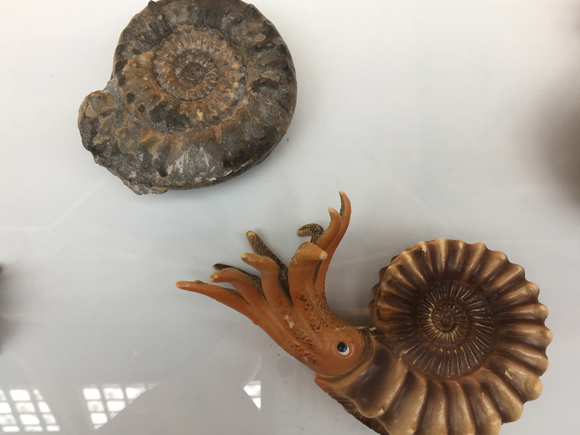
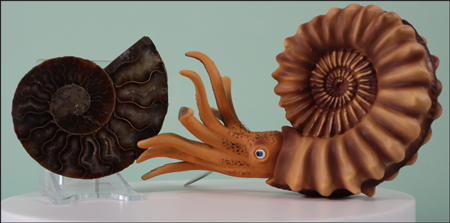
Our drawing is based upon the Bullyland ammonite figure. This model is popular with fossil collectors.  It is often included inside ammonite fossil display cabinets.

We spotted a Bullyland ammonite model being used to help illustrate a display of ammonite fossils. Ammonite replicas are often purchased by fossil hunters.

A Bullyland ammonite model is used to help illustrate a display of ammonite fossils. Picture credit: Everything Dinosaur.

Picture credit: Everything Dinosaur

To view the range of Bullyland prehistoric animal figures available: Bullyland Models and Figures.

Mike from Everything Dinosaur commented:

“Ammonites are fascinating. Their fossils are important markers in biostratigraphy and helpful in relative dating.  Remarkably, these molluscs did not die out at the end of the Cretaceous. There is evidence to indicate that a few taxa survived into the Palaeocene.  What amazing invertebrates!”

15 01, 2026

New Study Suggests T. rex Grew Up More Slowly Than Previously Thought

By |2026-01-18T18:09:15+00:00January 15th, 2026|Categories: Palaeontological articles|Tags: , , , |0 Comments

A comprehensive overview of T. rex ontogeny has been published in the open access journal PeerJ.  This research suggests that Tyrannosaurus rex could have taken around forty years to reach full size. The study suggests that the Tyrannosaurus rex species grew more gradually and over a longer lifespan than indicated by prior models, with a protracted period of subadult development.  Knowing more about the ontogeny (growth) of dinosaurs like T. rex will help scientists to better understand how this iconic predator may have lived and how it interacted with prey species.  In addition, this research has implications with regards to the current debate over the Nanotyrannus taxon.

Previous studies had indicated that Tyrannosaurus rex grew rapidly and that it had a series of dramatic growth spurts before reaching adult size at around twenty-five years of age. In 2015, the reboot of the “Jurassic Park” franchise occurred. In the film “Jurassic World” a new theropod dinosaur was introduced – Indominus rex. We wrote an article comparing the growth rate of T. rex with this new, fictional theropod. We compared the growth rates proposed for these two theropod taxa. Whilst speculative, it permitted a comparison of I. rex growth based on the fictional movie timeline with the postulated growth rate for a large tyrannosaurid based on the current research.  The results are shown in the graph below.

T. rex ontogeny compared to I. rex.

I. rex versus T. rex growth rates.  The timeline from the 2015 film “Jurassic World” hinted at an extremely rapid growth rate for the fictional theropod Indominex rex.  At the time, research suggested that T. rex grew rapidly too, undergoing a series of growth spurts, particularly in its teenage years before reaching full size at around twenty-five years of age.  New research suggests T. rex grew more slowly.  Picture credit: Everything Dinosaur.

Picture credit: Everything Dinosaur

The article comparing the growth rates of Tyrannosaurus rex and Indominus rexThe Growth Spurts of Tyrannosaurs.

A Comprehensive Assessment of T. rex Ontogeny

Earlier studies into T. rex ontogeny proposed that the “Tyrant Lizard King” exceeded eight tonnes in weight within two decades and had a lifespan of approximately thirty years. However, this understanding of Tyrannosaurus rex growth dynamics is dependent on single-point histological sampling of multiple skeletal elements and lacks specimens encompassing the earliest growth states.

Corresponding author of the study Dr Holly Ballard (Oklahoma State University), specialises in studying osteohistology (growth patterns of animals preserved in bone tissue) to map population growth dynamics in extinct vertebrates. We have reported on Holly’s research previously.  For example, back in 2015, we wrote an article examining research into the growth rates of the dinosaur Maiasaura peeblesorum.

To read this blog post: Examining the Lives of Dinosaurs.

Studying the Leg Bones from Seventeen Individuals

The researchers examined the growth rings preserved in the leg bones of seventeen T. rex. The individuals ranged from juveniles to mature adults.  It is the most comprehensive histological analysis of Tyrannosaurus ontogeny to date. Four alternative statistical models were employed.  The study indicates that rather than racing to adulthood with remarkable growth spurts, Tyrannosaurus rex grew more slowly and steadily than previously thought.

Co-author of the study John “Jack” Horner (Chapman University, California) explained that a forty-year growth phase may have permitted younger tyrannosaurs to fill a variety of ecological niches within Late Cretaceous palaeoenvironments.  Their growth rate could be one factor that permitted this taxon to dominate terrestrial ecosystems as the apex predator.

Many Tyrannosaurus rex models and figures are based on monsters from the movies.  Only a few T. rex models are developed based on closely following the scientific evidence. Our own Everything Dinosaur Evolution 1:33 scale Tyrannosaurus rex figure follows the fossil record closely.  The model represents a mature, adult animal.  Rather than reaching full size at around twenty-five years of age, based on this research, our figure represents a T. rex more than thirty years of age.

According to this study, T. rex could have reached forty years of age. However, very few individuals lived that long. Indeed, only two specimens in the sample of seventeen tyrannosaurs represent adult dinosaurs.

Introducing Everything Dinosaur Evolution.

Introducing Everything Dinosaur Evolution. A stunning range of prehistoric animal models developed by following the fossil evidence. Picture credit: Everything Dinosaur.

Picture credit: Everything Dinosaur

To view the Everything Dinosaur Evolution range: Everything Dinosaur Evolution Tyrannosaur Figures.

The Implications for Nanotyrannus

Although Tyrannosaurus rex is the best-known species of this group of dinosaurs, recent studies have proposed that some specimens previously identified as T. rex may in fact be members of other related species. Some scientists, for example, have argued that certain smaller specimens represent a small-bodied species, named Nanotyrannus, rather than juvenile specimens of Tyrannosaurus rex.

The paper’s authors acknowledge the variation in tyrannosaurs. No single, completely uniform growth pattern is highlighted. They acknowledge variation among individual specimens, including ones historically attributed to the Nanotyrannus genus. However, T. rex ontogeny alone cannot prove that the outlying specimens within this dataset represent different taxa. Unusual growth patterns might reflect individual variation or pathology.  In addition, the dataset of tyrannosaur specimens is far from complete.  To gain greater certainty, a much larger sample would be required.

To read Everything Dinosaur’s blog post from November 2024 featuring details of the paper validating the Nanotyrannus taxon: A New Chapter in Tyrannosaur Evolution.

This new study does challenge current views on T. rex ontogeny.  These researchers conclude that the Tyrannosaurus rex species grew more gradually and over a longer lifespan.  Few tyrannosaur population members attained their adult size. Furthermore, this research indicates that these predators had a prolonged subadult phase of their lifecycle.

The scientific paper: “Prolonged growth and extended subadult development in the Tyrannosaurus rex species complex revealed by expanded histological sampling and statistical modeling” by Woodward, Myhrvold and Horner published in PeerJ.

The multi-award-winning Everything Dinosaur website: Tyrannosaur and Other Prehistoric Animal Figures.

14 01, 2026

A New Saurolophine Hadrosaur is Scientifically Described

By |2026-01-16T14:32:37+00:00January 14th, 2026|Categories: Palaeontological articles|Tags: , , |0 Comments

Catching up with some of the latest developments in ornithischian dinosaur research. For example, late last year, a new saurolophine hadrosaurid dinosaur from New Mexico was formally described.  Named Ahshislesaurus wimani, it reinforces the view that hadrosaurs were among the dominant large herbivorous dinosaurs present in southern Laramidia during the last ten million years of the Cretaceous.

Ahshislesaurus wimani life reconstruction.

Ahshislesaurus wimani life reconstruction. Picture credit: Sergey Krasovskiy.

Picture credit: Sergey Krasovskiy

Ahshislesaurus wimani

The research team erected a new hadrosaur taxon based on the study of skull bones as well as postcranial material. The bones that would be identified as Ahshislesaurus were uncovered in San Juan County (northwestern New Mexico), by famed collector John B. Reeside, Jr. in 1916. In 1935, the fossils were classified as belonging to another hadrosaurid named Kritosaurus navajovius. However, this new research identified distinctions between these fossils and all known hadrosaurids, including several key differences in the animal’s skull.

Ahshislesaurus (pronounced Ah-shi-sle-sore-us), is estimated to have reached lengths in excess of eleven metres.  It might have weighed more than eight tonnes. The fossil material comes from the lower Hunter Wash Member of the lower Kirtland Formation (Campanian faunal stage). The paper describing the new species was published in the Bulletin of the New Mexico Museum of Natural History and Science.  It is a journal managed by the New Mexico Museum of Natural History and Science.

Co-author of the paper, Dr Anthony Fiorillo, Executive Director of the New Mexico Museum of Natural History and Science stated:

“Discoveries like this remind us that science truly is a community. Our team of researchers spanning five institutions and two countries were able to build upon research that started nearly a century ago and now advances our understanding of what our state looked like during the Late Cretaceous Period.”

Views of the right jugal of the holotype of Ahshislesaurus wimani.

Right jugal of the holotype of Ahshislesaurus wimani gen. et sp. nov., (USNM VP-8629); in A, lateral view; B, medial view. Picture credit: Dalman et al.

Picture credit: Dalman et al

Dr Fiorillo examined the fossils alongside his colleague Dr Spencer Lucas.  In addition, Sebastian Dalman (Montana State University), the lead author and co-authors Steven Jasinski (Harrisburg University), Edward Malinzak (Pennsylvania State University), and Martin Kundrát (Pavol Jozef Šafárik University in Slovakia) were involved in the research.

De Lucas commented:

“It seems like palaeontologists are discovering new dinosaurs in New Mexico every few months. This new hadrosaur just adds to my conviction that there are many, many new dinosaurs still out there waiting to be unearthed!”

To read an article from 2018 about the discovery of a new species of armoured dinosaur in New Mexico: A New Nodosaur from New Mexico.

A new species of chasmosaurine ceratopsian from New Mexico: The Chasmosaurine Bisticeratops.

A Novel Clade of Flat-headed Saurolophine Hadrosaurids

Although only some isolated skull material has been found, the scientists postulate that Ahshislesaurus lacked a head crest. The skull of Ahshislesaurus wimani preserves several taxonomically informative characters that show close affinities with the stratigraphically younger Naashoibitosaurus ostromi from the De-na-zin Member. Together with Naashoibitosaurus, Ahshislesaurus forms a potentially novel clade of flat-headed saurolophine hadrosaurids. This clade suggests the saurolophines were a taxonomically diverse group, which, during the last twenty million years of the Cretaceous, were among the dominant herbivorous dinosaurs in southern Laramidia.

Scientists are building up a detailed picture of the dinosaur fauna from the Late Cretaceous of New Mexico. Similar types of dinosaurs existed in southern Laramidia as those in more northerly parts of the landmass. However, the genera are different.  For example, the herbivorous Ahshislesaurus wimani co-existed with ankylosaurids and horned dinosaurs like Navajoceratops.  The apex predator was a tyrannosaur – Bistahieversor.

Ahshislesaurus wimani cervical vertebrae.

Proximal cervical vertebrae of the holotype of Ahshislesaurus wimani gen. et sp. nov., (USNM VP-8629); in right lateral view. Picture credit: Dalman et al.

Picture credit: Dalman et al

What’s in a Name?

This new hadrosaur taxon was named for the Ah-shi-sle-pah Wilderness in San Juan County, where its fossils were found. The specific epithet, “wimani”, honours the first Swedish professor of palaeontology, Carl Wiman (1867–1944), from Uppsala University, who worked on fossil vertebrates from the San Juan Basin. Recognition of a new hadrosaurid species from New Mexico also provides further evidence for latitudinal variation in the hadrosaurid fauna during the Late Cretaceous in Laramidia. In addition to the holotype of A. wimani, several specimens from the same strata may also belong to this newly identified species, including a well-preserved left dentary and a partial skeleton, as well as two humeri, one belonging to a large adult and the other to a juvenile.

The scientific paper: “A new saurolophine hadrosaurid (Ornithischia: Hadrosauridae) from the Upper Cretaceous (Campanian) Hunter Wash Member, Kirtland Formation, San Juan Basin, New Mexico” by Sebastian Dalman, Steven E. Jasinski, Dale Edward Malinzak, Spencer G. Lucas, Martin Kundrát and Anthony R. Fiorillo published in the New Mexico Museum of Natural History and Science Bulletin.

For scientifically accurate dinosaur models and figures visit the award-winning Everything Dinosaur website: Prehistoric Animal Models and Figures.

13 01, 2026

Making a Successful Prediction in a 1926 Scientific Publication

By |2026-01-13T14:05:30+00:00January 13th, 2026|Categories: Dinosaur Fans|0 Comments

The Australian sauropod Rhoetosaurus brownei was named and scientifically described a hundred years ago.  It remains the only Jurassic sauropod known from Australia.  Remarkably, it was the first dinosaur named from Australian fossil material.  Rhoetosaurus might not be the best-known sauropod, but we remember the excitement when our friend Anthony Beeson designed a model of this iconic dinosaur for CollectA.  Having already added a Brachiosaurus figure to the CollectA range, the CollectA Rhoetosaurus model represented a departure for the company.  Firstly, many dedicated and devoted model collectors were unaware of this dinosaur.  Secondly, it was the first sauropod figure made by CollectA to be depicted in a rearing pose.

CollectA Rhoetosaurus model.

A model of the Middle Jurassic sauropod Rhoetosaurus brownei.

The CollectA Rhoetosaurus Model

Measuring around seventeen centimetres tall, the CollectA Rhoetosaurus model was introduced more than fifteen years ago.  The CollectA Age of Dinosaurs range was growing fast.  Models of Tyrannosaurus rex, Triceratops and Stegosaurus existed. However, the Rhoetosaurus demonstrates the manufacturer’s desire to highlight less well-known prehistoric animals.  This desire continues today. For example, CollectA will add a phytosaur model, a first for the company.

Mike from Everything Dinosaur commented:

“We applaud the efforts of the design team at CollectA to introduce dinosaur fans and model collectors to some of the more unusual and overlooked members of the Dinosauria.”

To view the extensive CollectA Age of Dinosaurs model range: CollectA Age of Dinosaurs Models.

CollectA mini sauropods set.

The CollectA Rhoetosaurus model is also available as a mini dinosaur model. It is part of the sauropod model set introduced by CollectA in 2024.

A Prediction in a Scientific Paper

Rhoetosaurus brownei was scientifically described by Heber Longman. At the time, this distinguished scientist was director of the Queensland Museum. The paper describing Rhoetosaurus was published in the “Memoirs of the Queensland Museum” in March 1926. Remarkably, in conclusion Longman made a prediction about future dinosaur discoveries “down under”.

He wrote:

“In view of the prodigious variety of dinosaurian forms recorded from other parts of the world, illustrating the “bizarrerie” of nature to a degree unsurpassed by any other group, it will not be surprising if many additional forms are found in the future in Australian deposits.”

Given the vast size of Australia and the country’s geology, further dinosaur fossil finds were something of a safe bet.  Over the last hundred years a wide variety of dinosaur taxa have been named including sauropods. For instance, Diamantinasaurus matildae, Savannasaurus elliottorum and Wintonotitan wattsi.  In addition, the largest Australian terrestrial animal is another sauropod, the gigantic Australotitan cooperensis.  However, the taxonomic validity of some genera has been challenged.

To learn more about the confusing taxonomy of Australian sauropods: Describing and Classifying Australian Sauropods.

Although all these sauropods were discovered in Queensland, the same state as the Rhoetosaurus fossil material, none of these dinosaurs were closely related to Rhoetosaurus.  Sauropods such as Wintonotitan, Diamantinasaurus and Savannasaurus lived millions of years after Rhoetosaurus had become extinct.

More Fossil Specimens Needed

Additional fossil specimens are needed to help resolve and clarify Australian sauropod taxonomy.  Heber Longman was proved correct when, back in 1926 he predicted more Australian dinosaur discoveries.  However, over a hundred years later, we await a second Jurassic sauropod fossil discovery in Australia.

Perhaps 2026 will change that…

For prehistoric animal models and figures, visit the Everything Dinosaur website: Dinosaur and Other Prehistoric Animal Models.

12 01, 2026

Saying Goodbye to the Papo Giganotosaurus

By |2026-01-11T10:05:15+00:00January 12th, 2026|Categories: Dinosaur Fans|0 Comments

Earlier this month, we highlighted the Papo prehistoric animal models that are going out of production and being retired.  Today, we look back at a figure that has captured the hearts of many dinosaur fans. However, it is a controversial figure.  The Papo Giganotosaurus model is one of six Papo prehistoric animal figures going this year.  Originally introduced in 2020 it will soon be unavailable.

The unusual posture has drawn criticism.  Moreover, it certainly stands out amongst other Giganotosaurus models.  The Papo Giganotosaurus is an intriguing addition to any collection. Fans loved its bold size and hand-painted detail, which brought this mighty theropod to life. However, the model also sparked lively discussion. Some collectors questioned the figure’s pose.  It does not reflect the scientific evidence. Yet, many found the stance charming, endearing and full of character.

To read about Papo model retirements (2026): Papo Model Retirements in 2026.

Mike from Everything Dinosaur holding the Papo Giganotosaurus model.

Mike from Everything Dinosaur holding the Papo Giganotosaurus model. Picture credit: Everything Dinosaur.

Picture credit: Everything Dinosaur

To view the range of Papo figures in stock: Papo Prehistoric Animal Figures.

The Retirement of the Papo Giganotosaurus Model

It is sad to see this figure go. For many younger collectors, the Papo Giganotosaurus was a gateway into deeper interest in dinosaurs and prehistoric animals. Its retirement reminds us how certain models become more than toys — they acquire a charm all of their own. We will miss it, but its legacy will endure in the collections of dinosaur model fans.

Mike from Everything Dinosaur commented:

“We saw early prototypes of the Papo Giganotosaurus model about twelve months before it went into production. At the time we asked the designers to reconsider their design.  However, the project continued.  In a way we are glad that the design team did not listen to us.  The Papo Giganotosaurus model might not be the most anatomically accurate figure, but it had a certain style, and it reflects that flamboyant Papo panache.”

The multi-award-winning website of Everything Dinosaur: Dinosaur Toys.

11 01, 2026

Everything Dinosaur Expands its Online Presence by Joining Mastodon

By |2026-01-11T18:47:52+00:00January 11th, 2026|Categories: Everything Dinosaur News and Updates|0 Comments

Everything Dinosaur has expanded its online presence with a brand-new home on Mastodon. Sue and Mike are excited to welcome collectors, dinosaur fans, and educators to this fast-growing social network. This platform offers a calmer and more community-focused space. As a result, it is ideal for sharing science, model news, and behind-the-scenes stories.  Follow Everything Dinosaur on Mastodon.

You can now follow the Everything Dinosaur official account here: Follow Everything Dinosaur on Mastodon.

The image below shows the official Everything Dinosaur Mastodon profile.

Everything Dinosaur on Mastodon. The company's home page on the platform.

Everything Dinosaur’s homepage on the Mastodon platform. Picture credit: Everything Dinosaur.

Picture credit: Everything Dinosaur

Everything Dinosaur on Mastodon

On Mastodon, Everything Dinosaur will post updates about new figures, design work, model news and fossil discoveries. In addition, Sue and Mike will answer questions and join discussions with enthusiasts from around the world. This helps build stronger links with the global community of prehistoric animal model fans.

An ambition is to highlight the verified website link on Mastodon and our clear profile details. This makes it easy for followers to confirm they are connecting with the real account.

If you already use Mastodon, you can follow Everything Dinosaur today. If not, now is a great time to join. The platform is friendly and easy to use. More importantly, it puts people before algorithms. It is not owned and run by billionaires either. So, follow Everything Dinosaur on Mastodon.

The Everything Dinosaur shop: Prehistoric Animal and Dinosaur Models.

10 01, 2026

Happy Birthday Rhoetosaurus – Australia’s First Named Dinosaur

By |2026-01-11T16:14:48+00:00January 10th, 2026|Categories: Dinosaur Fans|0 Comments

Many happy returns Rhoetosaurus on your hundredth birthday.  This unusual Australian sauropod was named and scientifically described a hundred years ago.  Rhoetosaurus (Rhoetosaurus brownei) is not that well known among the general public.  Even ardent dinosaur fans struggle to recall it.  However, this taxon is extremely important.  When described in 1926, it became Australia’s first named dinosaur.  In addition, it is the only named pre-Cretaceous sauropod known from Australia.

Its taxonomic affinity within the Sauropoda is uncertain.  For example, palaeontologist Gregory S. Paul assigns it to the Cetiosauridae family.  Size estimates also vary, body size estimates based on a partial femur and the vertebrae indicate an animal between twelve to fifteen metres in length. Other sources state that this sauropod may have grown to more than eighteen metres in length.

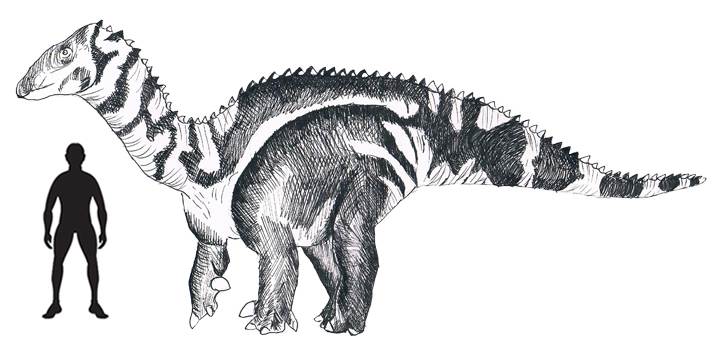
Rhoetosaurus brownei scale drawing.

Rhoetosaurus brownei with a human figure for scale. Picture credit: Everything Dinosaur.

Picture credit: Everything Dinosaur

Rhoetosaurus brownei – Not an Elephant!

Stockmen mustering horses on a remote station, approximately thirty-five miles (fifty kilometres) north of the small town of Roma (south-western Queensland), found fossil bones weathering out of a shallow gully. They assumed that the bones were from an elephant, a pachyderm that had escaped from a circus.  Some of the vertebrae measured more than fifty centimetres long.  The station’s manager, Arthur Browne alerted Heber Longman, the director of the Queensland Museum.  Longman described Rhoetosaurus and published his work in the journal “Memoirs of the Queensland Museum (1926)”.

The fossils are thought to be around 165 million years old (Middle Jurassic).  Subsequently, a joint expedition by Queensland Museum and the University of Queensland visited the site and recovered more bones, including an almost complete right lower hind limb. Rhoetosaurus (pronounced reet-oh-sore-us) fossils probably represent a single individual.  The collection of bones collected more than fifty years apart represent one of the most complete specimens of an Australian sauropod.

A study (Nair and Salisbury) set about attempting to clarify the taxonomy. Examination of alternative phylogenetic hypotheses rules out a close relationship between Rhoetosaurus and East Asian Jurassic sauropods. The phylogeny remains unresolved.  The lower hind limb of Rhoetosaurus highlights a several anatomical traits differentiating it from other sauropods. For instance, the pes retains four claws, thought to represent a basal trait.  Most sauropods have only three claws on each hind foot.

Longman thought that Rhoetosaurus was a camarasaurid.  However, this classification has been discounted.  Whilst in the absence of further fossils, the taxonomy of Rhoetosaurus brownei remains elusive.

The CollectA Prehistoric Life Rhoetosaurus Model

In 2009, the model manufacturer CollectA introduced a Rhoetosaurus figure. It is part of their not-to-scale Age of Dinosaurs range.  The dinosaur is depicted in a rearing pose.  It is a rare model.  It measures seventeen centimetres tall.  The Rhoetosaurus model was designed by the English polymath Anthony Beeson.

CollectA Rhoetosaurus model.

A model of the Middle Jurassic sauropod Rhoetosaurus brownei.

To view the CollectA not-to-scale model range: CollectA Age of Dinosaurs.

Mike from Everything Dinosaur commented:

“The Rhoetosaurus fossils are hugely significant. These fossils provide important and thus far, the only information on Australian Jurassic sauropods.  By studying these remains palaeontologists can gain a better understanding of sauropod evolution prior to the break-up of Gondwana.”

For prehistoric animal models and figures visit the multi-award-winning Everything Dinosaur website: Dinosaur and Prehistoric Animal Models.

9 01, 2026

News of Papo Model Retirements for 2026

By |2026-01-09T14:58:44+00:00January 9th, 2026|Categories: Papo Prehistoric Animal Models|0 Comments

At the start of the year, manufacturers review their inventories and production plans. Papo is no exception.  This French model manufacturer is busy making plans.  To this end, they have announced several Papo prehistoric animal model retirements.  Six figures are out of production and retired:

  • Plesiosaurus (model number 55021)
  • Carnotaurus (model number 55032)
  • Blue Oviraptor (model number 55059)
  • Therizinosaurus (model number 55069
  • Brown running T. rex (model number 55075)
  • Giganotosaurus (model number 55083)
Papo prehistoric animal model retirements - 2026. The Papo Carnotaurus is being retired.

It’s time to say goodbye.  Papo prehistoric animal model retirements – 2026. The Papo Carnotaurus retires. Picture credit: Everything Dinosaur.

Picture credit: Everything Dinosaur

Papo Prehistoric Animal Model Retirements

Of the six figures, the Papo Plesiosaurus and Papo Carnotaurus are the oldest.  For example, the Papo Carnotaurus was introduced in 2013. The blue Oviraptor figure came out in 2017.  It replaced a much older, brown version.  In a similar vein, the brown running Tyrannosaurus rex was launched in 2019, it was a new colour version of an older running T. rex figure. The Papo Therizinosaurus model was introduced in 2019.  It has proved to be a popular model.  The most recently introduced figure to be retired this year is the Papo Giganotosaurus.  It was launched in 2020.

Papo Giganotosaurus model.

The Papo Giganotosaurus dinosaur model. This theropod model retires. Moreover, it is one of six prehistoric animal models being retired by Papo in 2026. Picture credit: Everything Dinosaur.

Picture credit: Everything Dinosaur

The Papo Giganotosaurus figure attracts controversy. The choice of pose by the designers divides collectors. The pose does not reflect the posture attributed to a theropod dinosaur. However, many collectors find the “hugging posture” endearing.

Everything Dinosaur stocks Papo prehistoric animal models: Papo Prehistoric Animal Models.

Mike from Everything Dinosaur comments:

“Whilst we are genuinely sad to see these six Papo prehistoric animal models go out of production, they have enjoyed long and very successful runs and remain popular with collectors. At the same time, these retirements free up valuable production capacity, giving Papo the opportunity to focus on creating exciting new figures. We look forward to seeing what the future holds for this much-loved range.”

The award-winning Everything Dinosaur website: Dinosaur and Prehistoric Animal Figures.

Go to Top