

The Rhynie chert fossils represent one of the most important palaeontological discoveries ever made. This unique Scottish site preserves an Early Devonian ecosystem in astonishing detail. As a result, scientists can learn about an ancient palaeoenvironment. The biota that existed in a swamp close to hot, mineral-rich springs was like nothing known on Earth today.
Moreover, the Rhynie chert captures life in situ. It preserves hot spring environments, early land plants, arthropods, and microbial communities. Therefore, it provides a rare snapshot of terrestrial ecosystems around 407 million years ago. As part of a media release concerning a new study into the giant, enigmatic taxon Prototaxites, we received an artist’s impression of the Rhynie chert Devonian landscape.
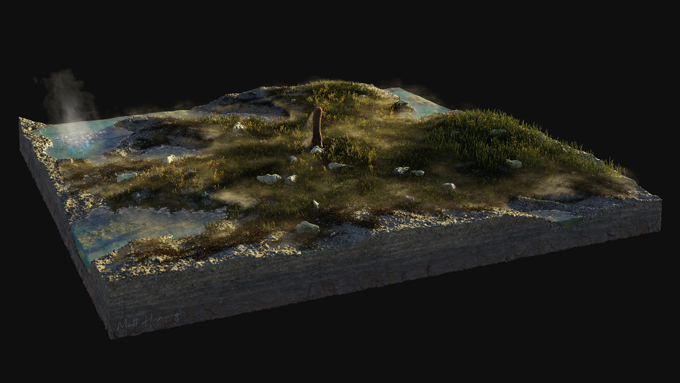
Artist’s impression of what the environment at Rhynie, Aberdeenshire, where the Prototaxites fossils were discovered, would have looked like 410 million years ago. Picture credit: Matt Humpage.
Picture credit: Matt Humpage
Researching Rhynie Chert Fossils
Recent research has provided additional insight. A recent study suggests that Prototaxites does not belong to fungi or plants. Instead, it may represent an entirely unknown complex life form. This discovery reshapes how we understand early terrestrial life and evolutionary experimentation.
To read our blog post about this research: Beautiful Rhynie Chert Fossils Reveal Their Secrets.
The Rhynie chert fossils continue to challenge long-held assumptions. They demonstrate that Early Devonian ecosystems were already diverse and surprisingly sophisticated. Consequently, this site remains a global reference point for palaeobiology and evolutionary research.
Mike from Everything Dinosaur commented:
“Museum fossil collections are invaluable. Fossils collected decades ago can play a role in new research. Improved analytical techniques allow scientists to re-examine old specimens and uncover fresh insights. We still have so much to learn about our incredible planet and its deep evolutionary history.”
The Rhynie chert fossils continue to transform our understanding of early terrestrial life. They remind us that evolution experimented in unexpected ways during the Devonian.
Everything Dinosaur acknowledges the assistance of the National Museums of Scotland in the compilation of this article.
Visit the Everything Dinosaur website: Models of Prehistoric Animals and Plants.

Leave A Comment