All about dinosaurs, fossils and prehistoric animals by Everything Dinosaur team members.
15 11, 2025

New Study Reveals Link Between the Sleepy Koala and Thylacoleo carnifex

By |2025-11-14T09:39:12+00:00November 15th, 2025|Categories: Dinosaur and Prehistoric Animal News Stories|0 Comments

A surprising evolutionary link between today’s passive, sleepy koalas and the fearsome “marsupial lion” – Thylacoleo carnifex is revealed.  Evidence provided by collagen peptide data favours a close relationship between the extinct Thylacoleo and the koala.  The study, published in the Proceedings of the Royal Society B, suggests that these very different marsupials are part of a broader clade including wombats and the extinct genera Zygomaturus and Palorchestes.

The research was led by Dr Michael Buckley (University of Manchester).  An international team of researchers analysed fifty-one marsupial bones collected from caves and swamps across Tasmania.  Their results provide the first biomolecular data linking several extinct Australian megafauna species to their living relatives.

Marsupial fossils used in collagen peptide study to determine phylogenetic relationships between taxa.

Bone images of the specimens from Mowbray swamp to contrast differences in preservation state from those of Scotchtown Cave. Picture credit: University of Manchester.

Picture credit: The University of Manchester

From a Cuddly Koala to the Marsupial Predator Thylacoleo carnifex

During the Late Pleistocene, the landmass consisting of Australia, New Guinea and Tasmania was home to a rich and diverse megafauna.  Fluctuating sea levels as a result of glaciation exposed the continental shelves of today’s islands, effectively linking them all together into a single palaeocontinent.  With the end of the glaciation, New Guinea and Tasmania gradually became separated from mainland Australia.  It is estimated that New Guinea being separated around eight thousand years ago.  In contrast, Tasmania became an island as recently as six thousand years ago.

This ancient landmass, known as Sahul, faced one of the greatest waves of megafaunal extinctions on the planet during the Late Pleistocene. Australia lost nearly ninety percent of its giant land animals. The reasons for this extinction event remain highly controversial.  For example, was the extinction of the megafauna due to climate change, the impact of hunting and landscape change by modern humans or a combination of all these factors?

ZooMS (Collagen Fingerprinting)

Using an innovative technique called zooarchaeology by mass spectrometry (ZooMS), or collagen fingerprinting, the team was able to analyse fossils more than 100,000 years old – far beyond the age limit for traditional DNA analysis.  This enabled the team to reconstruct evolutionary relationships between extinct and extant marsupials. ZooMS can identify even tiny bone fragments and reveal their species, it could help scientists refine the timeline of when Australia’s megafauna disappeared and how long they overlapped with humans.

Dr Buckley stated:

“Until now, we’ve struggled to determine exactly how many of these extinct species were related because Australia’s hot climate destroys DNA over time. However, collagen proteins survive in much older and even extremely fragmented bones, allowing us to identify species and reconstruct the evolutionary relationships between extinct and living marsupials that could not be achieved through traditional methods.”

The research revealed that the extant koala and the extinct Thylacoleo carnifex shared a common ancestor around 25-35 million years ago.

Extant marsupials

A collection of extant marsupials from Australia including wombats, tree kangaroos and koalas. A new study has provided fresh insights into evolutionary relationships. Picture credit: Everything Dinosaur.

Picture credit: Everything Dinosaur

Clarifying the Vombatiformes

The research also provides new biomolecular data helping to clarify diprotodontids.  Analysis of ancient collagen sequences associated with the extinct species Zygomaturus trilobus and Palorchestes azael confirmed that these species belonged to the broader wombat/koala group known as the Vombatiformes.

Dr Buckley explained:

“ZooMS also allows thousands of fossil specimens to be analysed quickly, so it could be a game-changer for the study of extinct species. We can now identify more fossils, improve extinction chronologies, and better understand ancient biodiversity.”

The increasing use of collagen to retrieve phylogenetic information—as one among many tools—offers great potential to better understand the diversity and evolution of past life on Earth.

Everything Dinosaur acknowledges the assistance of a media release from the University of Manchester in the compilation of this article.

The scientific paper: “Collagen fingerprinting and sequence analysis provides a molecular phylogeny of extinct Australian megafauna” by Michael Buckley, Kieren J. Mitchell, Lee J. Arnold, Elizabeth H. Reed and Rolan Eberhard published in the Proceedings of the Royal Society B.

The Everything Dinosaur website: Models of Prehistoric Animals.

14 11, 2025

New CollectA Prehistoric Animal Models for 2026 (Part 2)

By |2025-11-13T21:21:31+00:00November 14th, 2025|Categories: CollectA Deluxe Prehistoric Animal Models|1 Comment

Today, in collaboration with our chums at CollectA we can announce a further two, new for 2026 prehistoric animal models.  Both figures represent Late Cretaceous dinosaurs and both figures have a declared scale of 1:40. The two figures are a CollectA Lokiceratops model and a CollectA Meraxes gigas.  Both models are in the CollectA Deluxe range.

  • CollectA Deluxe 1:40 scale Lokiceratops (L. rangiformis) – model measures approximately 16.5 cm long (Lo-key-sera-tops).
  • CollectA Deluxe 1:40 scale Meraxes gigas – model measures approximately 27.5 cm in length (Mur-rax-ease).
CollectA Deluxe Lokiceratops figure in lateral view.

The new for 2026 CollectA Deluxe 1:40 scale Lokiceratops model.

The CollectA Deluxe Lokiceratops Dinosaur Model

Fossils representing a horned dinosaur (ceratopsian) were discovered in Montana by a professional fossil hunter. The material was initial thought to represent an adult Medusaceratops. However, detailed analysis revealed unique anatomical characteristics and the species Lokiceratops rangiformis was scientifically described in 2024 (Loewen et al). Epiparietal two on the headshield was huge. They curved downwards to from blade-like structures. In addition, the frill ornamentations are not symmetrical. The epiparietals the episquamosals on either side of the headshield are very different.  The new CollectA Lokiceratops model reflects the orientation and the shape of these structures accurately.

A close-up view of the asymmetrical of the CollectA Deluxe Lokiceratops model.

Close-up view of the asymmetrical headshield showing wide variation in the epiparietals the episquamosals of the CollectA Deluxe Lokiceratops model. The CollectA Lokiceratops model represents one of the largest centrosaurine dinosaurs known to science.

To read Everything Dinosaur’s blog post from 2024 about the discovery of Lokiceratops rangiformisLokiceratops a New Centrosaurine from Montana.

A Huge Member of the Centrosaurinae

Estimated to have been around 6.7 metres in length. Lokiceratops is one of the largest centrosaurine dinosaurs known to science.  Large scales on the naris and fine details on the skin, including the addition of large, rounded scales can be observed in the close-up image above.  In addition, the two prominent, sideways pointing brow horns and the bright skin patches where the headshield fenestrae are located give this figure a real presence.

Intriguingly, the figure is rumoured to have a prominent umbilical scar.  This reflects research from 2022 on the distantly related Psittacosaurus (Bell et al).  Not all dinosaurs may have retained this scar into adulthood. A persistent umbilical scar may not have been present in all the non-avian dinosaurs, but if it is there on the model, it is a pleasing nod in the direction of a recent study.

A posterior view of the CollectA Deluxe Lokiceratops model.

The CollectA Deluxe Lokiceratops 1:40 scale dinosaur model shown in posterior view.  The CollectA Lokiceratops model has incredible skin texture, and the prominent fenestrae are highlighted on the rear of the headshield as well as at the front.

The Large Fenestrae in the Headshield

Skull material associated with this taxon reveals a pair of substantial holes (fenestrae) in the headshield. In life, these holes would have been covered in skin.  The design team have equipped their CollectA Lokiceratops model with brightly coloured patches on the front of the headshield.  The inference being that these patches would have played a role in visual communication, perhaps signalling herd dominance or fitness for breeding.  In addition, as these features would have been observed on the back of the headshield, a more subtle colour scheme has been chosen for this part of the dinosaur’s body.  This makes sense, after all, it is very likely that these animals moved in herds.

The patches of skin on the back of the headshield would have conveyed information to the other Lokiceratops that were following.

CollectA Lokiceratops model headshield.

A view of the dramatic headshield of the CollectA Lokiceratops model. The frill itself was asymmetrical. This unusual feature suggests that horned dinosaurs had more variety in their ornamentation than scientists previously thought.  The blade-like second epiparietals inspired the genus name. This dinosaur was named after the blade-wielding Norse god Loki.

The CollectA Deluxe Meraxes gigas

The second new CollectA prehistoric animal model announced today is Meraxes gigas.  It too is a 1:40 scale figure.  The dinosaur model shown in the images is a prototype, we believe the production figure will have an articulated lower jaw.

CollectA Deluxe Meraxes gigas.

The new for 2026 CollectA Deluxe Meraxes gigas figure. The production model is likely to have an articulated lower jaw.

Fossils of a large carcharodontosaurid dinosaur were discovered in 2012 in exposures of the Huincul Formation of Patagonia.  The fossils, which include extensive skull material represent one of the most complete specimens found to date of a carcharodontosaurid.  Meraxes was formally named and described in 2022.

Histological analysis of the bones suggest that this predator could have been more than fifty years old when it died.  It is one of the oldest known non-avian theropods.  The model has been given keratinised lips in keeping with recent research.  The teeth would not have been visible when the mouth was closed. In addition, the forelimbs are greatly reduced.  The forelimbs of Meraxes gigas were disproportionately small. A trait observed in other types of theropod such as the abelisaurids and tyrannosaurs.

CollectA Deluxe 1:40 scale Meraxes gigas model.

The CollectA Deluxe Meraxes gigas figure is lipped. It follows a trend for creating lipped theropod models following the publication of recent research (Cullen et al 2023) that proposed that most theropod dinosaurs possessed extraoral tissue that was probably highly keratinised.

In the picture (above) the enlarged claw on the second toe of each foot can be observed.

To view the range of CollectA Deluxe figures in stock: CollectA Deluxe Prehistoric Animal Models.

Prominent Crests

The model has prominent bony crests on its snout.  The bright red colouration chosen by the design team supports the hypothesis that this facial feature demonstrated maturity and played a role in visual communication.  It is thought that this theropod measured around ten to eleven metres in length.  The genus name was inspired by a female dragon in George R. R. Martin’s book series “A Song of Ice and Fire”, which inspired the television series “Game of Thrones”.  Interestingly, the eyes on the model are small, this reflects the known skull material.

CollectA Deluxe Meraxes 1:40 scale dinosaur model.

A posterior view of the new for 2026 CollectA Meraxes gigas dinosaur model.

The model has been given a striking colour scheme.  The painting is thought to have been inspired by the colouration of the six-banded Patagonian lizard (Diplolaemus sexcinctus).  This lizard is found in the same part of Patagonia where the Meraxes fossils were found.  Thus, a link is provided by CollectA between the extinct and extant reptilian fauna of Patagonia.

Confirming the Declared Scale

The CollectA Deluxe Meraxes and the CollectA Lokiceratops model have a declared scale of 1:40. How does the declared scale compare with the known fossil material? Actually, we think both models are in approximately 1:40 scale, their scale fits the size assessment for the dinosaur based on the fossils.

  • Lokiceratops rangiformis – estimated length 6.7 metres.  Therefore, a model in 1:40 scale would be approximately 16.75 cm long (the CollectA Deluxe Lokiceratops measures 16.5 cm).
  • Meraxes gigas – estimated length 10 to 11 metres.  Therefore, a model in 1:40 scale would be between 25 to 27.5 cm (the CollectA Deluxe Meraxes model measures 27.5 cm).

Sue from Everything Dinosaur commented:

“The declared scale for these two figures is quite accurate.  We are looking forward to stocking these two CollectA Deluxe dinosaurs.”

These models will be in stock at Everything Dinosaur some time in 2026, possibly in the spring.

To read last week’s blog post announcing the first new for 2026 prehistoric animal from CollectA: New CollectA Prehistoric Animal Models for 2026 (Part 1).

The Everything Dinosaur website: Prehistoric Animal Models and Toys.

13 11, 2025

Everything Dinosaur Showcases Innovative Sustainable Packaging with YouTube Collaboration

By |2025-11-12T20:34:10+00:00November 13th, 2025|Categories: Everything Dinosaur News and Updates|0 Comments

Everything Dinosaur has launched new sustainable dinosaur packaging for its Everything Dinosaur Evolution range. The first figure in the series is a scientifically accurate Tyrannosaurus rex.  It is a 1:33 scale model. This exciting project highlights the company’s focus on sustainability, innovation, and education.

Sue from Everything Dinosaur met with Ben Thomas and Doug James to discuss this eco-friendly initiative. Ben has a Master’s degree in Palaeontology from the University of Portsmouth. He and Doug create popular science videos for their YouTube channel, which has nearly three-quarters of a million subscribers. Their goal is to make learning about life and science both engaging and fun.

Sue Judd (Everything Dinosaur) with YouTube influencer Ben Thomas discussing the sustainable packaging for the Everything Dinosaur Evolution T. rex model.

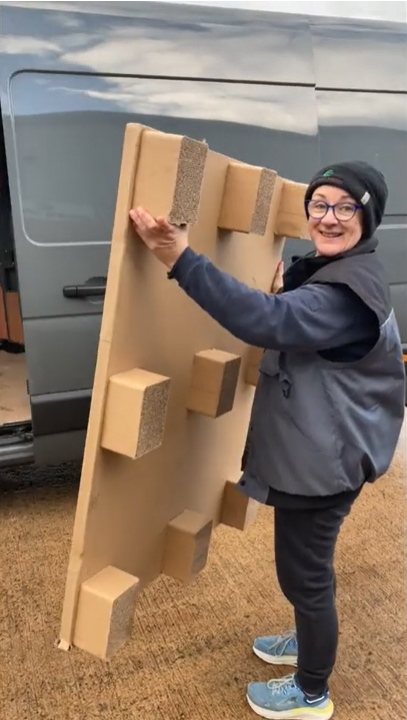
Sue from Everything Dinosaur in discussion with influencer Ben Thomas highlighting the fully compostable product tray into which the T. rex figure is packed. All the Everything Dinosaur Evolution packaging is fully recyclable. Picture credit: Everything Dinosaur.

Picture credit: Everything Dinosaur

Ben and Doug plan to feature the new T. rex model on their channel. The video is expected to premiere at the end of November. During their visit, Doug used a drone to film aerial footage of Everything Dinosaur’s warehouse. These shots will help viewers see how the business combines science, creativity, and responsibility.

Take a look at Ben’s YouTube channel: Ben Thomas YouTube Channel.

Sustainable Dinosaur Packaging Designed in the UK

The Everything Dinosaur Evolution range was developed in the UK. Each model is designed with expert input from renowned palaeontologist Dr Dean Lomax in collaboration with palaeo-reconstruction artist Bob Nicholls and award-winning digital sculptor Glen Southern. The packaging uses sustainable materials that reduce waste and improve recyclability. Everything Dinosaur wants customers to understand the science behind its models and the care taken to protect the planet.  For example, single use plastic bags have been removed from all packaging.

Sue Judd explained:

“We’re passionate about combining science with sustainability. Working with Ben and Doug helps us share our story with a wider audience. It’s about inspiring curiosity while making responsible choices for the future.”

Everything Dinosaur’s collaboration with Ben and Doug shows how innovation can connect education and environmental awareness. By focusing on sustainable dinosaur packaging, the company sets an example for the industry.

Everything Dinosaur continues to lead the way in responsible retailing, using smart technology and scientific expertise to make a difference.

We are trying to change the world one dinosaur model at a time!

10 11, 2025

PNSO Hongkongsaurus Model – A Dinosaur That Never Was

By |2025-11-10T22:20:16+00:00November 10th, 2025|Categories: PNSO Age of Dinosaurs Models|0 Comments

The new for 2025 PNSO Hongkongsaurus model is in stock at Everything Dinosaur.  It celebrates a remarkable fossil discovery.  In 2013, fragmentary dinosaur bones were first reported on the tiny Port Island, Hong Kong.  This uninhabited island, popular with tourists, lies at the mouth of the Tolo Channel and forms part of the Hong Kong UNESCO Global Geopark.  The island is also known as Chek Chau, which translates as “red island” after the red-coloured sandstones and conglomerates that make up much of this landmass.

These sediments were deposited most likely in the Late Cretaceous. Iron oxide gives them their rich colour, showing that they formed in a hot, semi-arid or desert landscape. Rivers and flash floods swept down from nearby highlands, building alluvial fans and braided channels across the basin floor.

The dinosaur bones found on the island are the first dinosaur fossils reported from Hong Kong. When scientists examined the fossils, they realised how rare this find was. The fragments probably include a coracoid, part of a dinosaur’s shoulder girdle. They may have come from one individual whose bones were moved and redeposited by ancient floods. In 2024, the discovery was announced publicly, and Port Island was closed to visitors as excavations began.

The PNSO Hongkongsaurus Model

Researchers from the Institute of Vertebrate Palaeontology and Palaeoanthropology (IVPP) recovered about thirty fossil-bearing blocks. These were taken to a laboratory in Kowloon Park’s Hong Kong Heritage Discovery Centre for careful study. Experts think the bones probably belonged to a sauropod, one of the long-necked, plant-eating giants of the Mesozoic. However, some scientists have suggested they might instead belong to a large ornithopod. Because the fossils are so fragmentary, the exact classification remains uncertain.

Despite this uncertainty, the find inspired Chinese model-makers PNSO to create a beautiful, speculative reconstruction. Their PNSO Hongkongsaurus model portrays a graceful, long-necked sauropod striding through a red, dusty floodplain.

PNSO Hongkongsaurus model.

The speculative PNSO Hongkongsaurus model.

To view the PNSO range of prehistoric animal figures in stock: PNSO Age of Dinosaurs Models.

The name “Hongkongsaurus” means “Lizard from Hong Kong”. It is not a formal scientific name – the fossils are too incomplete for that. In taxonomic terms, Hongkongsaurus is a nomen dubium, a doubtful name used informally until more evidence emerges and a scientific description is published.

Even so, the PNSO Hongkongsaurus captures the imagination. It symbolises Hong Kong’s entry into the world of dinosaur science. The model links science, art and discovery, offering collectors a glimpse of a vanished world beneath the Hong Kong UNESCO Global Geopark.

Mike from Everything Dinosaur commented:

“The fossil bones are fragmentary, but there is a possibility that more dinosaur fossils will be found either on Chek Chau or on other nearby islands.  If more material is discovered, Hong Kong may yet get its first dinosaur.”

The Everything Dinosaur website: Dinosaur Models and Toys.

9 11, 2025

Models of Megalodon Can Enhance a Fossil Tooth Collection

By |2025-11-12T10:52:02+00:00November 9th, 2025|Categories: Photos of Everything Dinosaur Products|0 Comments

Explore stunning models of megalodon and discover how they bring this prehistoric shark to life beside real fossil teeth.  Fossil fans collect all sorts of fossils.  Fossils of invertebrates as well as bones and teeth are included in collections.  A popular addition to any collection is a fossilised tooth from the giant prehistoric shark Otodus megalodon.

Megalodon fossil tooth

A large fossil tooth from a Otodus megalodon. Picture credit: Everything Dinosaur.

Picture credit: Everything Dinosaur

Collecting Models of Megalodon

Collecting models of megalodon to display next to your fossil shark tooth collection is a wonderful way to connect to one of our planet’s super-predators.  Models provide a visual guide to how the shark looked.  The power and grace of this mighty hunter is conveyed.  Models show anatomical details, when the fossil teeth do not provide an impression of the actual fish. For example, Safari Ltd introduced an Otodus megalodon figure. It is part of the Wild Safari Prehistoric World series.

Models of megalodon.

Fearsome marine predator.  The Wild Safari Prehistoric World Otodus megalodon figure. Picture credit: Everything Dinosaur.

Picture credit: Everything Dinosaur

This figure measures nearly twenty centimetres in length. It is an inexpensive Otodus megalodon model option.  It is more than just a toy, it is a scientific tool helping collectors and educators to visualise this ancient predator.

To view the range of Safari Ltd prehistoric animal models in stock: Safari Ltd Prehistoric Animal Figures.
The PNSO Age of Dinosaurs Megalodon

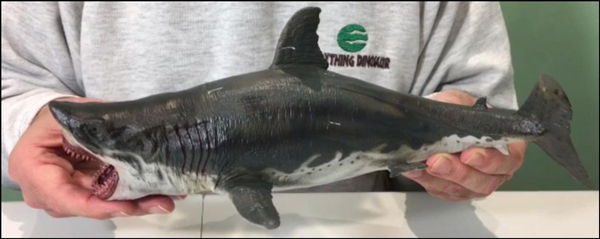
If collectors are looking for a bigger more imposing figure, we recommend the PNSO Age of Dinosaurs Megalodon.  This model measures over thirty-two centimetres long.  In addition, it is supplied with display stands, a significant aid when it comes to displaying this large model next to fossils. It is one of PNSO’s original large figures, and it remains popular today.

PNSO Megalodon model "Patton".

The PNSO large megalodon model “Patton” being held by an Everything Dinosaur team member. Picture credit: Everything Dinosaur.

Picture credit: Everything Dinosaur

The PNSO prehistoric animal model range: PNSO Prehistoric Animal Figures.
Fossil fans pair fossil teeth with museum-quality figures. The contrast between real fossils and lifelike models sparks fascination and discussion. It bridges the gap between imagination and scientific evidence. These models inspire curiosity about ancient marine animals. They remind us that giant sharks are not a myth.

Mike from Everything Dinosaur commented:

“By collecting detailed models of megalodon, we celebrate model making and palaeontology.  Furthermore, each fossil display tells a story, and the figures help to highlight the wonders of the natural world.”

The Everything Dinosaur website shop includes lots of prehistoric shark models: Models of Prehistoric Animals to Purchase.

7 11, 2025

New PNSO Prehistoric Animal Models in Stock

By |2025-11-07T22:06:55+00:00November 7th, 2025|Categories: PNSO Age of Dinosaurs Models|0 Comments

Three new PNSO prehistoric animal figures are now in stock at Everything Dinosaur. The Hongkongsaurus, Guanlingsaurus and Dinocephalosaurus have arrived.  Team members have been busy contacting customers who requested an alert email when these models arrived.  All three figures represent animals whose fossils come from China.

Three new PNSO prehistoric animal figures. Hongkongsaurus, Guanlingsaurus and the Triassic marine reptile Dinocephalosaurus.

All three prehistoric animals are associated with China. Hongkongsaurus is based on fossils found on Port Island in the Hong Kong UNESCO global geopark. Dinocephalosaurus and Guanlingsaurus fossils have been discovered in Guizhou Province. Picture credit: Everything Dinosaur.

Picture credit: Everything Dinosaur

To view the range of PNSO prehistoric animal figures in stock at Everything Dinosaur: PNSO Prehistoric Animal Figures.
PNSO Prehistoric Animal Figures

All three of these new figures will be supplied with an Everything Dinosaur fact sheet.  The Hongkongsaurus fact sheet presents a unique challenge.  The dinosaur has been modelled on fragmentary fossil evidence from the uninhabited Port Island (Hong Kong).  These fossils have yet to be formally described.  As a result, the Hongkongsaurus is not a valid taxon. The name was created by PNSO to honour the discovery of the first dinosaur fossils from Hong Kong.

Mike from Everything Dinosaur commented:

“We congratulate PNSO for bringing out three additional figures. Furthermore, it is great to see them introducing models based on fossils found in China.”

The award-winning Everything Dinosaur website: Dinosaur and Prehistoric Animal Models.

7 11, 2025

New CollectA Prehistoric Animal Models for 2026 (Part 1)

By |2025-11-06T08:01:24+00:00November 7th, 2025|Categories: CollectA Age of Dinosaurs Popular and CollectA Prehistoric Life Models|0 Comments

Everything Dinosaur in collaboration with CollectA reveal news of the first of the new prehistoric animal figures for 2026.  There is going to be a new CollectA Tylosaurus model.  Whilst no species has been defined, we think that the model represents Tylosaurus proriger.

  • CollectA Age of Dinosaurs Popular Tylosaurus (model measures approximately 20.5 cm in length).
CollectA Age of Dinosaurs Popular range Tylosaurus figure.

The CollectA Age of Dinosaurs Popular range Tylosaurus.

The New CollectA Tylosaurus Model

We suspect that this marine reptile figure will replace the original Tylosaurus model from the Age of Dinosaurs Popular range.  The mosasaur has been remodelled and updated.  For example, it has a hypocercal tail. A hypocercal tail has a larger lower lobe compared to the upper lobe.  The cervical vertebrae bend down into the lower lobe.  In contrasts, sharks and some primitive bony fishes have a larger upper lobe in their tails.  The vertebral column extends into the upper lobe, and the tail shape is described as heterocercal.

The front flippers of the Tylosaurus figure are broad, T. proriger is noted for its broad front flippers that are larger than the rear flippers.

CollectA Age of Dinosaurs Prehistoric Life Tylosaurus model (2026).

The front flippers are broad and fractionally larger than the rear flippers. This reflects the fossil material associated with the species Tylosaurus proriger.

To view the range of CollectA Age of Dinosaurs Popular figures in stock: CollectA Age of Dinosaurs Popular Figures.

Distinctive Colouration

This model of a giant mosasaur has distinctive colouration.  The concept of marine countershading is reflected in the colour scheme chosen.  The dorsum is dark, whereas the underbelly is much lighter.  This form of countershading is seen in many marine predators today.  In addition, the stripes running along the flanks remind us of the stripes seen on a Tiger shark.

CollectA Tylosaurus model (new for 2025).

The new for 2026 CollectA Tylosaurus model. We suspect this marine reptile figure will replace the Age of Dinosaurs Tylosaurus (model number 88320), that first came out around fifteen years ago.

The front of the snout lacks teeth.  This is the distinctive protuberance that inspired the species name (T. proriger).  Fossil skulls reveal damage to this area, suggesting Tylosaurus may have rammed prey with its snout to stun or injure them.  The snout may also have played a role in intraspecific combat.  If you look closely at the image above, the forked tongue of the model can be seen.  The forked tongue is a reminder of this mosasaur being a member of the Order Squamata (snakes and lizards).  Furthermore, there are two rows of pterygoid teeth in the roof of the mosasaur’s mouth.

CollecA Age of Dinosaurs Popular Tylosaurus model.

The new CollectA Tylosaurus marine reptile model has a distinctive paint scheme.

The new Tylosaurus model measures approximately twenty and a half centimetres in length.

We expect to announce more new for 2026 CollectA prehistoric animal figures next Friday.

The Everything Dinosaur website: Prehistoric Animal Figures.
4 11, 2025

Nanotyrannus Taxon Confirmed: A New Chapter in Tyrannosaur Evolution

By |2025-11-11T09:18:19+00:00November 4th, 2025|Categories: Dinosaur and Prehistoric Animal News Stories|0 Comments

For decades, palaeontologists have debated whether Nanotyrannus lancensis was a real species or simply a juvenile Tyrannosaurus rex. A new study, published in the journal “Nature” has solved this mystery. A remarkable fossil from the famous “Duelling Dinosaurs” discovery in Montana has confirmed that Nanotyrannus was indeed a distinct tyrannosaur species – not a teenage T. rex.

The fossil, unearthed in the Hell Creek Formation, captures a Triceratops and a small tyrannosaur preserved together. For years, scientists argued that the smaller predator was a young Tyrannosaurus rex. However, new research led by Lindsay Zanno of North Carolina State University demonstrates that this specimen represents a fully mature Nanotyrannus lancensis.

To read Everything Dinosaur’s blog post from 2020 about North Carolina State University acquiring the “Duelling Dinosaurs” specimen: “Duelling Dinosaurs” Get Permanent Home.

The researchers studied the tyrannosaur’s histology, bone fusion and anatomical development.  They determined that this dinosaur was around twenty years old when it perished.  This was not a juvenile T. rex after all.

Nanotyrannus lancensis skull from the dueling dinosaurs specimen.

The snout of Nanotyrannus lancensis from the “Duelling Dinosaurs” specimen. Picture credit: North Carolina State University.

Picture credit: North Carolina State University

Late Cretaceous North American Tyrannosaur Diversity

Significantly, the fossil skeleton shows traits that cannot be explained by growth alone. It had proportionally longer forelimbs, more teeth, fewer tail vertebrae, and distinctive skull nerve canals. Such features appear early in development and remain constant throughout life.

Co-author James Napoli (Stony Brook University, New York), explained:

“For Nanotyrannus to be a juvenile T. rex, it would have to break every known rule of vertebrate growth. It’s simply impossible.”

Nanotyrannus forearm compared to that of a T. rex.

The researchers discovered that the forearm and hand of Nanotyrannus was different to that of Tyrannosaurus rex. Picture credit: NC Museum of Natural Sciences.

Picture credit: NC Museum of Natural Sciences

Sitting Outside the Tyrannosauridae

Tyrannosaurus rex is among the most comprehensively studied extinct tetrapods.  It was one of the last surviving non-avian dinosaurs.  This species provides insights into Late Cretaceous terrestrial diversity, ecosystem structure and biogeographic exchange immediately preceding the end-Cretaceous mass extinction event.  This new study changes how palaeontologists perceive tyrannosaur diversity.  Instead of a single species dominating predatory niches, there were multiple predators co-existing in the Late Cretaceous of North America.

Over two hundred tyrannosaur fossils were examined.  The team discovered another specimen with subtle differences from Nanotyrannus lancensis.  The specimen known as “Jane” (BMRP 2002.4.1) at the Burpee Museum of Natural History Illinois represents a larger species of Nanotyrannus. A second Nanotyrannus species was erected by the researchers – Nanotyrannus lethaeus. The species epithet was inspired by the River Lethe of Greek mythology, symbolising how this new species remained hidden for decades.

The confirmation of Nanotyrannus as a valid genus suggests the final few million years of the Cretaceous were far more dynamic than once thought. Several tyrannosaur species, not just T. rex, co-existed. While Tyrannosaurus rex dominated with power and size, Nanotyrannus excelled in speed and agility, filling a different ecological niche.

Fellow co-author Lindsay Zanno, (associate research professor at North Carolina State University) added:

“This discovery paints a richer, more competitive picture of the last days of the dinosaurs.”

A pack of Nanotyrannus attacks a juvenile T. rex

A pack of Nanotyrannus attacks a juvenile T. rex. Picture credit: Anthony Hutchings

Picture credit: Anthony Hutchings

Phylogenetic analysis demonstrates that the two Nanotyrannus species sits outside the Tyrannosauridae family. Nanotyrannus and its close relatives belong to a distinct tyrannosaur lineage, one that is not closely related to T. rex. However, the taxonomic position of this genus remains uncertain. It has been speculated that the formation of the Western Interior Seaway separated theropod populations and this may have resulted in two, dissimilar lineages evolving.

Nanotyrannus Models

Despite the controversy, a number of Nanotyrannus figures have been made available for collectors.  For example, Safari Ltd have made a Nanotyrannus figure and in 2021 PNSO introduced “Logan the Nanotyrannus” model.

PNSO Nanotyrannus dinosaur model.

The new for 2021 PNSO Nanotyrannus dinosaur model.

To see the range of PNSO prehistoric animal figures in stock: PNSO Age of Dinosaurs Models and Figures.

Nanotyrannus lancensis and Nanotyrannus lethaeus

The findings outlined in the paper are not without controversy.  Many authors who have questioned the validity of Nanotyrannus have accepted the study’s conclusions.  However, debate remains over the taxonomy and whether the Burpee Museum specimen “Jane” really does represent a separate species of Nanotyrannus. With Nanotyrannus lancensis recognised, palaeontologists can now revisit long-held ideas about tyrannosaur evolution.  For example, this new research will need to a reassessment of tyrannosaur growth rates.

Everything Dinosaur acknowledges the assistance of a media release from North Carolina State University in the compilation of this article.

The scientific paper: “Nanotyrannus and Tyrannosaurus coexisted at the close of the Cretaceous” by Lindsay E. Zanno and James G. Napoli published in Nature.

The Everything Dinosaur website: Prehistoric Animal Models and Figures.

3 11, 2025

From Carcharocles to Otodus: The True Name of the Megalodon

By |2025-11-11T10:14:51+00:00November 3rd, 2025|Categories: Palaeontological articles|0 Comments

Discover why scientists now use Otodus megalodon instead of Carcharocles megalodon, and learn how this change reshapes our view of this giant shark.  As a boy, I read about the giant prehistoric shark Carcharocles megalodon – often referred to as megalodon.  However, research has led to a revision of this taxon.  The species is referred to as Otodus megalodon. This change reflects a deeper understanding of shark evolution and how this ancient lamniform fits into the fossil record.

PNSO Megalodon model "Patton".

The PNSO large megalodon model “Patton” being held by an Everything Dinosaur team member.  This giant member of the Lamniformes has inspired many model makers.  Picture credit: Everything Dinosaur.

Picture credit: Everything Dinosaur

The image (above) shows an early prehistoric shark model from the Chinese company PNSO.

To view the range of PNSO prehistoric animal models in stock: PNSO Prehistoric Animal Models.

Otodus megalodon Instead of Carcharocles megalodon

The taxonomic history of this ancient shark is complicated. Fossil material was assigned to Carcharias megalodon by Louis Agassiz in 1835. Fossils, mainly teeth were subsequently assigned to Carcharodon, and this largely remained the case until some authors erected Carcharocles megalodon around fifteen years ago. Most of these studies placed megalodon within the same group as the great white shark, Carcharodon carcharias. Yet, new evidence tells a different story. Fossil teeth and jaw structures show that Otodus megalodon was part of the Otodontidae family, not directly related to modern great white sharks.

The Paleobiology Database resource records the use of O. megalodon in a paper published in 2015 (Reinecke and Radwanski).

This family line began with Otodus obliquus, a shark that lived more than 55 million years ago (Eocene Epoch). Over time, its descendants evolved larger, sharper teeth and greater size. Eventually, this lineage gave rise to Otodus megalodon, one of the largest marine predators known to science.

To read a blog post from 2018 about the ancestors of this shark lineage: On the Trail of Megalodon Ancestors.

Mike from Everything Dinosaur commented:

“The name changes, but the legend remains.  Fossilised teeth of this giant shark inspire fear and awe.  They remind us that there was a time when the oceans of the world were ruled by this enormous shark.”

The award-winning Everything Dinosaur website: Prehistoric Animal Figures.

2 11, 2025

How to Assemble Your New Everything Dinosaur Evolution Model

By |2025-11-03T21:33:08+00:00November 2nd, 2025|Categories: Everything Dinosaur Evolution|0 Comments

The new Everything Dinosaur Evolution Tyrannosaurus rex model is supplied with a detailed display base.  Here is a quick guide to assembling your 1:33 scale theropod figure.  This is your T. rex assembly guide.  In just a few steps the model will be taking centre stage in your prehistoric animal model collection.

Follow these simple steps to create a stunning display.

An Everything Dinosaur Evolution T. rex Assembly Guide

  • First, remove both the T. rex figure and the display base from their protective packaging. Check that all parts are clean.
Everything Dinosaur Evolution T. rex assembly guide.

Unpack the model from its protective green cloth. Unwrap the display base from its paper packaging. Check that the peg in the base is secure and that the hole in the model’s rear foot is clean. Picture credit: Everything Dinosaur.

Picture credit: Everything Dinosaur

  • Locate the small, metal peg on the base.  You will find a matching hole underneath the model’s rear foot.  Align these carefully.
How to assemble the Everything Dinosaur T. rex model.

Align the metal peg in the display base with the hole in the T. rex model’s hind foot. Picture credit: Everything Dinosaur.

Picture credit: Everything Dinosaur

  • Gently lower the foot onto the peg. Press down lightly until the model feels secure. Avoid twisting the figure while doing this.

Once attached, ensure the T. rex stands firmly and evenly on the base. Adjust the position if needed. The result should look balanced and natural. Finally, place your completed model on a stable surface away from direct sunlight. This helps preserve its fine details and painted finish.

Your Everything Dinosaur Evolution Tyrannosaurus rex is now ready to display! With its dynamic pose and detailed sculpt, it makes a striking centrepiece for any collection.

Join the Evolution!  Find the models here: Everything Dinosaur Evolution Dinosaur Models.

Easy to Assemble

Mike from Everything Dinosaur commented that the figure and base had been designed to make assembly easy.  New figures will be added to the Hell Creek Formation range shortly.

He explained:

“The T. rex is one of four figures planned for the Hell Creek Formation set. We are currently working on an amazing Triceratops.  Once again, we are following the fossil evidence to make a scientifically accurate dinosaur model.”

Visit the award-winning and customer friendly Everything Dinosaur website: Prehistoric Animal and Dinosaur Models.

Go to Top