Amazing Isle of Wight Dinosaur Discovery Reveals Fearsome New Predator
A remarkable new dinosaur species has been identified from a fossil discovered on the Isle of Wight. The dinosaur, named Invictibellatrix amberina, was a formidable predator that lived approximately 120 million years ago (Early Cretaceous). Researchers from University College London (UCL) led the study, which has been published in the scientific journal “Royal Society Open Science”. This new Isle of Wight dinosaur belonged to a mysterious group of carnivorous theropods called the Megaraptora. Significantly, it represents the first evidence of these theropod dinosaurs in Europe.
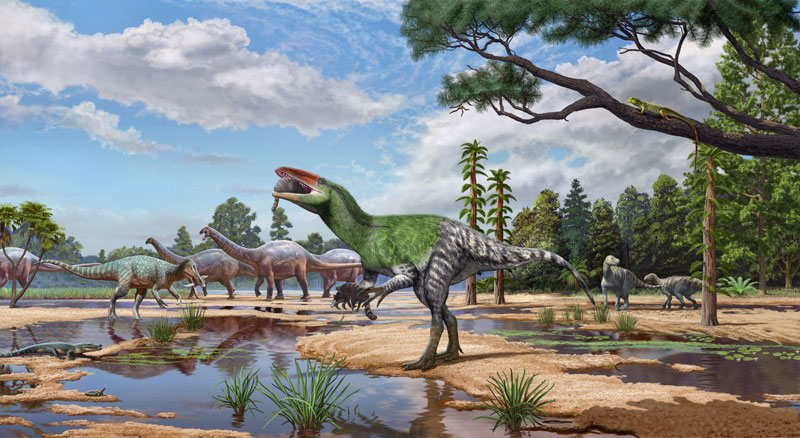
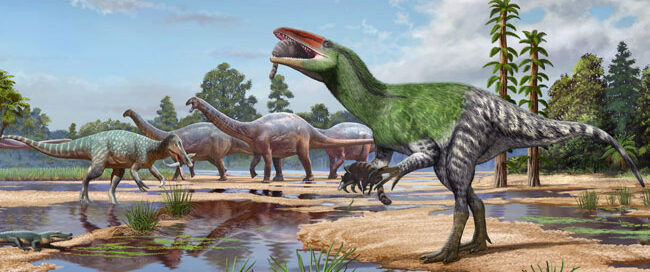
The new theropod dinosaur, Invictibellatrix amberina (centre of the image), in its ecosystem on the Isle of Wight, United Kingdom in the Early Cretaceous (around 120 million years ago). It lived in what was likely a seasonally wet-to-dry floodplain environment and is surrounded by other dinosaurs including large, long-necked rebbachisaurid sauropods (directly behind Invictibellatrix, centre) and relatives of Iguanodon (right). A spinosaurid theropod, potentially the apex predator of the time, fishes (left). Invictibellatrix has just caught and is consuming two small mammals. Gymnosperms dominate the environment as flowering plants (angiosperms) were not common at this time. Other reptiles including relatives to modern lizards, crocodiles and turtles enjoy the warm Early Cretaceous weather of the UK. Picture credit: Sergey Krasovskiy and Pedro Salas.
Picture credit: Sergey Krasovskiy and Pedro Salas
Invictibellatrix amberina – A Fearsome Cretaceous Predator
The newly described dinosaur was approximately three to four metres long. It stood around 1.5 metres tall and was roughly comparable in size to a large tiger. Although relatively small compared to later megaraptorans, it would have been a dangerous predator.
Megaraptorans were predominantly two-legged carnivorous dinosaurs. Unlike tyrannosaurids, which evolved massive skulls and powerful jaws, megaraptorans possessed relatively slender heads. Their forelimbs were equipped with enormous, curved claws that probably played an important role in capturing and subduing prey.

A typical Late Cretaceous megaraptoran theropod. This is a model of Megaraptor (M. namunhuaiquii) from Argentina. Note the slender jaws and the long, forelimbs with powerful, grasping claws. This is the red/brown coloured Megaraptor model from Haolonggood (Duan Jing Zhu).
To view the range of Haolonggood prehistoric animal models in stock: Haolonggood Prehistoric Animal Models.
The researchers suggest that Invictibellatrix may have possessed feathers. Furthermore, its hand claws could have measured between ten and twenty centimetres in length. It probably hunted smaller dinosaurs, lizards and mammals. However, the precise diet of this Early Cretaceous predator remains unknown.
Lead author Dr Cassius Morrison (UCL Earth Sciences) compared its ecological role to that of a modern hyena. Although formidable, Invictibellatrix was probably not the apex predator within its ecosystem.
A New Isle of Wight Dinosaur Fossil Overlooked for a Century
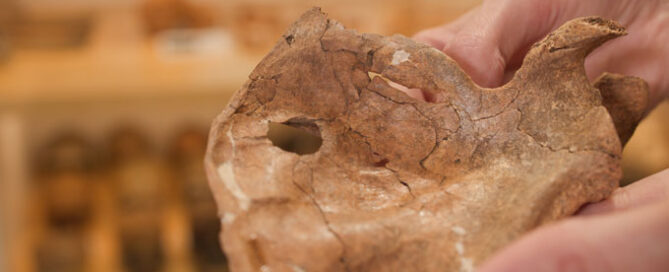
Remarkably, the fossil was discovered more than a hundred years ago. Amateur palaeontologist Reginald Walter Hooley collected the specimen from the south-western coast of the Isle of Wight. Following Hooley’s death, the Natural History Museum acquired more than a thousand specimens from his collection in 1924. Among them was a fragment of the rear portion of a dinosaur skull.
For decades, this scientifically important fossil remained largely overlooked.
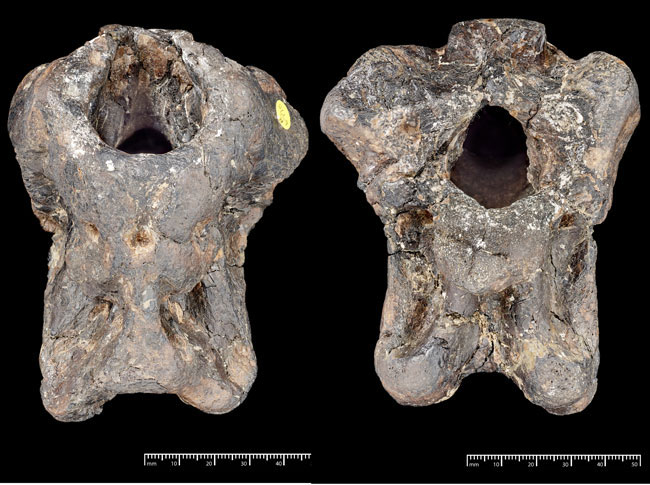
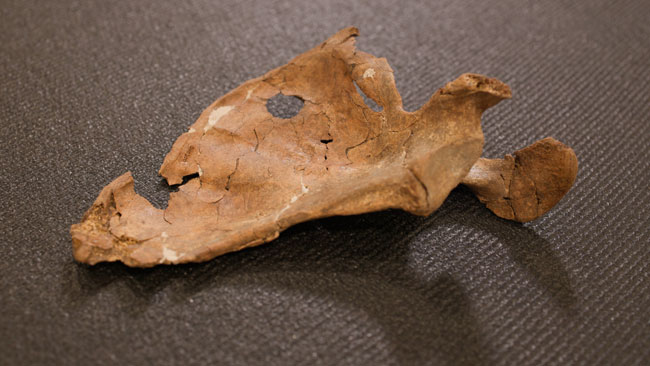
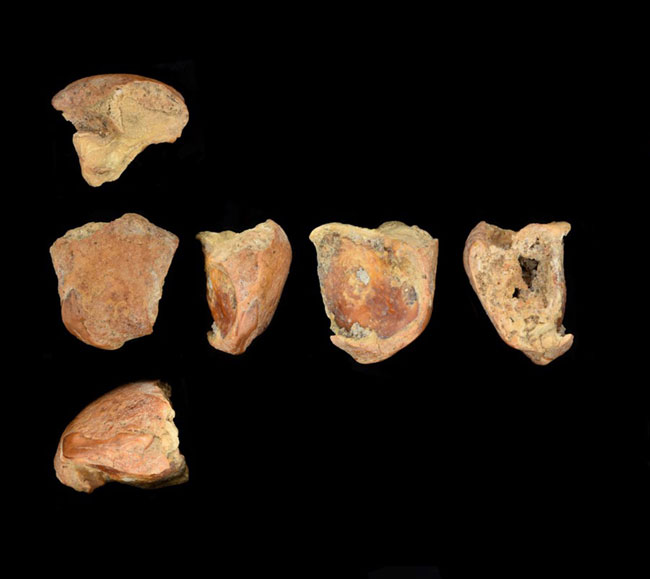
Anterior (left) and posterior (right) views of the newly identified megaraptoran theropod dinosaur fossil leading to the erection of a new species – Invictibellatrix amberina. The oval hole is where the brain would have been. The fossil was acquired by the Natural History Museum in 1924. Note, scale bar equals 5 cm. Picture credit: The Trustees of the Natural History Museum, London.
Picture credit: The Trustees of the Natural History Museum, London
The scientists used computed tomography (CT) scanning to examine the fossil. This technique enabled them to create three-dimensional digital reconstructions of the preserved skull bones and the internal braincase cavity. Subsequently, the research team compared these structures with those of other predatory dinosaurs. These included tyrannosaurs, spinosaurids and various other theropods.
Several distinctive anatomical features were identified. For example, the opening through which the spinal cord entered the braincase was oval-shaped. In addition, the fossil possessed an unusual hourglass-shaped crest.
These characteristics, together with the results of computational evolutionary analyses, supported the identification of a new megaraptoran species.
The First Megaraptoran Dinosaur Discovered in Europe
The discovery of Invictibellatrix amberina (pronounced In-vik-tee-bel-ah-tricks am-ber-ree-nah) could help resolve a long-standing mystery concerning megaraptoran evolution. Previously, scientists had identified megaraptoran fossils in regions including Asia, South America and Australia. However, definitive evidence of their presence in Europe had remained elusive. Researchers have proposed that megaraptorans originated in Asia before dispersing through Europe into the southern supercontinent of Gondwana.
The Isle of Wight fossil provides important evidence supporting this hypothesis.

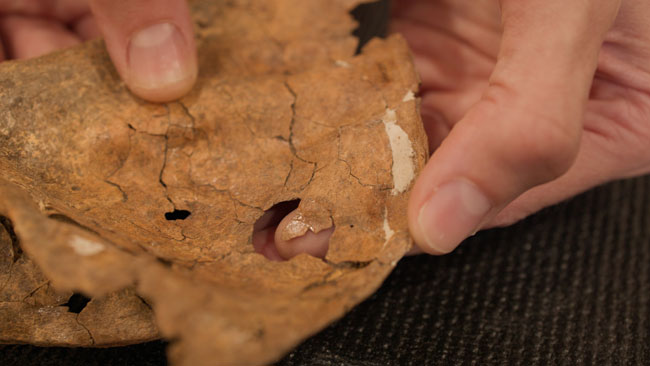
Dr Cassius Morrison (University College London) with the braincase fossil. Picture credit: The Trustees of the Natural History Museum, London.
Picture credit: The Trustees of the Natural History Museum, London
The scientists also used mathematical modelling to investigate the geographical distribution of megaraptorans through geological time. Their results suggest that these dinosaurs were widespread during the Early Cretaceous. However, their distribution subsequently changed. By the Late Cretaceous, megaraptorans appear to have disappeared from the northern landmass of Laurasia. Meanwhile, some lineages evolved into gigantic apex predators across Gondwana. For example, Megaraptor namunhuaiquii from the Late Cretaceous of Argentina.
Some of the largest megaraptorans possessed formidable hand claws measuring approximately thirty-five centimetres long. In addition, megaraptorans such as Maip macrothorax may have grown to nine to ten metres in length, matching some tyrannosaurs and the largest allosaurs in size.

A 1:40 scale replica of the giant, South American megaraptor Maip macrothorax. The CollectA Deluxe Maip macrothorax model measures 26 cm in length.
The image above shows the CollectA Deluxe 1:40 scale replica of M. macrothorax. It was introduced in 2025.
To view the CollectA Deluxe range: CollectA Deluxe Prehistoric Animal Models.
An article providing information on Maip macrothorax: A New, Giant Megaraptorid Theropod is Described from Argentina.
The reasons for their apparent disappearance from northern continents remain uncertain. Environmental changes, climatic shifts and competition with other large theropods may have contributed.
Invictibellatrix amberina – What’s in a Name?
The genus name Invictibellatrix translates as “unconquered female warrior”. It acknowledges the evolutionary success of megaraptorans, some of which eventually became enormous apex predators. The researchers also intended the name to convey a positive message of resilience and hope to people experiencing discrimination, bullying or oppression.
The species name amberina refers partly to amber associated with the geological deposits from which the fossil originated (Wessex Formation). It also references a feminine personal name.
Everything Dinosaur applauds the research team for naming a new dinosaur species that gives hope and strength to all those who are bullied, discriminated, victimised and oppressed. That tomorrow will be theirs and not to give up in the face of such odds.
Together, these names give the dinosaur a distinctive identity that reflects both its evolutionary history and the researchers’ wider message.
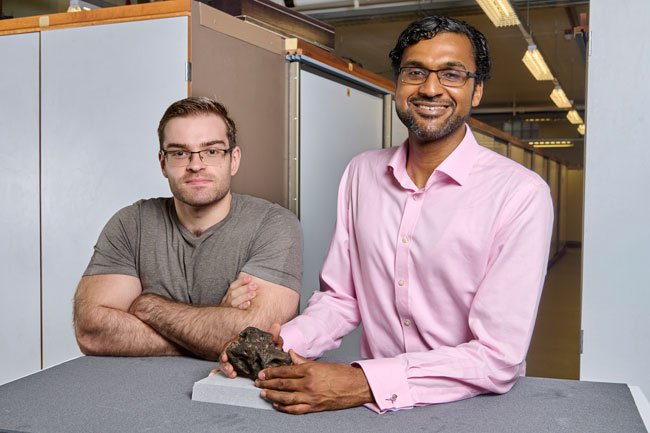
Dr Cassius Morrison (University College London) with co-author PhD student Charlie Scherer (University College London) holding the fossil of the new Isle of Wight dinosaur. Picture credit: The Trustees of the Natural History Museum, London.
Picture credit: The Trustees of the Natural History Museum, London
More Dinosaur Discoveries Await in Museum Collections
The identification of Invictibellatrix amberina highlights the importance of revisiting historical fossil collections. Although palaeontologists have studied the Isle of Wight for more than two centuries, new dinosaur species continue to be recognised.
Professor Paul Barrett of the Natural History Museum, the study’s senior author, emphasised the scientific importance of historical museum collections. Specimens collected many decades ago can yield extraordinary discoveries when examined using modern techniques.
The Isle of Wight has already provided scientists with an exceptional record of Early Cretaceous dinosaurs. The identification of this European megaraptoran adds another important chapter to a remarkable prehistoric story.
Two new, spinosaurids described: New Spinosaurids from the Isle of Wight Described.
A new Isle of Wight dinosaur (an iguanodontian – Comptonatus chasei) from the Isle of Wight: A New Iguanodontian Dinosaur from the Isle of Wight.
Furthermore, the discovery raises an intriguing possibility. Other overlooked fossils housed in museum collections might contain evidence of previously unknown dinosaurs.
Everything Dinosaur acknowledges the assistance of University College London and the Natural History Museum in the compilation of this article.
The scientific paper: “A new megaraptoran dinosaur from the Lower Cretaceous Wessex Formation, UK, and its implications for theropod evolution and biogeography” by Cassius D. Morrison, Charlie R. Scherer, Philip Mannion, Laura B. Porro, Brett Clark, Daniel D. Folkes and Paul M. Barrett published in Royal Society Open Science.
The award-winning Everything Dinosaur website: Everything Dinosaur.