All about dinosaurs, fossils and prehistoric animals by Everything Dinosaur team members.

Everything Dinosaur team members working in schools, helping museums and other educational bodies. Our work with and in schools.

12 02, 2026

Celebrating Women in Science: Palaeontologist’s First Single Author Paper

By |2026-02-13T07:15:06+00:00February 12th, 2026|Categories: Key Stage 1/2|0 Comments

This week we celebrated the International Day of Women and Girls in Science. It is time to acknowledge the achievements of female researchers and their contribution to scientific disciplines. At Everything Dinosaur, we try and support aims and aspirations.  For example, we recently congratulated British palaeontologist Megan Jacobs on the publication of her first sole-authored scientific paper.  Published in the prestigious Proceedings of the Geologists’ Association, the study examined the history of research into dinosaur tracks found on the Isle of Wight.

A dinosaur footprint from the Isle of Wight.

A tridactyl dinosaur print from the Isle of Wight (size 8 foot for scale). Picture credit: Megan Jacobs.

Picture credit: Megan Jacobs

This island is known as the “Dinosaur Isle”.  It is one of the most important places in Europe for dinosaur footprints and tracks.  These trace fossils highlight the diversity of the Dinosauria.  They are especially important for example, in strata representing the Vectis Formation, as dinosaur body fossils are rare.  The tracks indicate the presence of theropods, ornithopods and armoured dinosaurs.

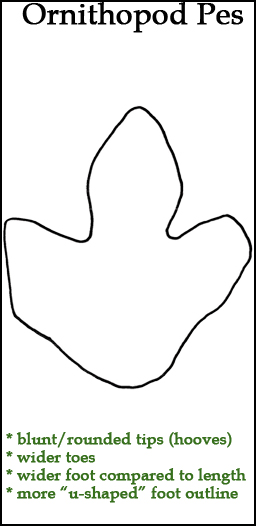
A first solo authored scientific paper is an important milestone in the career of a scientist. Its publication reminds us of how an iguanodontian track helped inspire teaching activities as part of a term topic programme supporting Key Stage 2 teaching. Our drawing of a large footprint from the Isle of Wight was one of a series of teaching resources we developed to help explain different types of fossils.

Ornithopod pes. Dinosaur footprints found on beach.

Line drawing of the hind footprint of a large ornithopod (iguanodontid).  Picture credit: Everything Dinosaur.

Picture credit: Everything Dinosaur

The Historiography of Dinosaur Footprints

The new paper explores how scientists have documented, studied and debated these ancient footprints over time. It delves into the historiography of fossil track studies, shedding light on how earlier interpretations have shaped our current understanding of dinosaur behaviour and palaeoecology. Furthermore, her work offers more than a detailed review of fossil tracks. It highlights the value of historical science, showing how past researchers built knowledge piece by piece. For many years, dinosaur footprints were seen as curiosities. Now, with detailed historical analysis, they are recognised as important evidence of behaviour, movement and ecosystem dynamics.

This publication also marks a key moment for Jacobs’ career. Publishing a solo authored paper in a prestigious journal is a major achievement for any palaeontologist. Her work exemplifies how women are making essential contributions to dinosaur science — from tracks and bones to evolutionary insights.

An example of Isle of Wight dinosaur footprints.

An ornithopod print from the Isle of Wight. Picture credit: Megan Jacobs.

Picture credit: Everything Dinosaur

The University of Portsmouth graduate has studied body fossils from the Isle of Wight too. For example, back in 2021 we authored a blog post about the discovery of a large Isle of Wight dromaeosaurid (Vectiraptor greeni). Its fossils had been found by local fossil collector Mick Green on the foreshore of Compton Bay.

To read our 2021 post about V. greeniNewly Described Dromaeosaurid Dinosaur from the Isle of Wight.

Tracks Preserve Behaviours

The study of dinosaur footprints continues to be a vibrant field. Tracks preserve behaviours that body fossils alone cannot show — from walking and running to group movement and hunting strategies. Megan Jacobs’ paper not only honours the scientists who came before but also pushes the field forward by encouraging deeper reflection on how we study fossils.  The relatively abundant and easily accessible dinosaur prints on the Isle of Wight continue to inform and spark enthusiasm for studying the Earth Sciences.

As we celebrate the role of women and girls in science, Megan’s first solo authored paper demonstrates her contribution to UK palaeontology. Her work inspires the next generation of researchers to explore Earth’s ancient past with fresh perspective and rigour.  After all, a single ornithopod track from the Isle of Wight inspired us to create dinosaur themed teaching studies.

We wish Megan every success with her career.

The scientific paper: “The historiography of dinosaur footprints of the Lower Cretaceous Wealden Group on the Isle of Wight, UK” by Megan L. Jacobs published in the Proceedings of the Geologists’ Association.

18 01, 2026

Helping Teachers and Teaching Assistants with Prehistoric Animal Facts

By |2026-01-23T06:40:47+00:00January 18th, 2026|Categories: Teaching|Tags: , , |0 Comments

Teaching aids play a vital role in primary education. However, accuracy must always come first. At Everything Dinosaur, we support teachers and teaching assistants.  We have produced helpful lesson plans and have even outlined term topics.  Unfortunately, some teaching materials still promote misleading ideas, including illustrations of “swimming dinosaurs”.

Team members at Everything Dinosaur recall spotting a misleading teaching aid. An image showed a plesiosaur. However, the caption referred to swimming dinosaurs. This is incorrect. Plesiosaurs were marine reptiles, not dinosaurs.  In addition, another visual referred to “Tyrannosaurus Rex”. In binomial nomenclature, the trivial or species name is never capitalised.

Swimming Dinosaurs and other information.

Spotted in a primary school, a series of pictures of prehistoric animals. However, not all the information is correct. Picture credit: Everything Dinosaur.

Picture credit: Everything Dinosaur

Swimming Dinosaurs? Why Accuracy Matters in the Classroom

Such mistakes may seem minor. However, they undermine learning. Children build knowledge step by step. Therefore, early inaccuracies can create long-term confusion.  Marine reptiles such as the Plesiosauria lived during the Mesozoic, non-avian dinosaurs are also associated with the Mesozoic.  However, plesiosaurs are not members of the Dinosauria.  In fact, they are not closely related. Consequently, grouping them together weakens scientific understanding.
Everything Dinosaur believes clarity is essential. Accurate terminology supports curiosity and confidence. Most importantly, it encourages children to ask better questions.

By challenging misconceptions about marine reptiles and swimming dinosaurs, educators can promote stronger, evidence-based learning in the classroom.

Mike from Everything Dinosaur commented:

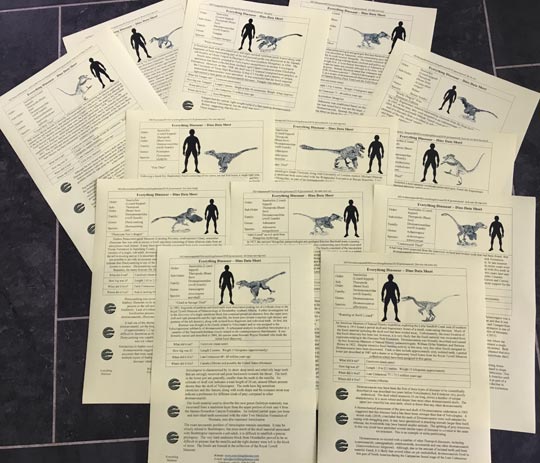
“At Everything Dinosaur, we are committed to helping people.  We demonstrate this in various ways. For example, we answer lots of questions about dinosaurs and we supply free prehistoric animal fact sheets with the models we sell.  Helping to inform and educate about the amazing creatures that once roamed our planet is at the heart of everything we do.”

Fact sheets prepared by Everything Dinosaur for the Beasts of the Mesozoic range of models.

A collection of Beasts of the Mesozoic fact sheets created by Everything Dinosaur.  Information sheets are supplied free of charge. Picture credit: Everything Dinosaur.

Picture credit: Everything Dinosaur

The multi-award-winning Everything Dinosaur website: Dinosaur and Prehistoric Animal Figures.

1 04, 2025

New Research Challenges the Story of Humanity’s Shift from Hunter-Gatherers to Farming

By |2025-03-31T11:47:04+01:00April 1st, 2025|Categories: Teaching|0 Comments

New research published this week highlights the role of human interactions during the transition from hunter gathering to farming.  The study, published in the Proceedings of the National Academy of Sciences (PNAS) challenges consensus.  It has turned previous ideas on prehistoric societies on their head as it highlights the role of human interactions during the shift from hunting and gathering to farming – one of the biggest changes in human history – rather than earlier ideas that focused on environmental factors.

For the vast majority of our existence, Homo sapiens has adopted a hunter-gatherer foraging lifestyle.  However, from about 12,000 years ago our species began to adopt a different lifestyle.  Communities formed, settling in one location as farming began to take over.  Scientists sometimes refer to this change as the “Agricultural Revolution”.

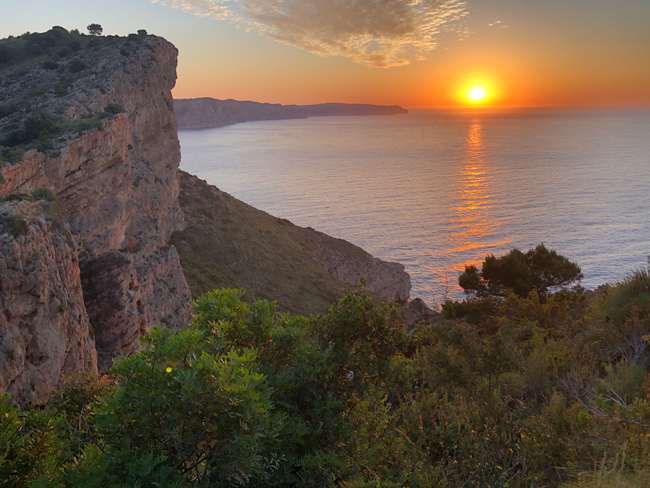
Views from Cova de les Cendres (Alacant, Spain). Early farmers settled in this area.

Views from Cova de les Cendres (Alacant, Spain). Early farmers arrived at this area through navigation. Picture credit: Oreto García-Puchol.

Picture credit: Oreto García-Puchol

The Palaeolithic and the Neolithic Transition

The “Stone Age”, the time when the most advanced tools used by humans were mainly made of stone, is divided into stages.  For example, the earliest stage of this time in human history is referred to as the Palaeolithic.  This denotes a period of time from the earliest known use of stone tools by hominins around 3.3 million years ago, down to roughly around 11,650 years ago. Palaeolithic means “Old Stone Age”.

The “Middle Stone Age” or Mesolithic followed, and this time period is associated with a decline in group hunting of megafauna in favour of a broader hunter-gatherer lifestyle. The Neolithic or “New Stone Age” marks the transition from a hunter-gatherer way of life to that of living in permanent settlements with a focus on farming.

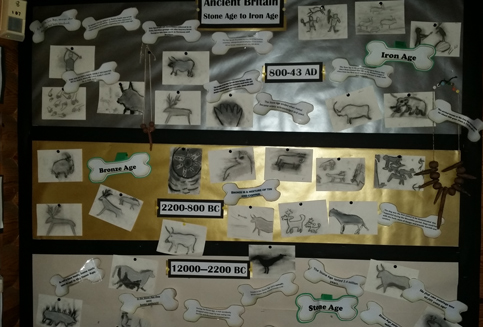
Stone Age study in a school.

Children learning about prehistoric societies. Schools in the UK have learning about the Stone Age and the transition to settled agriculture as part of their history curriculum.  Picture credit: Everything Dinosaur.

Picture credit: Everything Dinosaur

Using a Mathematical Model to Plot Changes in Human Behaviour

The study involved a collaboration between researchers from the University of Bath, the Max Planck Institute for Evolutionary Anthropology in Germany, University College London and the University of Cambridge.  The team developed a new mathematical model and framework that challenges the traditional view that this major transition was driven by external factors, such as climate warming, increased rainfall, or the development of fertile river valleys.

The research team conclude that modern humans were not just passive participants in this process. They played an active and vital role in the transition. Factors such as varying population growth rates and mortality rates driven by competition between hunter-gatherers and farmers, influenced the development of farming in these regions.

The mathematical model had originally been used to study predator-prey interactions.  However, the researchers modified the framework permitting them to examine how early adopting farming communities and hunter-gatherers may have influenced each other. This study suggests that early farming societies spread through migration, competition, and cultural exchange, reshaping how hunter-gatherers lived and interacted with their environment.

A New Perspective on Prehistoric Societies

Commenting on the results, Dr Javier Rivas (Department of Economics at the University of Bath), stated

“Our study provides a new perspective on prehistoric societies. By statistically fitting our theoretical predator-prey model to observed population dynamics inferred from radiocarbon dates, we explored how population growth shaped history and uncovered interesting patterns, such as how the spread of farming, whether by land or sea, influenced interactions between different groups. More importantly, our model also highlights the role of migration and cultural mixing in the rise of farming.”

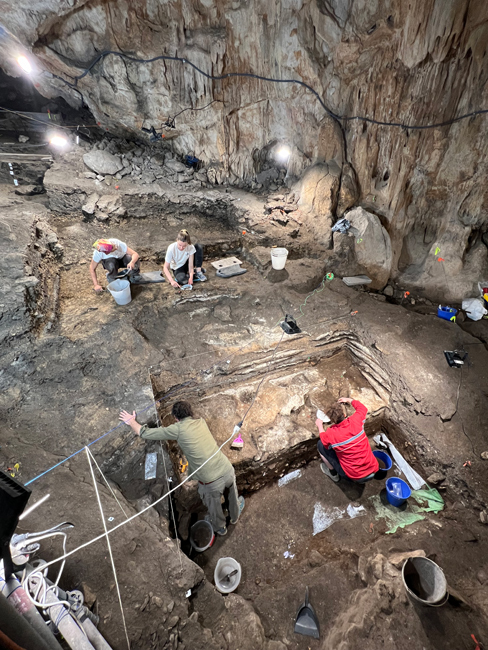
Excavating a cave floor in Spain to develop a better understanding in the transition of prehistoric societies from hunter-gathering to settled farming.

A field team excavating the floor of the Cova de les Cendres (Alacant, Spain), one of the sites included in the study. Picture credit: Oreto García-Puchol.

Picture credit: Oreto García-Puchol

The research team hope to develop this research by adding more factors into their model and evaluating it over larger regions and bigger datasets.

Dr Javier Rivas explained:

“We hope the methods we’ve developed will eventually become a standard tool for understanding how populations interacted in the past, offering fresh insight into other key moments in history, not just the shift to farming.”

The European Research Council funded this research.

Everything Dinosaur acknowledges the assistance of the University of Bath in the compilation of this article.

The award-winning Everything Dinosaur website: Prehistoric Animal Figures and Models.

5 10, 2024

Archaeologists Win Funding to Undertake New Research

By |2024-10-06T07:46:20+01:00October 5th, 2024|Categories: Teaching|0 Comments

Archaeologists based at the University of Bradford have been awarded £720,000 GBP ($945,000 USD) in new funds to purchase an advanced mobile laboratory.  This state-of-the-art facility can be deployed virtually anywhere in the world. The award comes from the Arts and Humanities Research Council (AHRC).  It will help to give academics the ability to investigate previously unexplored landscapes, such as wetlands and the inter-tidal zone.

This new facility could be employed to help researchers learn more about the ancient Stone Age settlements that once existed in the now submerged Doggerland.  The equipment considered for purchase includes portable seismic profiling systems and sophisticated drones able to map in three dimensions.  A remotely operated vehicle is also likely to be put at the disposal of the scientists.

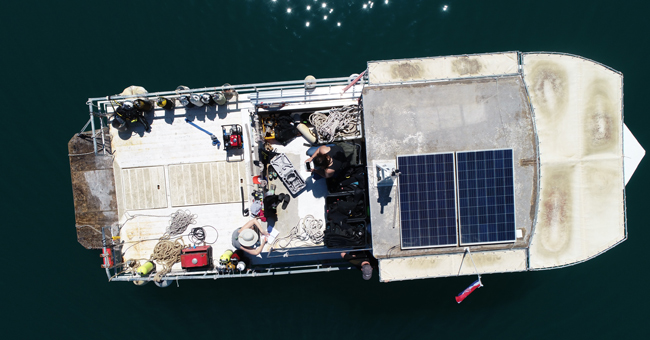
University of Bradford archaeologists carrying out offshore survey in Kaštela Bay, near Split, off the Dalmatian Coast of Croatia.

Archaeologists from the University of Bradford carrying out offshore survey in Kaštela Bay, near Split, off the Dalmatian Coast of Croatia. Picture credit: University of Bradford.

Picture credit: University of Bradford

Mobile Laboratory – Part of a National Conservation Project

The research equipment funding is part of RICHeS (Research Infrastructure for Conservation and Heritage Science).  In total, about £80 million ($105 million USD) has been set aside for a national network of conservation and heritage projects.  The University of Bradford has already benefitted from similar grants.  For example, some of the funds received were used to create Virtual Bradford, the UK’s first digital twin city. Furthermore, the University has been at the forefront of a research project exploring prehistoric landscapes.

To read more about this funding: Prehistoric Landscapes Research Project Receives Funding Boost.

Commenting on the latest funding award, Dr Cathy Batt, the Principal Investigator and Head of the School of Archaeological and Forensic Sciences (University of Bradford), stated:

“RICHeS will not only transform Bradford’s present capacity, but highlights the significance of research into archaeology and heritage nationally.”

Professor Chris Gaffney MBE, Professor of Archaeological Science at the University of Bradford, added:

“This award is fantastic news, building on the long-term success in archaeological prospection at Bradford. It reflects our work on iconic landscapes such as Stonehenge and the Mesolithic environment beneath the North Sea. We are delighted that this award will stimulate and support research in new areas, particularly by students and early career researchers.”

From Land to Sea

From Land to Sea a mobile facility for surveying and prospecting is one of thirty projects to receive RICHeS funding. It will be based at the University of Bradford, and it will underpin a step-change in understanding prehistoric landscapes. The facility will combine new technology and expertise and use easily transportable equipment in a wide range of environments, both in the UK and internationally. It will let researchers survey on land, in shallow water and near-coastal areas.

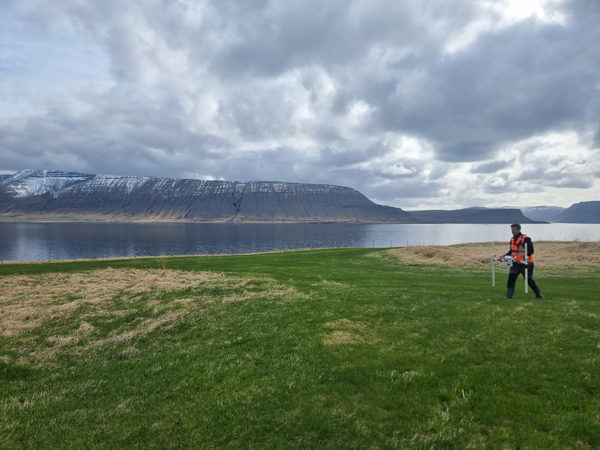
Mobile laboratory funding helps archaeologists.

An archaeologist undertaking a geophysical survey looking for early Viking settlements. Picture credit: University of Bradford.

Picture credit: University of Bradford

The mobile laboratory aims to offer flexible and portable technologies. These will allow researchers to examine and understand landscapes in terrestrial, wetland and marine environments. Users of the facility will be able to quickly react to changing conditions driven by factors including climate change or infrastructure development.

Transforming Communities

The project has lofty ambitions.  It hopes to transform the ability of researchers to answer questions about the development of early civilisations.  The mobile laboratory will also promote engagement with the broader society and impacted communities.

Everything Dinosaur acknowledges the assistance of a media release from the University of Bradford in the compilation of this article.

The Everything Dinosaur website: Everything Dinosaur.

9 05, 2024

Tyrannosaurus rex Was Not as Clever as a Primate According to New Research

By |2024-05-07T12:48:53+01:00May 9th, 2024|Categories: Adobe CS5, Dinosaur Fans, Main Page, Palaeontological articles, Photos/Pictures of Fossils, Teaching|0 Comments

New scientific research has challenged the findings of a 2023 study that concluded T. rex may have been as clever as a primate. How smart was T. rex? That is a fascinating question, one that body and trace fossils cannot really answer. The idea that the Dinosauria were slow, lumbering, stupid giants has largely been debunked. However, scientists have continued to puzzle over their cognitive abilities.

In April 2023, Everything Dinosaur blogged about a controversial study by Dr Suzana Herculano-Houzel from the Department of Psychology at Vanderbilt University (Tennessee). Doctor Herculano-Houzel postulated that Tyrannosaurus rex had around 3 billion cerebral neurons. The Brazilian neuroscientist implied that this super-sized predator had cognitive capabilities that matched primates.

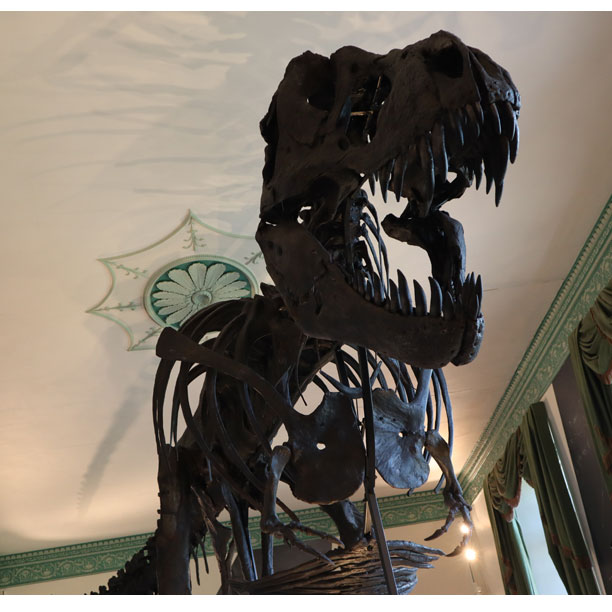
Titus the T.rex exhibit. A T. rex skeleton on display.

The spectacular Titus the T. rex exhibit at Wollaton Hall.  How smart was T. rex?  A newly published paper challenges an earlier study that postulated that this theropod was as clever as an extant primate. Picture credit: Everything Dinosaur.

Picture credit: Everything Dinosaur

The earlier paper proposed that large theropods such as Tyrannosaurus rex were long-lived, and remarkably intelligent.  It was postulated that these animals had “macaque or baboon-like cognition”.

To read Everything Dinosaur’s blog post about this paper: How Big was a T. rex Brain?

Challenging Established Views About Dinosaur Intelligence

The research challenged established views on dinosaur biology and inferred behaviours.  In addition, the earlier paper raised questions about whether neuron count estimates could benefit research on extinct animals in general.  However, a team of international scientists, including Dr Darren Naish (University of Southampton), have refuted these claims.  In a study published in “The Anatomical Record”, the researchers conclude that Tyrannosaurus rex was probably about as smart as a modern crocodile.

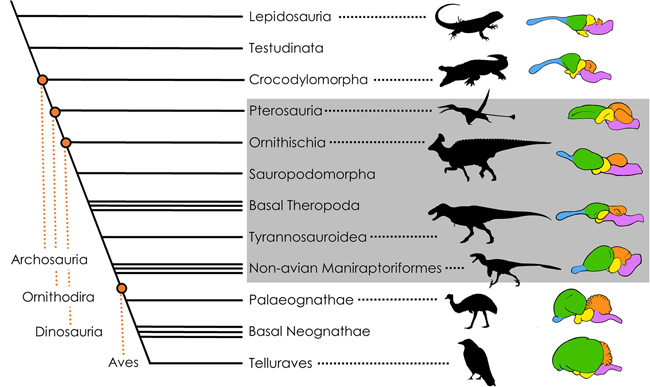
Their work reaffirms older theories about the intelligence of large theropods. Soft tissue structures like dinosaur brains rarely survive as fossils. Scientists can use endocasts, moulds made of the brain cavity to estimate brain size and structure. This is imperfect. For example, in extant crocodilians the brain only occupies about a third of the cranial cavity. In mammals and birds nearly 100% of this cavity is occupied by the brain.  By revisiting Herculano-Houzel’s (2023) work, the researchers identified several crucial discrepancies regarding interpretation and analysis of data.

Dr Herculano-Houzel probably overestimated the size of the brain of T. rex. It was assumed that the brain filled the whole of the endocranial cavity. In essence, the brain size of T. rex was modelled on mammals and birds, but this new study suggests crocodilians are a better analogy.

How smart was T. rex?

Blue: olfactory bulb and tracts, Green: pallium (homologous to the mammalian cerebral cortex), Orange: cerebellum, Yellow: diencephalon and optic tectum, Violet: brain stem. Olfactory structures, pallium and subpallium comprise the telencephalon. The overlay in grey indicates extinct taxa, the brain morphologies of which are estimated. The brain morphology of extinct ornithodirans is similar when compared to living reptiles. Picture credit: Caspar et al.

How Smart was T. rex?

The data used by Dr Herculano-Houzel was found to be inconsistent. For instance, brain size estimates had included other structures that are located in the cranium, but not part of the brain, the olfactory bulb for example. In addition, the earlier study had used a mixture of both juvenile and adult tyrannosaurs.  The use of not fully mature animals in the study could have led to inaccurate results.

The team revised the estimates of encephalisation and telencephalic neuron counts in the Dinosauria.  For large-bodied theropods in particular, this study estimated significantly lower neuron counts than previously proposed.  Their phylogenetic modelling indicated a neuron count for T. rex at between 250 million and 1.7 billion neurons.  Although the data spread was substantial, the results modelled reflect the neuron counts found in extant crocodilians.  This dataset did not produce neuron counts approaching those found in primates.

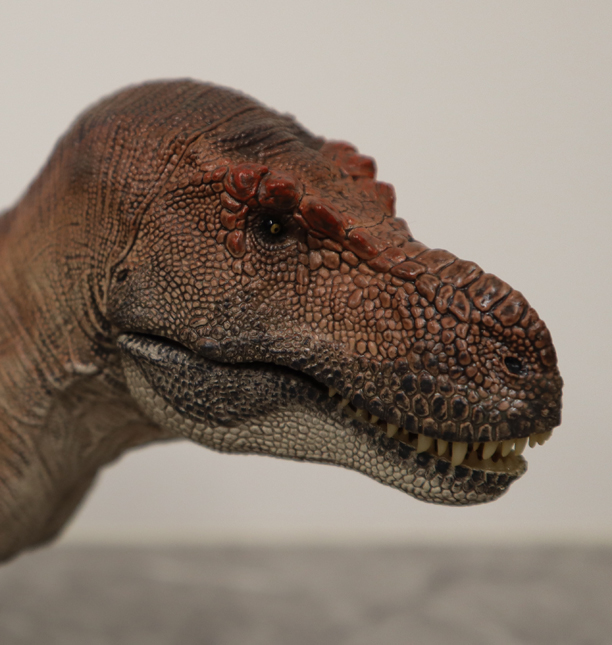
A close-up view of the Rebor T. rex Tusk figure.

A close-up view of the detail on the head of the Rebor T. rex Tusk dinosaur model.  Although this theropod was a formidable predator, its intelligence may have been overestimated. Picture credit: Everything Dinosaur.


Picture credit: Everything Dinosaur

The image (above) shows a close-up view of a 1:35 scale model of a Rebor Tyrannosaurus rex.

To view the Rebor range of prehistoric animals available from Everything Dinosaur: Rebor Dinosaur and Prehistoric Animal Figures.

Brain Size May Not Represent the Best Measure of Cognitive Abilities

Furthermore, the researchers reviewed the suitability of neurological variables such as neuron numbers and relative brain size to predict cognitive complexity, metabolic rate and life history traits in dinosaurs.  They concluded that these measures are not helpful when trying to assess the cognition of extinct creatures.

The team stated that trying to gauge the cognitive abilities of dinosaurs without close living analogues is extremely challenging.  Neuron numbers might be considered a minor component in an assessment of intelligence and much more work is required to build a robust framework to better understand the level of cognition in extinct animals.  In addition, the team concluded that given the depiction of dinosaurs in the popular media, researchers should acknowledge the limitations of the presented inferences to allow their audience to delineate between reasoned conclusions and speculation.

So, when it comes to calculating how smart was T. rex?  Scientists have yet to devise robust models to explore dinosaur intelligence.

Everything Dinosaur acknowledges the assistance of the open-source paper (Caspar et al) published in the journal The Anatomical Record in the compilation of this article.

The scientific paper: “How smart was T. rex? Testing claims of exceptional cognition in dinosaurs and the application of neuron count estimates in palaeontological research” by Kai R. Caspar, Cristián Gutiérrez-Ibáñez, Ornella C. Bertrand, Thomas Carr, Jennifer A. D. Colbourne, Arthur Erb, Hady George, Thomas R. Holtz Jr, Darren Naish, Douglas R. Wylie and Grant R. Hurlburt published in The Anatomical Record.

Visit the award-winning Everything Dinosaur website: Dinosaur Models and Toys.

8 04, 2024

A Colourful Stegosaurus at Quince Tree Day Nursery

By |2024-04-10T09:32:36+01:00April 8th, 2024|Categories: Adobe CS5, Dinosaur and Prehistoric Animal Drawings, Early Years Foundation Reception, Educational Activities, Main Page, Teaching|0 Comments

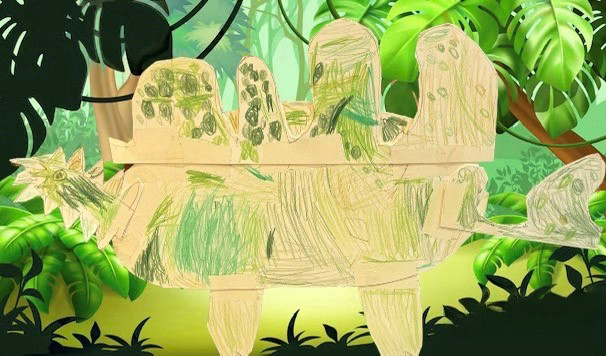
At Everything Dinosaur, we get sent lots of pictures, photographs and artwork from dinosaur fans.  The budding young palaeontologists at Quince Tree Day Nursery (Essex), created a colourful classroom Stegosaurus and they were eager to show our dinosaur experts their armoured dinosaur illustration.  The Stegosaurus seems quite happy in its forest home.  As a plant-eater it would certainly have enough food to eat.  This Jurassic giant probably spent most of its time eating.  A fully-grown Stegosaurus was around nine metres long and it loved its greens.  Our dinosaur experts estimate that this herbivore would have eaten around ten kilograms of plants every day!

Quince Tree Day Nursery Stegosaurus.

The children and teachers at Quince Tree Day Nursery in Essex have created a super Stegosaurus. The nursery recently rated as “Outstanding” by Ofsted, have placed their Stegosaurus in a forest, We are sure this plant-eater will be happy with so many plants to eat. Picture credit: Quince Tree Day Nursery.

Picture credit: Quince Tree Day Nursery

Dinosaur Artwork on Display at Quince Tree Day Nursery

The children and teachers at the day nursery have added plates to the back of their Stegosaurus.  In addition, the dinosaur has plates on his neck and around his head.  Quince Tree Day Nursery provides care for children from six weeks to five years of age. The dedicated staff work hard to create a supportive and nurturing environment for the children.  Many youngsters obsess on the Dinosauria, and we often amazed by their knowledge when we get to meet them.

A recent Ofsted inspection of Quince Tree Day Nursery (January 2024) rated this nursery as “Outstanding”.

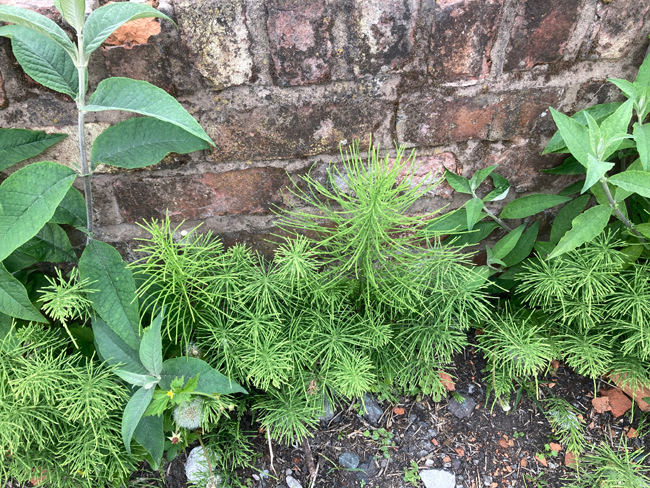
Stegosaurus lived in the Late Jurassic.  The world looked very different compared to today.  For example, flowering plants had probably not evolved.  However, Stegosaurus would have eaten plants that you can still see today, plants like horsetails.

Horsetails

Stegosaurus lived in a world with very few (if any) flowers.  It munched on horsetails and other plants.  Horsetails (Equisetum) continue to thrive as they are able to grow in areas where other plants would find it difficult to get a foothold. Often regarded as weeds, these tough little plants are essentially living fossils as the earliest examples of the genus Equisetum date from the Early Jurassic of South America. Picture credit: Everything Dinosaur.

Picture credit: Everything Dinosaur

A spokesperson from Everything Dinosaur congratulated the teachers and children at the nursery for the stunning Stegosaurus artwork.

Our thanks to Rachael for sending into us the delightful photograph.

For a further information on Stegosaurus and free Stegosaurus drawing materials: Contact Everything Dinosaur.

6 12, 2023

A Fun Dinosaur Themed Teaching Activity for Young Children

By |2024-03-09T15:03:00+00:00December 6th, 2023|Categories: Early Years Foundation Reception, Educational Activities, General Teaching, Key Stage 1/2, Main Page, Photos/Schools|0 Comments

Whilst sorting our image archive, we came across a super example of a dinosaur themed teaching activity. In December 2019 Everything Dinosaur visited Greenhill Primary in Bury (Greater Manchester). The teaching team had invited us in to help with the Year 1 term topic. The children had been learning all about dinosaurs and prehistoric animals. One of the areas of learning the teachers wanted to focus upon was improving literacy.

Dinosaur themed teaching activity.
A super example of a dinosaur themed activity helping to support Year 1 literacy. This example was spotted on a visit to Greenhill Primary in Bury. Picture credit: Everything Dinosaur.

Picture credit: Everything Dinosaur

Dinosaur Themed Teaching Activity

The dedicated and enthusiastic teaching team had prepared a comprehensive term topic. A topic that would appeal to a variety of learning styles. The children were excited and keen to demonstrate their knowledge.

Dinosaurs appeal to children. Many are fascinated by them, and a clever term topic can really engage young minds. If the children are motivated and enthused, they will quickly develop new skills and gain confidence with writing and reading.

The colourful drawings of prehistoric animals posted around the classroom helped to encourage the pupils in their own creative writing.

The award-winning Everything Dinosaur website: Everything Dinosaur.

21 11, 2023

Final Year Engineering Students Visit Everything Dinosaur

By |2023-11-23T20:43:05+00:00November 21st, 2023|Categories: Adobe CS5, Dinosaur Fans, Educational Activities, Everything Dinosaur News and Updates, Main Page, Photos, Press Releases, Teaching|0 Comments

Engineering students visit Everything Dinosaur. As part of the company’s work in the community, Everything Dinosaur was visited by Tom and Bolaji, two final year engineering students at Liverpool John Moores University. Tom and Bolaji are currently working on a practical project that focuses on using state-of-the-art software and engineering skills. The project forms part of their final year studies.

Engineering students visit Everything Dinosaur.
Sue from Everything Dinosaur with engineering students Tom and Bolaji from Liverpool John Moores University. Picture credit: Everything Dinosaur.

Picture credit: Everything Dinosaur

Students Visit Everything Dinosaur

We hope that Tom and Bolaji found the visit to our offices and warehouse illuminating. Everything Dinosaur team members have worked on a number of student projects. Recently, we were invited to talk to students at Manchester Metropolitan University. We have been engaged in several outreach projects, it is all about giving something back to the wider community and helping to motivate the next generation of entrepreneurs.

A spokesperson from Everything Dinosaur commented:

“It was wonderful to meet the two students. Their energy, enthusiasm and approach to business problems was refreshing. Tom and Bolaji definitely have a “can do” attitude. It was great to be able to exchange ideas and consider problems in our industry from a different perspective.”

Everything Dinosaur wishes them every success with their engineering project and in their careers.

Visit the Everything Dinosaur website: Everything Dinosaur.

15 11, 2023

Counting with Dinosaurs Helping Children to Gain Confidence

By |2023-11-22T12:23:46+00:00November 15th, 2023|Categories: Adobe CS5, Dinosaur Fans, Early Years Foundation Reception, Educational Activities, Main Page, Press Releases, Teaching|0 Comments

Whilst searching for an image in the Everything Dinosaur database, we came across a photograph of a counting with dinosaurs exercise. The picture had been taken on a visit to Whirley Primary in Cheshire back in 2019. The teaching team had launched an imaginative dinosaur-themed term topic. Everything Dinosaur team members were invited into the school to explain all about dinosaurs.

Dinosaurs and fossils help children with maths by counting with dinosaurs.
Dinosaurs and fossils help young children with numbers. Picture credit: Everything Dinosaur.

Picture credit: Everything Dinosaur

Counting with Dinosaurs

The reception class had been struggling with addition and subtraction. The teaching team developed some simple prehistoric-animal themed counting exercises to help the children to become more confident. After our visit, we supplied the school with some additional, free teaching resources.

Visit the Everything Dinosaur website: Everything Dinosaur.

A spokesperson from Everything Dinosaur commented:

“We supplied the school with some additional teaching materials. Lesson plans and supporting materials to assist with the scheme of work were emailed. It is always a pleasure to help schools. We do our best to assist the teaching teams.”

To contact an Everything Dinosaur team member: Email Everything Dinosaur.

27 10, 2023

New £7 Million Grant to Explore Submerged Prehistoric Landscapes

By |2023-11-23T10:56:48+00:00October 27th, 2023|Categories: Geology, Main Page, Photos, Teaching|0 Comments

University of Bradford researchers in collaboration with other leading institutions have been awarded a substantial grant helping them to explore prehistoric landscapes.

The Submerged Landscapes Research Centre, at the University of Bradford is embarking on an ambitious project to map the Baltic and the North Sea thanks to a grant of €8 million (just under £7 million GBP). This is the largest single grant ever awarded to Bradford University.

Sea levels were much lower 20,000 years ago during the Last Glacial Maximum. The grant will permit the scientists to explore ancient landscapes that are now submerged. The funding is from the European Research Council. This research will provide a deeper understanding of how our ancestors lived in these regions. Wind farm developments are making these locations more inaccessible for scientists.

University of Bradford exploring prehistoric landscapes
Global sea levels were 130 metres lower 20,000 years ago. Picture credit: University of Bradford.

European Union Research Funding

The EU has provided overall funding of more than €13.2 million for SUBNORDICA – a research collaboration between Moesgaard Museum, Aarhus University, the University of Bradford and the German research institute NIHK.

The scientists will be able to utilise the latest technologies to map and explore the seabed.

Exploring prehistoric landscapes.
Underwater excavation, example from the NIhK excavation at Strande, Germany. Picture credit: Christian Howe.

Generative AI and computer simulation will be employed to identify areas where long lost settlements may still survive and can be mapped.

Researchers at the University of Bradford’s Submerged Landscapes Research Centre will lead exploration in the southern North Sea along with partners in Holland (TNO), Belgium (VLIZ) and the University of York. The University of Bradford will also host the project’s computing infrastructure, providing modelling and AI support in the quest to explore prehistoric landscapes.

The grant comes from the European Research Council, set up by the European Union in 2007 to fund research excellence in projects based across Europe. The funding is part of the Horizon Europe programme and is part of an overall budget of more than €16 billion from 2021 to 2027.

A Scientific Collaboration to Explore Prehistoric Landscapes

The funding will permit closer collaboration and co-operation between the participating institutions.

Leading investigators celebrate the winning of a substantial grant.
Leading Investigators: Dr Katrine Juul Andresen, Professor Vincent Gaffney, Dr Svea Mahlstedt, Dr Peter Moe Astrup. Picture credit: Katrine Juul Andresen.

A spokesperson from Everything Dinosaur stated:

“The University of Bradford has been at the forefront of the mapping of ancient landscapes such as Doggerland and the Irish Sea. This funding will enable the team to use innovative technology and map a far greater area of European seascape.”

Visit the Everything Dinosaur website: Everything Dinosaur.

Go to Top