New Study Suggests T. rex Grew Up More Slowly Than Previously Thought
A comprehensive overview of T. rex ontogeny has been published in the open access journal PeerJ. This research suggests that Tyrannosaurus rex could have taken around forty years to reach full size. The study suggests that the Tyrannosaurus rex species grew more gradually and over a longer lifespan than indicated by prior models, with a protracted period of subadult development. Knowing more about the ontogeny (growth) of dinosaurs like T. rex will help scientists to better understand how this iconic predator may have lived and how it interacted with prey species. In addition, this research has implications with regards to the current debate over the Nanotyrannus taxon.
Previous studies had indicated that Tyrannosaurus rex grew rapidly and that it had a series of dramatic growth spurts before reaching adult size at around twenty-five years of age. In 2015, the reboot of the “Jurassic Park” franchise occurred. In the film “Jurassic World” a new theropod dinosaur was introduced – Indominus rex. We wrote an article comparing the growth rate of T. rex with this new, fictional theropod. We compared the growth rates proposed for these two theropod taxa. Whilst speculative, it permitted a comparison of I. rex growth based on the fictional movie timeline with the postulated growth rate for a large tyrannosaurid based on the current research. The results are shown in the graph below.
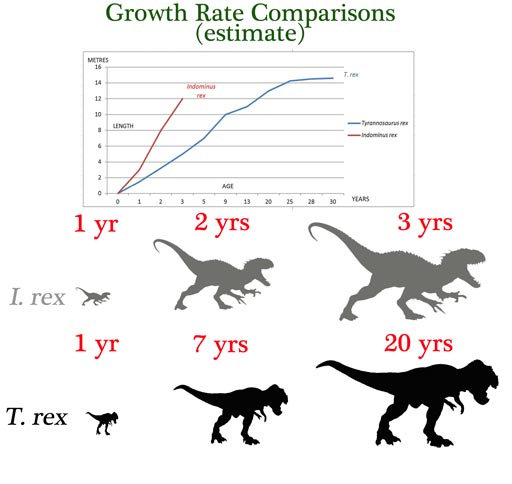
I. rex versus T. rex growth rates. The timeline from the 2015 film “Jurassic World” hinted at an extremely rapid growth rate for the fictional theropod Indominex rex. At the time, research suggested that T. rex grew rapidly too, undergoing a series of growth spurts, particularly in its teenage years before reaching full size at around twenty-five years of age. New research suggests T. rex grew more slowly. Picture credit: Everything Dinosaur.
Picture credit: Everything Dinosaur
The article comparing the growth rates of Tyrannosaurus rex and Indominus rex: The Growth Spurts of Tyrannosaurs.
A Comprehensive Assessment of T. rex Ontogeny
Earlier studies into T. rex ontogeny proposed that the “Tyrant Lizard King” exceeded eight tonnes in weight within two decades and had a lifespan of approximately thirty years. However, this understanding of Tyrannosaurus rex growth dynamics is dependent on single-point histological sampling of multiple skeletal elements and lacks specimens encompassing the earliest growth states.
Corresponding author of the study Dr Holly Ballard (Oklahoma State University), specialises in studying osteohistology (growth patterns of animals preserved in bone tissue) to map population growth dynamics in extinct vertebrates. We have reported on Holly’s research previously. For example, back in 2015, we wrote an article examining research into the growth rates of the dinosaur Maiasaura peeblesorum.
To read this blog post: Examining the Lives of Dinosaurs.
Studying the Leg Bones from Seventeen Individuals
The researchers examined the growth rings preserved in the leg bones of seventeen T. rex. The individuals ranged from juveniles to mature adults. It is the most comprehensive histological analysis of Tyrannosaurus ontogeny to date. Four alternative statistical models were employed. The study indicates that rather than racing to adulthood with remarkable growth spurts, Tyrannosaurus rex grew more slowly and steadily than previously thought.
Co-author of the study John “Jack” Horner (Chapman University, California) explained that a forty-year growth phase may have permitted younger tyrannosaurs to fill a variety of ecological niches within Late Cretaceous palaeoenvironments. Their growth rate could be one factor that permitted this taxon to dominate terrestrial ecosystems as the apex predator.
Many Tyrannosaurus rex models and figures are based on monsters from the movies. Only a few T. rex models are developed based on closely following the scientific evidence. Our own Everything Dinosaur Evolution 1:33 scale Tyrannosaurus rex figure follows the fossil record closely. The model represents a mature, adult animal. Rather than reaching full size at around twenty-five years of age, based on this research, our figure represents a T. rex more than thirty years of age.
According to this study, T. rex could have reached forty years of age. However, very few individuals lived that long. Indeed, only two specimens in the sample of seventeen tyrannosaurs represent adult dinosaurs.

Introducing Everything Dinosaur Evolution. A stunning range of prehistoric animal models developed by following the fossil evidence. Picture credit: Everything Dinosaur.
Picture credit: Everything Dinosaur
To view the Everything Dinosaur Evolution range: Everything Dinosaur Evolution Tyrannosaur Figures.
The Implications for Nanotyrannus
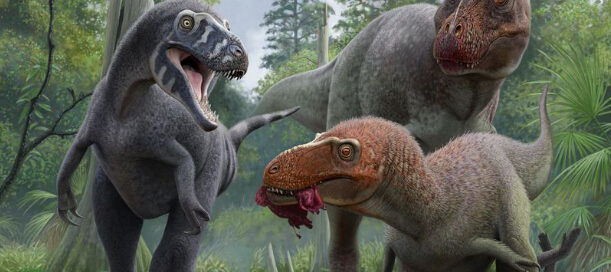
Although Tyrannosaurus rex is the best-known species of this group of dinosaurs, recent studies have proposed that some specimens previously identified as T. rex may in fact be members of other related species. Some scientists, for example, have argued that certain smaller specimens represent a small-bodied species, named Nanotyrannus, rather than juvenile specimens of Tyrannosaurus rex.
The paper’s authors acknowledge the variation in tyrannosaurs. No single, completely uniform growth pattern is highlighted. They acknowledge variation among individual specimens, including ones historically attributed to the Nanotyrannus genus. However, T. rex ontogeny alone cannot prove that the outlying specimens within this dataset represent different taxa. Unusual growth patterns might reflect individual variation or pathology. In addition, the dataset of tyrannosaur specimens is far from complete. To gain greater certainty, a much larger sample would be required.
To read Everything Dinosaur’s blog post from November 2024 featuring details of the paper validating the Nanotyrannus taxon: A New Chapter in Tyrannosaur Evolution.
This new study does challenge current views on T. rex ontogeny. These researchers conclude that the Tyrannosaurus rex species grew more gradually and over a longer lifespan. Few tyrannosaur population members attained their adult size. Furthermore, this research indicates that these predators had a prolonged subadult phase of their lifecycle.
The scientific paper: “Prolonged growth and extended subadult development in the Tyrannosaurus rex species complex revealed by expanded histological sampling and statistical modeling” by Woodward, Myhrvold and Horner published in PeerJ.
The multi-award-winning Everything Dinosaur website: Tyrannosaur and Other Prehistoric Animal Figures.