

Remarkable “Spiny Dragon” Reveals Hidden Secrets of Dinosaur Skin
The discovery of the ornithischian Haolong dongi is changing how scientists understand dinosaur skin. Recently, researchers described this remarkable dinosaur from northeastern China. The fossil dates to approximately 125 million years ago (Early Cretaceous). Importantly, it preserves dinosaur integument in astonishing detail. H. dongi belongs to a group of plant-eating dinosaurs called iguanodontians. More specifically, researchers classify it as an iguanodontid. These dinosaurs were medium to large herbivores that thrived during the Early Cretaceous.
Iguanodontids form part of a larger evolutionary group known as hadrosauroids. This group eventually gave rise to the famous duck-billed dinosaurs. However, Haolong dongi sits near the base of this lineage. Therefore, scientists describe it as a basal hadrosauroid.
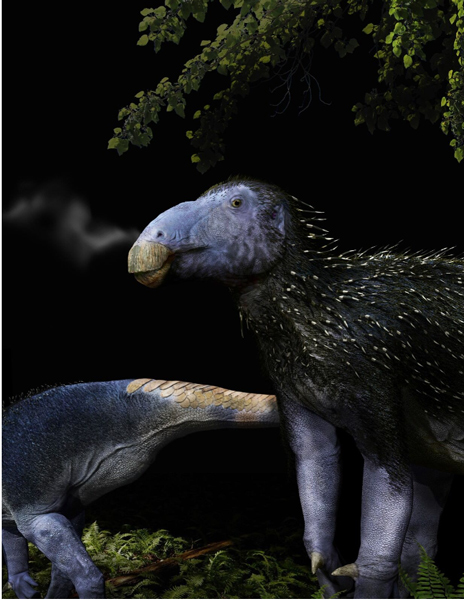
The newly described ornithischian dinosaur Haolong dongi. Picture credit: Fabio Manucci.
Picture credit: Fabio Manucci
Although the Iguanodon taxon celebrated its 200th anniversary in 2025, scientists continue to uncover surprises. Indeed, Haolong dongi shows that iguanodontian dinosaurs still have secrets to reveal. Moreover, this discovery provides new clues about dinosaur biology and evolution. The integumentary structures associated with this newly described dinosaur are markedly different from those found in other non-avian dinosaurs. Indeed, whilst skin impressions of other hadrosauroids are known, no show scales and spikes as identified in this specimen. However, the basal ornithopod Kulindadromeus from the Middle Jurassic of Siberia does have large overlapping scales on the tail, similar to those found in H. dongi.
To read Everything Dinosaur’s blog post about the discovery of Kulindadromeus: Kulindadromeus – You’ve Never Seen a Dinosaur Like This Before.
A New Iguanodontid Dinosaur Discovery
The taxon Iguanodon was erected in 1825. Although this taxon celebrated its 200th anniversary last year and remains one the most extensively studied members of the Dinosauria, the iguanodontians still hold surprises. The integument is so well preserved that cellular structure is still visible after 125 million years. Ironically, the corresponding author of the study is Pascal Godefroit of the Royal Belgian Institute of Natural Sciences in Brussels. This museum houses a remarkable collection of Iguanodon fossil skeletons (I. bernissartensis).
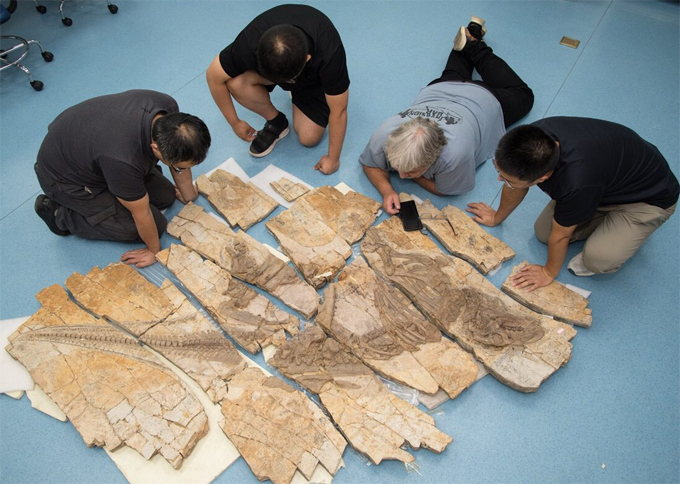
Researchers examining the fossil material. Picture credit: Thierry Hubin (Institute of Natural Sciences).
Picture credit: Thierry Hubin (Institute of Natural Sciences)
Astonishing Skin Preservation
The fossil material represents a juvenile. It possessed an unusual integument. Along its tail, it had large overlapping scales. Meanwhile, the neck and torso displayed smaller, tubercle-like scales. However, the most surprising feature was the presence of spikes of different sizes. Structures never seen before in a dinosaur taxon. Furthermore, the spikes differ from protofeathers seen in other dinosaurs. They also differ from spines in modern reptiles. Therefore, scientists believe they represent a unique evolutionary innovation. The spikes were cornified and exceptionally preserved down to the level of individual keratinocyte nuclei.
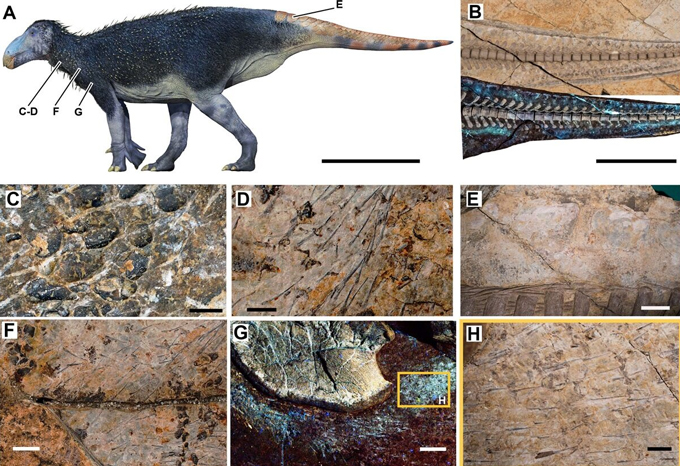
Preserved integumentary structures in AGM 16793, the holotype of Haolong dongi. Picture credit: Thierry Hubin (Institute of Natural Sciences).
Picture credit: Thierry Hubin (Institute of Natural Sciences)
Preserved integumentary structures in AGM 16793, the holotype of Haolong dongi. Life reconstruction of H. dongi (a) showing the location of c-g. Photograph and LSF image of the distal section of the tail (b), white objects on the skeleton and blue objects on the LSF image represent overlapping scales. Image of small scales along the neck (c). Photograph of small spikes along the neck (d). Large overlapping scales on the dorsal region of the tail (e). Image of small tuberculate scales and spikes in the chest region (f). LSF image of the left region of the chest, light blue elements represent small scales and spikes (g). A close-up image of (g) showing, well-preserved, small spikes.
Scale bars 50 cm (a) 25 cm (b), 1 mm (c, d, f, h), 2 cm (e) and 1 cm (g).
Honouring the Late Dong Zhiming
The generic name means “spiny dragon” in Chinese. The specific name is in honour of Dong Zhiming (1937–2024), a pioneer of dinosaur research in China and one of the most influential palaeontologists of the past sixty years, who recently passed away.
To read our tribute to the late, great Dong Zhiming: A Tribute to Professor Dong Zhiming.
Corresponding author Pascal Godefroit commented:
“Finding skin preserved at the cellular level in a dinosaur is extraordinary. It gives us a window into the biology of these animals at a level that we never thought possible.”
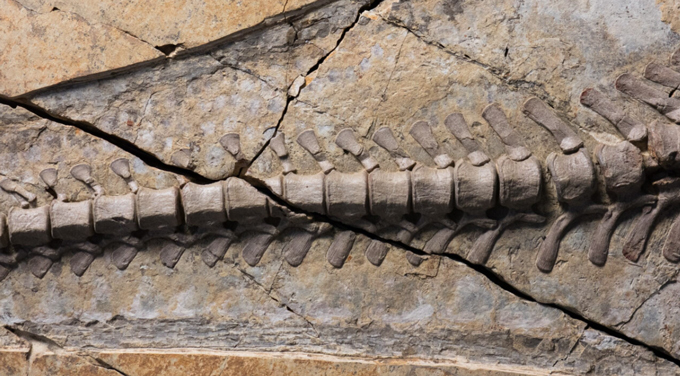
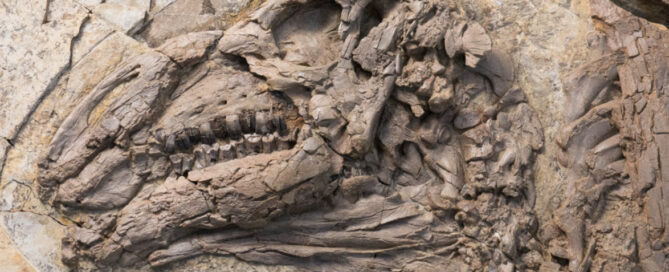
A close-up view of the caudal vertebrae of H. dongi. The base of the tail was covered in overlapping scales. These scales could have been present along the dorsal side of the entire tail. Picture credit: Thierry Hubin (Institute of Natural Sciences).
Picture credit: Thierry Hubin (Institute of Natural Sciences)
What were the Spikes of Haolong dongi For?
The spikes likely served as a deterrent against predators, making Haolong harder to swallow for the numerous smaller theropods that roamed the same ecosystem. The researchers conclude that their morphology and distribution imply a primary role in predator deterrence. They may also have played roles in thermoregulation or sensory perception.
First author of the paper, Huang Jiandong, director of the research department of Anhui Geological Museum (China), stated:
“This discovery shows that even well-studied groups like iguanodontian dinosaurs can still surprise us. The complexity of dinosaur skin is far greater than we imagined.”
This nearly complete and articulated iguanodontian dinosaur provides unprecedented insight into the microanatomy of non-avian dinosaur skin and highlights the complexity of skin evolution in ornithischian dinosaurs.
Co-author Wu Wenhao (Jilin University, China) added:
“Two centuries after the naming of Iguanodon, we are still rewriting the story of these iconic herbivores. This fossil reminds us that nature’s experiments often leave behind spectacular traces.”
Everything Dinosaur acknowledges the assistance of a media release from the Royal Belgian Institute of Natural Sciences in the compilation of this article.
The scientific paper: “Cellular-level preservation of cutaneous spikes in an Early Cretaceous iguanodontian dinosaur” by Jiandong Huang, Wenhao Wu, Lei Mao, Filippo Bertozzo, Danielle Dhouailly, Ninon Robin, Michael Pittman, Thomas G. Kaye, Fabio Manucci, Xuezhi He, Xuri Wang and Pascal Godefroit published in the journal Nature Ecology and Evolution.
The multi-award-winning Everything Dinosaur website: Dinosaurs and Prehistoric Animal Models.