

Celebrating Women in Science: Palaeontologist’s First Single Author Paper
This week we celebrated the International Day of Women and Girls in Science. It is time to acknowledge the achievements of female researchers and their contribution to scientific disciplines. At Everything Dinosaur, we try and support aims and aspirations. For example, we recently congratulated British palaeontologist Megan Jacobs on the publication of her first sole-authored scientific paper. Published in the prestigious Proceedings of the Geologists’ Association, the study examined the history of research into dinosaur tracks found on the Isle of Wight.

A tridactyl dinosaur print from the Isle of Wight (size 8 foot for scale). Picture credit: Megan Jacobs.
Picture credit: Megan Jacobs
This island is known as the “Dinosaur Isle”. It is one of the most important places in Europe for dinosaur footprints and tracks. These trace fossils highlight the diversity of the Dinosauria. They are especially important for example, in strata representing the Vectis Formation, as dinosaur body fossils are rare. The tracks indicate the presence of theropods, ornithopods and armoured dinosaurs.
A first solo authored scientific paper is an important milestone in the career of a scientist. Its publication reminds us of how an iguanodontian track helped inspire teaching activities as part of a term topic programme supporting Key Stage 2 teaching. Our drawing of a large footprint from the Isle of Wight was one of a series of teaching resources we developed to help explain different types of fossils.
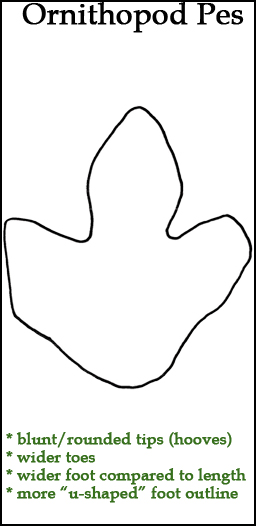
Line drawing of the hind footprint of a large ornithopod (iguanodontid). Picture credit: Everything Dinosaur.
Picture credit: Everything Dinosaur
The Historiography of Dinosaur Footprints
The new paper explores how scientists have documented, studied and debated these ancient footprints over time. It delves into the historiography of fossil track studies, shedding light on how earlier interpretations have shaped our current understanding of dinosaur behaviour and palaeoecology. Furthermore, her work offers more than a detailed review of fossil tracks. It highlights the value of historical science, showing how past researchers built knowledge piece by piece. For many years, dinosaur footprints were seen as curiosities. Now, with detailed historical analysis, they are recognised as important evidence of behaviour, movement and ecosystem dynamics.
This publication also marks a key moment for Jacobs’ career. Publishing a solo authored paper in a prestigious journal is a major achievement for any palaeontologist. Her work exemplifies how women are making essential contributions to dinosaur science — from tracks and bones to evolutionary insights.

An ornithopod print from the Isle of Wight. Picture credit: Megan Jacobs.
Picture credit: Everything Dinosaur
The University of Portsmouth graduate has studied body fossils from the Isle of Wight too. For example, back in 2021 we authored a blog post about the discovery of a large Isle of Wight dromaeosaurid (Vectiraptor greeni). Its fossils had been found by local fossil collector Mick Green on the foreshore of Compton Bay.
To read our 2021 post about V. greeni: Newly Described Dromaeosaurid Dinosaur from the Isle of Wight.
Tracks Preserve Behaviours
The study of dinosaur footprints continues to be a vibrant field. Tracks preserve behaviours that body fossils alone cannot show — from walking and running to group movement and hunting strategies. Megan Jacobs’ paper not only honours the scientists who came before but also pushes the field forward by encouraging deeper reflection on how we study fossils. The relatively abundant and easily accessible dinosaur prints on the Isle of Wight continue to inform and spark enthusiasm for studying the Earth Sciences.
As we celebrate the role of women and girls in science, Megan’s first solo authored paper demonstrates her contribution to UK palaeontology. Her work inspires the next generation of researchers to explore Earth’s ancient past with fresh perspective and rigour. After all, a single ornithopod track from the Isle of Wight inspired us to create dinosaur themed teaching studies.
We wish Megan every success with her career.
The scientific paper: “The historiography of dinosaur footprints of the Lower Cretaceous Wealden Group on the Isle of Wight, UK” by Megan L. Jacobs published in the Proceedings of the Geologists’ Association.