

Unique Fossil Provides Insight into Early Permian Food Web
A remarkable fossil discovery from Thuringia (Germany) has provided direct evidence of the feeding habits of early terrestrial predators. The fossil comes from the Bromacker locality. This is a UNESCO Global Geopark and it preserves an ancient ecosystem that existed approximately 290 million years ago. Bone fragments preserved in a mass have been identified as a bromalite. It was thought they represented a coprolite (fossilised faeces). A bromalite is a trace fossil. It represents material originating from an animal’s digestive system. For example, it could be excreted matter in the form of faeces or urine. It could also represent regurgitated matter such as pellets regurgitated by a bird of prey or even vomit. The bromalite has been identified as regurgitated material. The Bromacker bromalite study has been published in the academic journal “Scientific Reports”.
Compacted Bone Fragments
The fossil consists of a tangle of compacted bones. Indigestible food remains were regurgitated by a predator. Such finds are extremely rare, especially on land. The Bromacker find is the oldest known evidence of such regurgitation from the Palaeozoic and the first that can be clearly attributed to a terrestrial predator. Modern computerised tomography (CT scans) enabled the research team to reconstruct each bone in three dimensions. The analysis revealed that the predator had eaten at least three different vertebrates of different species and body sizes. These included two smaller, agile land animals and a significantly larger, herbivorous animal.
Only two large predators are known from the Bromacker locality. Firstly, there is Tambacarnifex which superficially resembled a large monitor lizard. Secondly, there is the sail-backed reptile Dimetrodon. Both are considered to be apex predators.
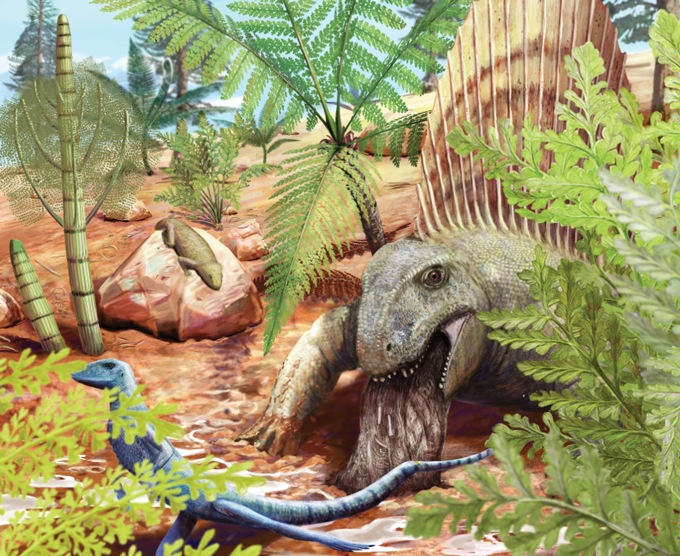
A Dimetrodon teutonis one of the apex predators of the Bromacker locality regurgitates undigestible remains. In the foreground an Eudibamus cursoris scuttles away from the carnivore. A Thuringothyris mahlendorffae basks on a rock in the background. The image also features the prehistoric plants Arnhardtia scheibei, Calamites gigas, Sphenopteridium germanicum, and Walchia piniformis. Picture credit: Sophie Fernandez.
Picture credit: Sophie Fernandez
The Significance of the Bromacker Bromalite Study
Commenting on the significance of this research, lead author of the study Arnaud Rebillard (Museum für Naturkunde Berlin) stated:
“For the first time, we can directly show which animals an early land predator ate. Such direct evidence of feeding relationships is virtually unknown from this period.”
In total, forty-one bones were identified. They comprise a maxilla attributed to the captorhinomorph Thuringothyris mahlendorffae, postcranial elements of the bolosaurid Eudibamus cursoris and an unidentified diadectid, along with several unassignable elements. The Bromacker bromalite study indicates that large, terrestrial predators were opportunists and consumed a wide variety of prey.
The discovery not only provides new insights into the behaviour of individual animals but also offers a rare glimpse into the food webs of early terrestrial ecosystems. It shows how complex and diverse life terrestrial food webs had become by the Early Permian.
Everything Dinosaur acknowledges the assistance of a media release from the Museum für Naturkunde Berlin in the compilation of this article.
The scientific paper: “Early Permian terrestrial apex predator regurgitalite indicates opportunistic feeding behaviour” by Arnaud Rebillard, Andréas Jannel, Lorenzo Marchetti, Mark J. MacDougall, Christopher Hamann, J.-Sébastien Steyer and Jörg Fröbisch published in Scientific Reports.
For models of Dimetrodon and other prehistoric creatures: Prehistoric Animal Figures.