

Sophisticated dating of zircon crystals found in volcanic ash has demonstrated that the famous Bromacker fossil site is four million years older than previously thought. The Bromacker fossil site is located in the Thuringian Forest near the village of Tambach-Dietharz (Germany). The study, published in the journal “Gondwana Research” indicates that the fossil-bearing rocks are 294 million years old. These rocks record a terrestrial ecosystem from the Early Permian (Asselian faunal stage).
The volcanic ash tuff layer which contained the zircon crystals is only a few millimetres thick. It was discovered during field work in 2024.
One of the co-authors of the paper, Sophie König (Friedenstein Foundation) commented:
“When we uncovered the dark, reddish-purple ash layer, the difference to the surrounding rock was immediately apparent, and we were very hopeful that we had finally found material that could be dated. The fact that the rock sample actually contained usable zircons still came as a surprise to me. We are delighted to have added an important scientific building block to the highly successful Bromacker project.”
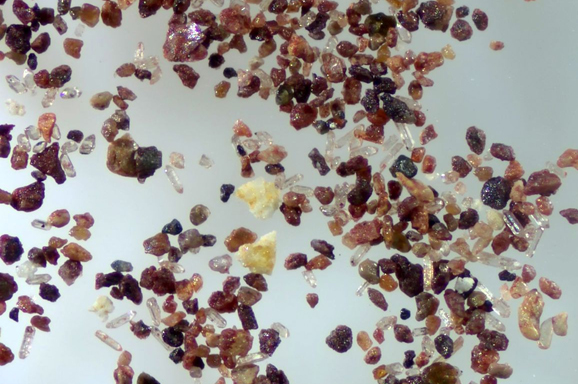
A photograph of zircon crystals. Picture credit: Jakob Stubenrauch.
Picture credit: Jakob Stubenrauch
Dating the Bromacker Fossil Site
Zircon crystals are durable and inert. They naturally trap radioactive uranium in their crystal lattice but exclude lead. As uranium naturally decays into lead at a known constant rate, measuring the ratio of uranium to lead found in a crystal is an accurate method of calculating the absolute age of the crystal. This permits volcanic deposits that contain zircon crystals to be accurately dated. In turn, this provides geologists with a benchmark against which associated sediments can be dated. The ratio of U to Pb acts as an internal clock.
In order to date the age of the ash layer zircon crystals were extracted from rock samples and analysed radiometrically at the TU Bergakademie Freiberg. The scientists could then determine the age of the famous Bromacker fossil site with a high degree of precision.
The results of the dating study have significant implications for research. They will help to date ecosystems and fossils from other fossil deposits of similar age that, like Bromacker, formed on the supercontinent Pangaea. The age of these fossils can now be better determined thanks to the correlation with the precisely dated Bromacker fossils.
Providing Information About Permian Ecosystems
Lead author of the research, Dr Lorenzo Marchetti (Museum für Naturkunde Berlin) explained:
“This extraordinary fossil deposit, which provides so much information about Permian ecosystems, needed precise dating in order to become a global reference for biostratigraphic, palaeoclimatic and evolutionary biology studies. Careful exploration of the Bromacker site led to this unexpected but urgently needed discovery of a layer of ash containing well-preserved zircon crystals.”
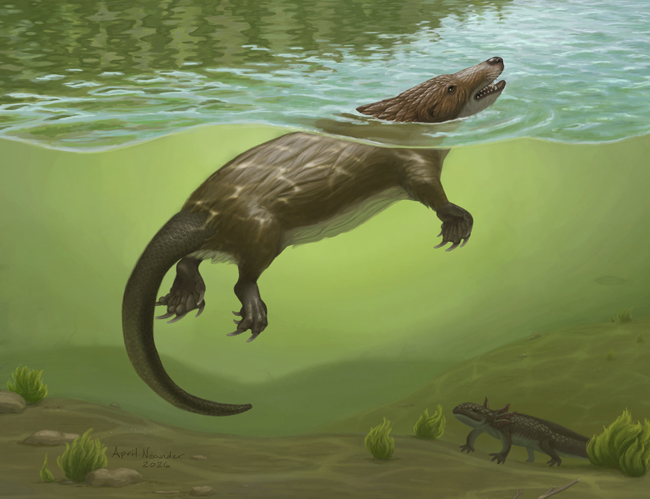
The new age of 294 mya has implications for the scientific understanding of early ecosystems and terrestrial vertebrates. For example, the food pyramid as we know it today developed earlier than previously thought. The time span between the first appearance of herbivores and the development of modern food webs was shorter, proving that the evolution of Bromacker organisms proceeded more rapidly than previously thought. Thanks to the new age dating, it is now clear that all these evolutionary innovations and the transition to a more seasonal climate occurred much earlier than the scientific community had previously assumed.
Remarkable fossil discoveries at the famous Bromacker fossil site: Spectacular Fossil Finds for the Bromacker Project Team.
Everything Dinosaur acknowledges the assistance of a media release from the Museum für Naturkunde Berlin in the compilation of this article.
The scientific paper: “First high-precision radioisotopic age from the Permian Bromacker lagerstätte (Tambach Formation, Germany) and implications for biochronology and biota evolution” by Lorenzo Marchetti, Jakob Stubenrauch, Alexandra Käßner, Marion Tichomirowa, Sophie König, Anna Pint and Thomas Voigt published in Gondwana Research.
The award-winning Everything Dinosaur website: Models of Prehistoric Animals.

Leave A Comment