

New Research Sheds Light on Oviraptorosaurian Incubation and Nesting Behaviour
Oviraptorosaurs were not just unusual theropod dinosaurs. They were also closely related to true birds, sharing a common evolutionary heritage within the Maniraptora clade. As a result, many of their behaviours provide important clues about how modern avian reproduction evolved. A fascinating new study on oviraptorosaurian incubation has been published in the journal “Frontiers in Ecology and Evolution”. The research outlines how these extremely bird-like theropods brooded their eggs. Moreover, it challenges long-held assumptions about how efficiently they incubated their clutches.
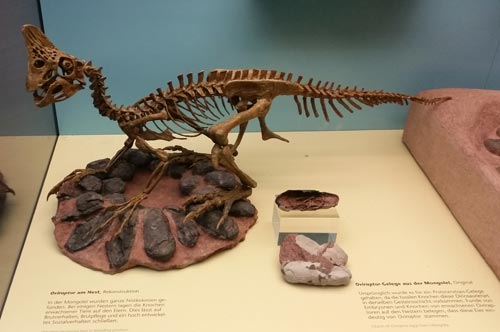
An Oviraptor and its nest. Palaeontologists study oviraptorosaurian dinosaurs to better understand the evolutionary roots of bird-specific reproductive characteristics. Picture credit: Everything Dinosaur.
Picture credit: Everything Dinosaur
Previous studies have highlighted this close avian relationship. In particular, palaeontologists have noted that some bird-specific reproductive traits may have deeper evolutionary roots. One such trait is thermoregulatory contact incubation (TCI). This behaviour, seen in modern birds, involves direct body contact between the adult and the eggs to regulate temperature.
The study focused on the Chinese oviraptorosaurian Heyuannia huangi.
To read an earlier study that examined the colouration of oviraptorosaurian eggs: Dinosaurs May Have Laid Coloured Eggs.
Thermoregulatory Contact Incubation (TCI)
Fossil evidence strongly supports this connection. Several oviraptorid specimens have been discovered preserved on top of their nests. Strikingly, these individuals adopt postures that closely resemble avian brooding behaviour. Their forelimbs are spread over the clutch, much like a bird sheltering its eggs. Therefore, it has been proposed that oviraptorosaurs may have undertaken a form of contact incubation similar to that of modern birds. However, as this new study demonstrates, the reality was likely more complex.

Scale drawing of the oviraptorosaurian Oviraptor philoceratops. Picture credit: Everything Dinosaur.
Picture credit: Everything Dinosaur
Specifically, the study explores how nest structure, egg arrangement, and body contact influenced embryo development. As a result, it paints a more complex picture of dinosaur reproduction than previously thought. For example, this new research reveals an important limitation. The scientists found that adult oviraptorosaurs likely could not directly warm all their eggs. Their nests typically consisted of multiple concentric rings of eggs. While the adult could cover the outer ring, the inner eggs remained partially insulated from body heat. Consequently, incubation efficiency was estimated at only around 65%, significantly lower than that seen in most modern birds.
Because of this limitation, the researchers propose a hybrid incubation strategy. In other words, oviraptorosaurs likely relied on both body heat and environmental warmth.
For example, sunlight may have warmed exposed portions of the nest. At the same time, partially buried eggs could retain heat from the surrounding sediment. Therefore, incubation was not solely dependent on the parent’s body temperature.
A Transitional Evolutionary Strategy
This mixed approach resembles strategies seen in some modern reptiles and ground-nesting birds. However, it also suggests a unique evolutionary stage between reptilian and fully avian reproduction. One key implication of this nesting strategy involves temperature variation within the clutch. Because inner and outer eggs received different amounts of heat, they likely developed at different rates. As a result, asynchronous hatching may have occurred. This means some chicks hatched earlier than others within the same nest.
In modern ecosystems, asynchronous hatching can influence survival. For instance, earlier hatchlings may gain a size advantage. However, in oviraptorosaurs, the exact biological impact remains uncertain.
Nevertheless, this study highlights how even subtle differences in nest structure could shape reproductive success.
Oviraptorosaurian Incubation and the Implications for Sex Determination
An especially intriguing section of the paper (4.3.5) examines the oviraptorid sex determination system. In modern birds, sex is determined genetically using Z and W chromosomes. Temperature does not influence whether an embryo becomes male or female. By contrast, many reptiles exhibit temperature-dependent sex determination (TSD), where incubation temperature plays a crucial role.
So, how does oviraptorosaurian incubation influence sex? The research team discusses the possibility that oviraptorids retained a genetic sex determination system, similar to birds. However, the authors also consider whether temperature variation within nests could still have influenced development in subtle ways. Importantly, there is no direct evidence that oviraptorosaurs used TSD like crocodilians or turtles. That said, the uneven incubation conditions identified in this study raise interesting questions.
For example, if temperature gradients existed across the nest, could they have affected growth rates, hatch timing, or even sex ratios? At present, this remains speculative.
Therefore, the safest conclusion is that oviraptorosaurs were likely genetically sex-determined, but their complex nesting environments may still have had biological consequences.
Combining Avian and Reptilian Traits When it Comes to Oviraptorosaurian Incubation
The researchers postulate that oviraptorosaurians occupied an evolutionary middle ground. They displayed clear bird-like behaviours, such as brooding posture and nest care. Yet, their incubation system was not as efficient as that of modern birds.
Instead, they appear to have combined avian and reptilian traits. On the one hand, they guarded and brooded their nests. On the other, they relied partly on environmental heat. Consequently, oviraptorosaurs provide a valuable window into the evolution of reproductive strategies among theropod dinosaurs.
Conclusions
This new study adds an important layer of detail to our understanding of dinosaur reproduction. It shows that brooding behaviour alone does not guarantee efficient incubation. More importantly, it highlights how nest design, temperature variation, and developmental biology all interact. Together, these factors shaped the survival of the next generation.
As more research emerges, we can expect even deeper insights into how these remarkable dinosaurs lived and reproduced.
The scientific paper: “Heat transfer in a realistic clutch reveals a lower efficiency in incubation of oviraptorid dinosaurs than of modern birds” by Chun-Yu Su, Jun-Yang Liao, Hsiao-Jou Wu, Kuan-Yu Chou, Ching Chen, Ming-Tsang Lee and Tzu-Ruei Yang published in Frontiers in Ecology and Evolution.
The multi-award-winning Everything Dinosaur website: Oviraptorosaurian and Other Dinosaur Models.