

A New Hadrosaur from Jiangxi Province
Researchers have described a new species of duck-billed dinosaur from fragmentary fossils found in Jiangxi Province, China. The hadrosaur has been named Gongshuilong fanwei.
In the early spring of 2021 construction workers uncovered fossils from exposures of the Upper Cretaceous Lianhe Formation. The exposures date from the very end of the Cretaceous (Maastrichtian faunal stage). The fragmentary remains of a least two individuals were identified. Intriguingly, the neural spines of the caudal vertebrae are elongated. Some of these neural spines are eight and half times the height of their centrum. It is likely that these tail bones supported a fan-like tail. Such an exaggerated, fan-like tail has not been found in any related hadrosaurs.
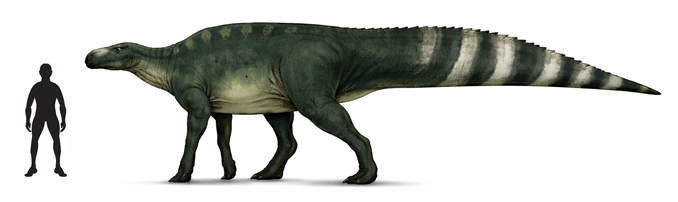
A life reconstruction of the newly described saurolophine hadrosaur Gongshuilong fanwei from China. This duck-billed dinosaur is estimated to have reached a body length of around 7 metres. Picture credit: Everything Dinosaur (AI assisted).
Picture credit: Everything Dinosaur (AI assisted)
Gongshuilong fanwei
A phylogenetic analysis indicates that Gongshuilong is a member of the Saurolophinae subfamily. Specifically, it has been classified as a member of the Brachylophosaurini. As such, it is only the second member of this tribe to have been discovered in Asia. Furthermore, Gongshuilong is the first scientifically described hadrosaurid genus from South China.
A phylogenetic analysis indicates that Gongshuilong is a member of the Saurolophinae subfamily. Specifically, it has been classified as a member of the Brachylophosaurini. As such, it is only the second member of this tribe to have been discovered in Asia. Furthermore, Gongshuilong is the first scientifically described hadrosaurid genus from South China. The genus name translates as “Gong River dragon”, a reference to the dig site being close to the Gong River.
The discovery of this new hadrosaur adds to the growing diversity of duck-billed dinosaurs known from the Late Cretaceous of Asia. Intriguingly, the authors of the study postulate that Gongshuilong increases the possibility of an Asian origin for the Saurolophinae and Brachylophosaurini.
The scientific paper: “A new saurolophine hadrosaurid (Dinosauria: Ornithopoda) from the Upper Cretaceous of South China, providing further support for the possible Asian origin of Brachylophosaurini” by Han Yao, Wenjiang Qiu, Juan Yu, Ling Yang, Huimin Wang, Shenghua Cao, Kui Zhao, Mengyuan Xu, Guo Shi, Fasheng Lou, Cuimin Zeng, Pikun Lu, Rui Wu, Xing Xu, Fenglu Han and Hai Xing published in the Journal of Systematic Palaeontology.
Visit the Everything Dinosaur website: Dinosaur Models.