

The Early Cretaceous ornithopod Lanzhousaurus magnidens described in 2005 (You, Ji and Li) has remarkable dentition. It had some of the largest plant-eating teeth known to science. However, unlike its relatives, it had relatively few teeth in its metre-long jaws. This unusual Chinese dinosaur puzzles palaeontologists. Why did L. magnidens evolve such enormous teeth?
Team members research and write fact sheets. These data sheets are sent out with sales of prehistoric animal figures. A Lanzhousaurus fact sheet had been prepared in time for the arrival of the new PNSO Lanqi the Lanzhousaurus model. Our fact sheet on Lanzhousaurus highlights the unusual dentition.
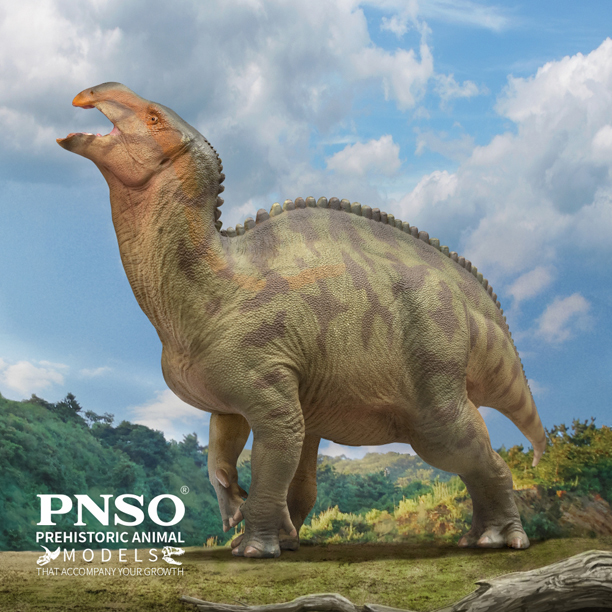
PNSO Lanqi the Lanzhousaurus (L. magnidens) dinosaur model which is new for 2026. This ornithopod was formally named and described in 2005.
The image (above) is that of the new PNSO Lanzhousaurus model. Everything Dinosaur team members have researched this ornithopod as they prepare to receive the models into stock.
To view the range of PNSO models available to Everything Dinosaur: PNSO Prehistoric Animal Models.
A Curious Ornithopod from Gansu Province
Lanzhousaurus fossils were unearthed in Gansu Province, north-western China. During the Early Cretaceous, ornithopod dinosaurs were diversifying rapidly. Unlike its near relatives, this herbivore followed a different evolutionary path. The fossilised teeth of Lanzhousaurus are robust and built to withstand heavy stresses. In addition, they are huge, with some examples over 10 cm long. Moreover, they had far fewer teeth compared to iguanodontids and advanced hadrosaurids. This suggests a different feeding strategy. Instead of grinding plant material with many small teeth, Lanzhousaurus magnidens likely relied on powerful biting.
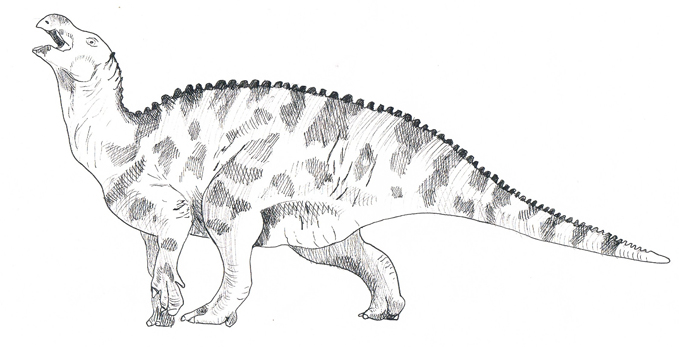
An illustration of Lanzhousaurus. It will be used in a free fact sheet that will be sent out with the new PNSO Lanzhousaurus dinosaur model. Picture credit: Everything Dinosaur.
Picture credit: Everything Dinosaur
Small numbers of large teeth in the jaw suggest that this plant-eating dinosaur may have processed food by crushing and slicing. Large teeth usually indicate strong bite forces.
This evolutionary approach offers several advantages. For instance, exceptionally large teeth:
- Resist wear under heavy loads.
- Handle tougher vegetation.
- Require less complex replacement systems.
Perhaps this dinosaur functioned like a heavy-duty plant processor. Our fact sheet discusses the strange dentition. The palaeoenvironment of Early Cretaceous China included fibrous plants. For example, there were numerous species of conifers and tough cycads. Consequently, Lanzhousaurus magnidens may have specialised in eating these harder food resources. Its teeth would have been ideal for stripping branches, crushing plant stems and breaking down fibrous plants.
In contrast, later hadrosaurids evolved dental batteries to finely grind plant material. These dental batteries were extremely efficient at processing vegetation.
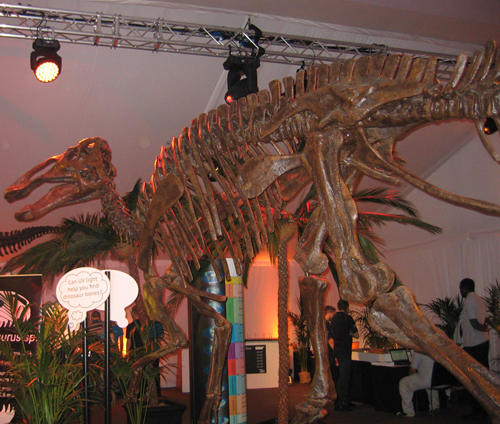
Duck-billed dinosaur on display. An Edmontosaurus a member of the Saurolophinae subfamily of the Hadrosauridae with its very efficient jaws and dental battery. Picture credit: Everything Dinosaur.
Picture credit: Everything Dinosaur
Why No Dental Battery?
Dental batteries evolved later in hadrosaurid dinosaurs. These systems required complex jaw mechanics and continuous tooth replacement. However, Lanzhousaurus magnidens represents an earlier stage in evolution. Its dentition had not yet developed into a full battery system. Instead, its jaw morphology demonstrates a different solution to herbivory. Evolution does not follow a single path. In this case, large teeth replaced the need for many smaller ones.
Furthermore, Lanzhousaurus may have occupied a unique ecological niche. By feeding on tougher plants, it avoided direct competition with other herbivores. A scientific concept known as niche-partitioning. This type of niche partitioning is common in dinosaur ecosystems. It allows multiple species to coexist in the same environment. Therefore, its unusual teeth may reflect both diet and competition.
Ultimately, Lanzhousaurus magnidens represents an evolutionary experiment. Ornithopods explored several feeding strategies before dental batteries became dominant.
Later hadrosaurids proved highly successful with their grinding teeth. However, Lanzhousaurus magnidens shows that alternative strategies also worked. Perhaps more fossils of ornithopods with bizarre, super-sized teeth will be found in the future.
Mike from Everything Dinosaur commented:
“We enjoyed researching Lanzhousaurus. Its unusual adaptations make it stand out amongst the Ornithopoda. Moreover, it gave us the opportunity to discuss the unusual dentition in our free fact sheet.”
Our multi-award-winning website: Dinosaur and Prehistoric Animal Figures.

Leave A Comment