

Rare Giant Echidna Fossil from Victoria Solves Ice Age Mystery
A remarkable fossil discovery has helped palaeontologists solve a long-standing mystery about Australia’s Pleistocene megafauna. An extinct giant echidna, Megalibgwilia owenii, has finally been confirmed as having roamed Victoria. As a result, scientists can now better understand the geographical distribution of this unusual monotreme.
For many years, the fossil record of echidnas in Australia has remained frustratingly limited. In particular, the absence of Megalibgwilia owenii from Victoria puzzled researchers. This species had already been found across a wide area, including Tasmania and parts of mainland Australia. However, the state of Victoria appeared to be a notable gap. Now, that gap has been filled. A bone from a skull, originally collected more than a century ago, has been identified as belonging to this giant echidna. Consequently, scientists have bridged a distribution gap of over six hundred miles (a thousand kilometres).
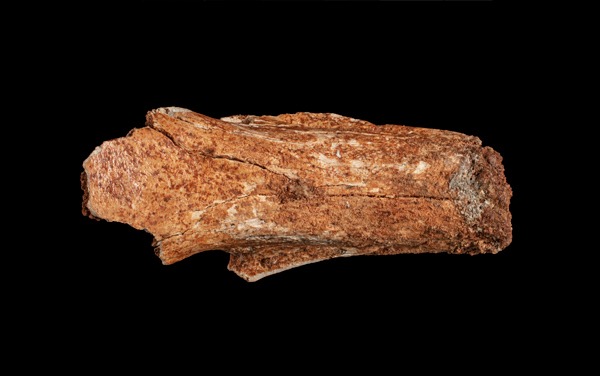
Anterior neurocranium and rostrum of Megalibgwilia owenii, Foul Air Cave, Buchan (NMV P256921) shown in dorsal view. The fossil specimen measures approximately 6.9 cm in length. Picture credit: Museums Victoria.
Picture credit: Museums Victoria
A Missing Piece in Australia’s Monotreme Fossil Record
The fragmentary fossil (specimen number NMV P256921) is a partial cranium including posterior rostrum of a large-bodied echidna. Detailed analysis identifies it as M. owenii. Surprisingly, this important fossil was not uncovered during a new expedition. Instead, it was sitting in a museum collection all along. The specimen was collected in 1907 during fieldwork at Foul Air Cave in Buchan, eastern Victoria. At the time, early explorers such as naturalist Frank Spry ventured into the cave using little more than ropes and kerosene lamps. They recovered numerous fossil bones and placed them into what is now the Museums Victoria collection.
Over a century later, researchers re-examined these fossils. In doing so, they recognised the distinctive features of a giant echidna skull. Modern techniques, including detailed measurements and 3D scanning, confirmed the identification.
Foul Air Cave is not an easy place to explore. In fact, its name reflects the harsh conditions inside. Deep within the cave, bacteria consume oxygen and release gases, creating a strong and unpleasant smell. The bacteria cause a stench, hence the name of this cave. The cave also acts as a natural trap. Animals that fell inside had little chance of escape. Over tens of thousands of years during the Pleistocene Epoch, their remains accumulated in the darkness. Ironically, these limestone caves still trap unwary animals today.
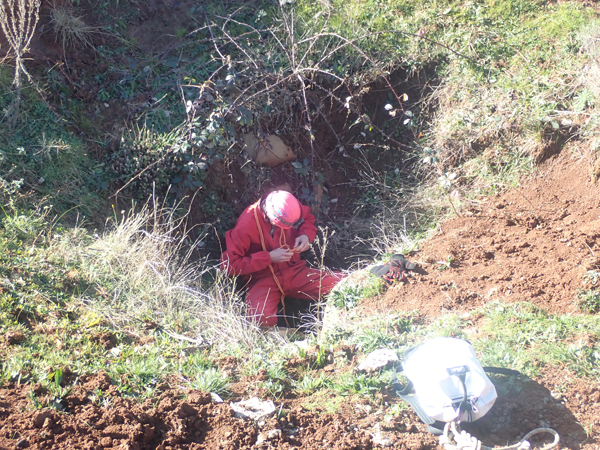
Preparing to descend into Foul Air Cave (Buchan, Victoria). Picture credit: Rob French/Museums Victoria.
Picture credit: Rob French/Museums Victoria
The cave preserves a rich fossil record. Scientists have found evidence of Australia’s megafauna, including giant marsupials and extinct predators such as the marsupial lion (Thylacoleo carnifex). Specimen number NMV P256921 confirms the presence of Megalibgwilia owenii in eastern Gippsland (Victoria). As such, it is the first fossil of this echidna species to have been found in Victoria.
The Remarkable Megalibgwilia owenii
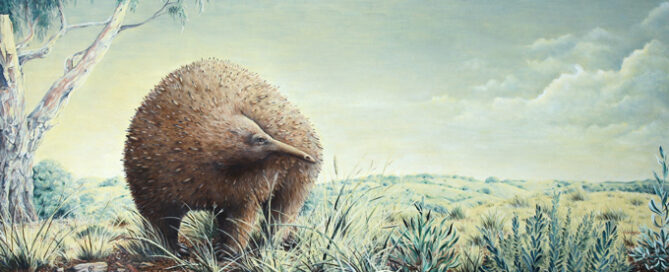
This echidna was much larger than extant echidnas. It could grow up to a metre in length and weigh around fifteen kilograms. It was roughly the size of a four-year-old child. The straight, robust snout and evidence of powerful forearms from studies of other fossilised bones suggest that this extinct monotreme had a different ecological niche in the Ice Age ecosystem of Australia compared to its modern-day counterparts. The robust, straight rostrum indicates a powerful beak and in combination with the strong forelimbs this animal dug through hard soils to feed on invertebrates. Extant echidnas have more specialised feeding habits, mostly consuming ants and termites.
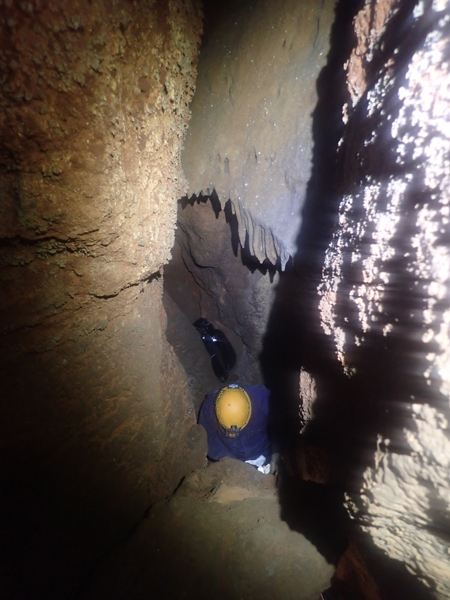
The descent into Foul Air Cave, Buchan (Victoria). Picture credit: Rob French/Museums Victoria.
Picture credit: Rob French/Museums Victoria
This study is important for several reasons. Firstly, it confirms that giant echidnas lived in Victoria during the Pleistocene Epoch. Secondly, it connects previously isolated fossil records across southern Australia. Moreover, the discovery highlights the importance of museum collections. Fossils collected long ago can still provide new insights when analysed using modern technology. Finally, it shows that there is still much to learn about Australia’s megafauna. Further research and fossil discoveries may reveal even more about the diversity of ancient monotremes. Perhaps even the presence of an as yet, undescribed species.
The Value of Museum Collections
The story of this giant echidna highlights that important discoveries do not always come from new fieldwork. Sometimes, fossil discoveries occur when re-examining specimens that have been part of a museum collection for decades. Museum collections provide a crucial link between past and present. Thanks to careful curation and continued research, they can unlock secrets hidden for generations.
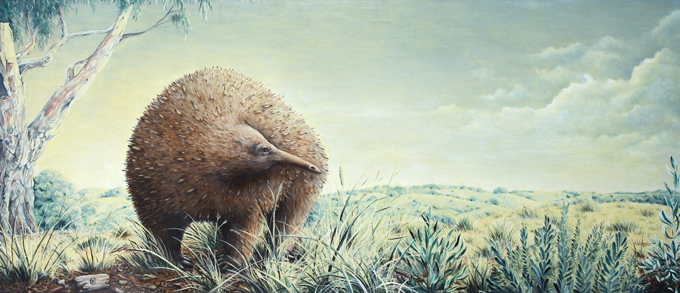
Megalibgwilia owenii life reconstruction. Picture credit: Chris Edser.
Picture credit: Chris Edser
As scientists continue to explore both caves and collections, more surprises are likely waiting to be found.
Everything Dinosaur acknowledges the assistance of a media release from Museums Victoria along with direct correspondence with one of the paper’s authors in the compilation of this article.
The scientific paper: “The first Victorian record of Owen’s Giant Echidna Megalibgwilia owenii from Buchan Caves in East Gippsland, Australia” by Tim Ziegler and Jeremy Lockett published in Alcheringa: an Australasian Journal of Palaeontology.
For models of prehistoric animals: Prehistoric Animal Replicas.