

New Study Indicates Promiscuity and Parental Behaviour in Birds Driven by Demographics – Did Similar Processes Shape the Behaviour of Dinosaurs?
A recent study published in “Nature Communications” is challenging how scientists interpret animal behaviour. Furthermore, as the study focused on birds, it may have implications for the Dinosauria. The research shows that population demographics drive mating systems and parental care in birds. Behaviour does not create population imbalance. Instead, population imbalance shapes behaviour.
The study’s conclusions could have wide implications. Birds are archosaurs. They are members of the Dinosauria. Therefore, their biology offers valuable clues about their extinct relatives such as Triceratops and Tyrannosaurus rex.
Population Demographics
An international team including Tamás Székely (Milner Centre for Evolution at the University of Bath), examined 261 bird species. They analysed adult sex ratios, mating systems, and parental care. A clear pattern emerged. Sex ratios are shaped by survival differences, not behaviour. Males and females hatch in similar numbers. However, they do not survive equally. Some mature more slowly. Others face higher mortality risks. As a result, adult populations become skewed. This imbalance then drives behaviour. The rarer sex tends to mate with multiple partners. Meanwhile, the more common sex competes more intensely.
If such factors were at work in the Dinosauria, it might explain the evolution of ornate frills in the Ceratopsia for example.

Close-up view of the asymmetrical frill of the CollectA Deluxe Lokiceratops model. A study suggests that population demographics drive mating systems and parental care in birds. Could the same evolutionary dynamics have played out in the Dinosauria?
Behavioural Consequences
These demographic shifts have striking effects. For instance, parental care in birds often becomes uneven. One parent may invest heavily in raising offspring. The other may seek additional mates.
Moreover, sexual selection intensifies. The more common sex evolves exaggerated traits. These include bright colours, large size, or elaborate displays. For example, the ornate, colourful but cumbersome tail of male peacocks.
Another example is the Great Bustard (Otis tarda). Males mature slowly, which reduces their numbers in the breeding population. Consequently, the species shows a strong female bias. This imbalance drives extreme behaviour. Males grow much larger than females and compete for mates. Females, in contrast, handle all nesting and chick care.
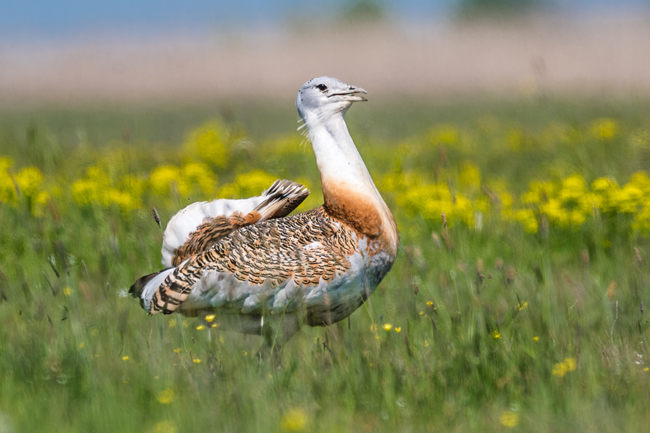
The Great Bustard (Otis tarda) which is found in north Africa and southern Europe. Polygamous birds such as the Great Bustard typically have more females than males in their population. Picture credit: Oliver Kruger.
Picture credit: Oliver Kruger
A Dinosaur Perspective
This research raises important questions. For instance, did similar processes shape the behaviour of extinct, non-avian dinosaurs? Direct evidence is rare. However, palaeontologists can look for indirect signals. These include growth patterns, display structures, and nesting behaviour. For example, some dinosaurs show delayed maturation. Bone studies of some theropods suggest individuals grew at different rates. If one sex matured later, it could reduce its breeding presence. This would create a skewed adult sex ratio, similar to modern birds.
Signals of Sexual Selection
Many dinosaurs evolved striking physical features. These may reflect competition driven by demographic imbalance. Lambeosaurines evolved elaborate crests. Hadrosaurs once thought to lack crests such as Edmontosaurus are now known to have sported soft crests, similar to the combs seen on some birds.

A close-up view of the new Edmontosaurus dinosaur model with its soft comb-like crest.
Read more: Duck-billed Dinosaur with a Comb like a Rooster.
Likewise, horns in ceratopsians may have played a role in mate competition. If one sex outnumbered the other, competition would intensify. Over time, this pressure could produce exaggerated ornaments, just as seen in birds.
Clues from Parental Care in Birds and Fossilised Nests
Research examining parental care in birds can offer further insight. In addition, the fossils of non-avian dinosaurs could yield intriguing evidence. Nests of oviraptorosaurs and other theropods have been extensively studied. Their nesting behaviour closely resembles that of many modern birds. Some studies suggest that brooding individuals may have been males. If correct, this indicates shared or male-dominated parental care. Such patterns of behaviour could arise from skewed sex ratios in the population.
To read a related article examining research into theropod dinosaur nesting behaviour: Oviraptorosaurian Incubation and Nesting Behaviour.
Is it Time to Interpret the Fossil Record Differently?
Importantly, fossil evidence for sex ratios in the non-avian dinosaurs remains limited. Males and females are often difficult to distinguish. Soft tissues rarely fossilise. As a result, direct demographic data are scarce. However, this new study provides a fresh framework. It suggests that survival differences shape population structure first. Behaviour then evolves in response.
This perspective changes how we interpret dinosaur biology. Features such as crests, horns, and size differences may not just signal display. They may also reflect deeper demographic patterns.
In short, the study highlights a powerful idea. Numbers matter. If one sex consistently dies younger or matures later, it reshapes behaviour across generations.
Birds offer a living window into dinosaur evolution. By studying them, scientists can better understand the lives of long-extinct species.
Everything Dinosaur acknowledges the assistance of a media release from the University of Bath in the compilation of this article.
The scientific paper: “Demographic causes and social consequences of adult sex ratio variation” by Zitan Song, András Liker, Yang Liu, Robert P. Freckleton and Tamás Székely published in Nature Communications.
The award-winning Everything Dinosaur website: Scientifically Accurate Prehistoric Animal Models.