

New Research Challenges Perceptions About Cretaceous Marine Ecosystems
An international team of researchers have uncovered evidence that ancient octopuses were once giant, apex predators. A study involving scientists from Japan and Germany suggests these early cephalopods were at the top of the food chain during the Cretaceous. A Cretaceous giant octopus preying on mosasaurs, plesiosaurs and other vertebrates is a frightening prospect.
The study was published in the journal “Science” earlier this month. The largest living octopus is the Giant Pacific Octopus (Enteroctopus dofleini). Its arm span can exceed six metres. However, the octopods revealed in this new research could have reached lengths exceeding nineteen metres (based on mantle size). Octopi are regarded as highly intelligent and capable hunters. Subsequently, much larger animals would have been formidable predators and probably competed with marine vertebrates.
Wear on Fossilised Jaws
Octopi and their close relatives have soft bodies. As a result, they rarely fossilise and the fossil record of octopi is extremely sparse. This makes their evolutionary history difficult to study. For example, we recently published an article that re-examined a famous specimen from the Mazon Creek Lagerstätte. For years, scientists believed this fossil represented an early octopus named Pohlsepia mazonensis. However, newly published research revealed evidence of jaws. Consequently, the fossil most probably represents a decaying nautiloid.
To read more about this research: Oldest Octopus Fossil is Not an Octopus Fossil.
Ironically, it is analysis of super-sized fossilised jaws that has led the researchers to conclude that giant octopi were apex predators in Cretaceous marine environments. These feeding structures preserve far more readily than soft tissues. These jaws, sometimes referred to as beaks, are made of chitin. It has a greater fossilisation potential than soft tissue.
Using high-resolution grinding tomography and an artificial intelligence model, the team found fossil jaws hidden inside rock samples from Cretaceous deposits spanning 100 to 72 million years ago. These fossils, found in Japan and Vancouver Island, had been well preserved in calm seafloor sediments, retaining fine wear marks that reveal how these animals fed.
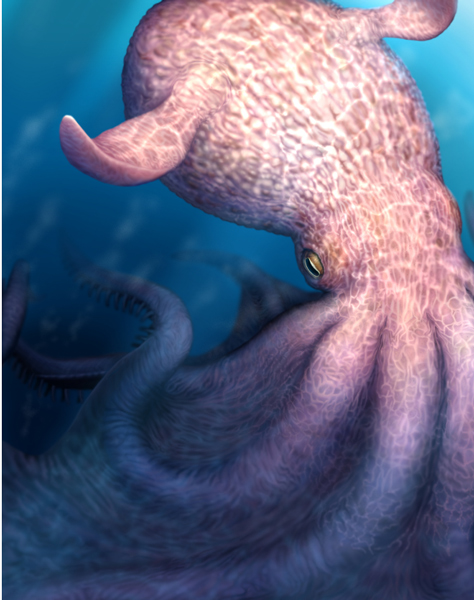
A life reconstruction of the Cretaceous giant octopus. Picture credit: Yohei Utsuki, Department of Earth and Planetary Sciences, Hokkaido University.
Picture credit: Yohei Utsuki, Department of Earth and Planetary Sciences, Hokkaido University
Giant Cephalopod Predators of Cretaceous Marine Environments
The fossil jaws have been assigned to two species, following a revision of known Cretaceous specimens. The two species are:
-
- Nanaimoteuthis jeletzkyi
- Nanaimoteuthis haggarti
The remains have been placed in an extinct group of finned octopi known as Cirrata. By analysing jaw size, shape and wear the team reconstructed their feeding habits. Furthermore, the wear patterns revealed powerful biting forces. The researchers concluded that these animals actively hunted and crushed hard prey. Therefore, they were not passive feeders. Instead, they were powerful predators in the North Pacific Ocean during the age of dinosaurs.
Co-author of the study, Professor Yasuhiro Iba (Hokkaido University) commented:
“Our findings suggest that the earliest octopuses were gigantic predators that occupied the top of the marine food chain in the Cretaceous. Based on exceptionally well-preserved fossil jaws, we show that these animals reached total lengths of up to nearly twenty metres, which may have surpassed the size of large marine reptiles of the same age.”
Evidence of Feeding on Hard Body Parts (Shells and Skeletons)
Careful analysis of the jaws revealed extensive wear. For example, the team identified scratches, chips and cracking. These features indicate repeated, forceful biting. Furthermore, the tips of the beaks were extensively damaged. Up to ten percent of the jaw tip had been worn away. The researchers concluded that this damage was not caused by transport induced abrasion. For example, the remains of the jaws being rolled by water currents along the seabed. The level of damage exceeds that seen in modern cephalopod beaks. As a result, the team inferred an aggressive feeding strategy. Moreover, it suggests these cephalopods regularly tackled hard-bodied prey.
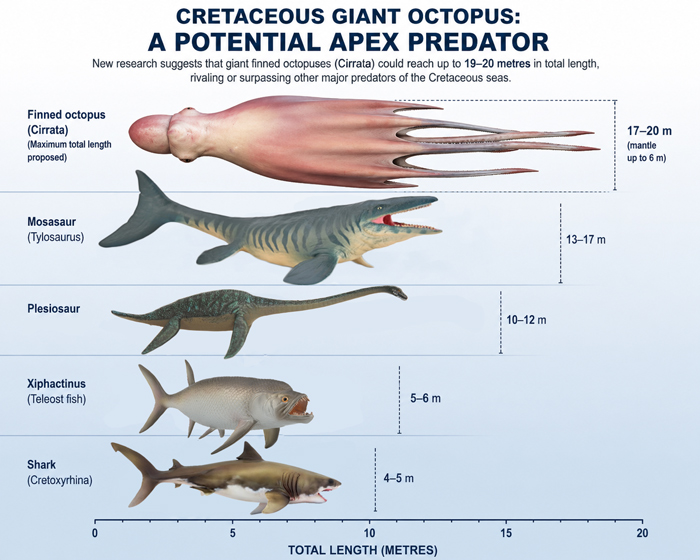
The scientists suggest that cephalopods may have been apex predators in the North Pacific Ocean during the Cretaceous. Picture credit: Everything Dinosaur (AI assisted).
Picture credit: Everything Dinosaur (AI assisted)
The picture (above) shows a hypothesised relationship between predatory vertebrates and the giant Cretaceous octopus. The mosasaur, plesiosaur and the Xiphactinus figure are from the CollectA range of figures. Whereas the Cretoxyrhina illustration is based on the PNSO model.
To view the CollectA Prehistoric Life Age of Dinosaurs range: CollectA Prehistoric Life Models.
To view the CollectA Deluxe prehistoric animal models: CollectA Deluxe Prehistoric Animal Figures.
PNSO prehistoric animal figures: PNSO Age of Dinosaurs.
An Intelligent Giant Cretaceous Octopus
Intriguingly, the fossils reveal uneven wear on the jaws. One side shows more damage than the other side. This suggests that these octopi might have favoured one side of the jaw when feeding. Asymmetric wear patterns indicate lateralised behaviour, the animal clearly favouring one side of the jaw over the other. Subsequently, the researchers conclude that these octopi were intelligent. In extant animals, lateralised behaviour is linked to advanced brain function. Therefore, a giant Cretaceous octopus may have displayed complex behaviours. Perhaps, they were smart enough to catch a plesiosaur.
The Kraken
The mythical Kraken was feared by sailors for centuries. Whilst some extant cephalopods such as the colossal squid (Mesonychoteuthis hamiltoni) can reach lengths of more than ten metres, these Cretaceous giants might have been twice as long. As a result, during the Cretaceous some invertebrates may have occupied apex predator roles. This new study proposes that giant octopi may have competed directly with large vertebrate predators. It makes them a rare example of an invertebrate successfully competing with large vertebrate predators. Furthermore, it provides a tantalising insight into Cretaceous marine environments.
Everything Dinosaur acknowledges the assistance of a media release from Hokkaido University in the compilation of this article.
The scientific paper: “Earliest octopuses were giant top predators in Cretaceous oceans” by Shin Ikegami, Jörg Mutterlose, Kanta Sugiura, Yusuke Takeda, Mehmet Oguz Derin, Aya Kubota, Kazuki Tainaka, Takahiro Harada, Harufumi Nishida, and Yasuhiro Iba published in the journal Science.