

A remarkable specimen once thought to be the oldest octopus fossil known to science has been reclassified. As a result, scientists have rewritten cephalopod evolutionary history. The specimen, named Pohlsepia mazonensis, comes from the famous Mazon Creek Lagerstätte. The strata dates to 311–306 million years ago approximately (Carboniferous). For years, scientists believed this fossil represented an early octopus. It pushed back the fossil record of these cephalopods by 150 million years. However, newly published research confirms that the fossil material represents a decaying nautiloid.
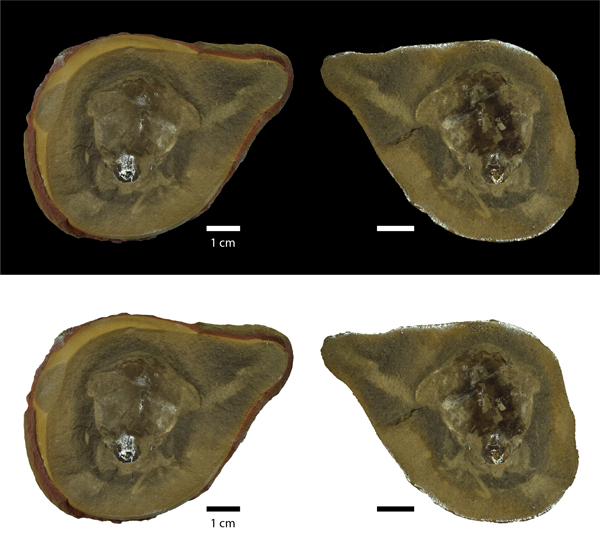
The fossils of Pohlsepia mazonensis. Pohlsepia mazonensis (left) PE51727a (part) and (right) Pohlsepia mazonensis PE51727b (counterpart). Picture credit: Clements et al/University of Reading.
Picture credit: Clements et al/University of Reading
A Fossil That Changed an Evolutionary Timeline
Previously, Pohlsepia played a crucial role in evolutionary studies. It served as a calibration point for molecular clocks. These studies suggested that octopuses evolved much earlier than expected. In fact, they pushed the origin of octobrachians back by around 150 million years. Prior to the finding of the Mazon Creek specimen PE51727a and PE51727b (part and counterpart), the earliest confirmed octopus fossils came from the Jurassic. Therefore, the fossil became a textbook example of what scientists call a “phylogenetic fuse”. This term describes a gap between predicted evolutionary origins and fossil evidence.
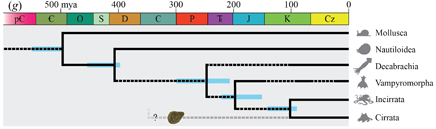
A schematic of a molecularly calibrated time-tree of cephalopod evolution with solid lines indicating known fossil occurrences. Blue squares indicate molecular divergence data based on Kröger et al, Tanner et al and López-Córdova et al. The putative position of Pohlsepia as a cirrate is marked, demonstrating the conflict of a highly derived crown-group octopus existing 150 million years before the transitional octopus fossils of the Mesozoic. Picture credit: Clements et al/University of Reading.
Picture credit: Clements et al/University of Reading
New Technology Reveals Hidden Details
Researchers led by Dr Thomas Clements (University of Reading), re-examined this enigmatic invertebrate fossil. They used advanced imaging techniques to uncover new evidence. In particular, the team applied synchrotron micro-X-ray fluorescence scanning. This powerful method detects chemical signatures within fossils.
As a result, the team identified a hidden structure inside the specimen. They discovered a radula, a tooth-bearing organ found in molluscs.
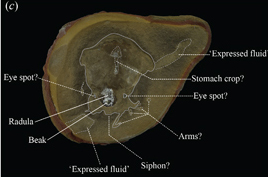
The soft tissue anatomy of Pohlsepia mazonensis. The putative anatomy of Pohlsepia mazonensis (PE51727a). Dotted lines represent unresolved anatomical characters, and solid lines represent unambiguous anatomical characters identified in this study. Picture credit: Clements et al/University of Reading.
Picture credit: Clements et al/University of Reading
Evidence Points to a Nautiloid
The radula proved to be the key to solving the mystery. Its tooth count and structure did not match an octopus. Instead, the features aligned with those of a nautiloid. Nautiloids are an ancient group of cephalopods, related to modern nautiluses. Therefore, scientists concluded that Pohlsepia is not an early octopus. Rather, it represents a decomposed nautiloid with preserved soft tissues. Furthermore, the Guinness Book of Records is going to have to be amended. The specimen had been logged as the oldest fossil example of an octopus known to science.
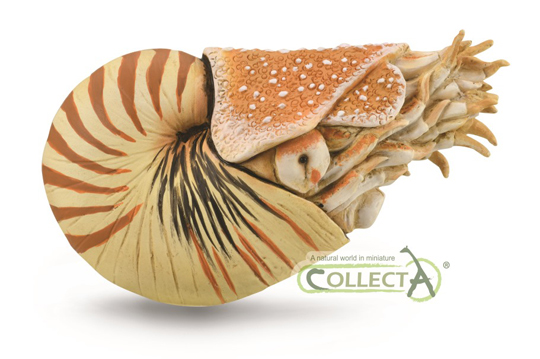
A model of a typical nautiloid. CollectA Nautilus pompilius sometimes referred to as the “Emperor nautilus” because of its large size.
The poor preservation of the specimen’s key anatomical soft tissue characters, such as the tentacles and the paired eyespots indicate that the animal was in an advanced state of decay before the fossilisation process began. Determining how long PE51727 decayed for is difficult, especially as there are limited studies investigating the decay and disarticulation of soft tissues in extant Nautilus for direct comparison. However, based on the observation of beak/radula disarticulation during the decay of coleoid cephalopods, and assuming no scavengers caused the carcass to disarticulate, it could occur somewhere between a few days and two weeks.
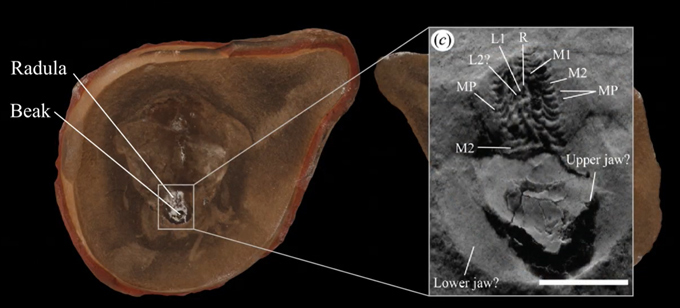
Magnified section of the fossil indicating the presence of mouth parts and a radula. Picture credit: Clements et al/University of Reading.
Picture credit: Clements et al/University of Reading
De-bunked Oldest Octopus Fossil Leads to a Rewriting of Cephalopod Evolution
This reinterpretation of the fossil material has significant implications. Firstly, it removes key evidence for a Palaeozoic origin of octopuses. As a result, the evolutionary timeline for octobrachians must be reconsidered. The fossil record now aligns more closely with other evidence. Moreover, this discovery highlights how scientific understanding evolves over time. New tools can overturn long-held assumptions.
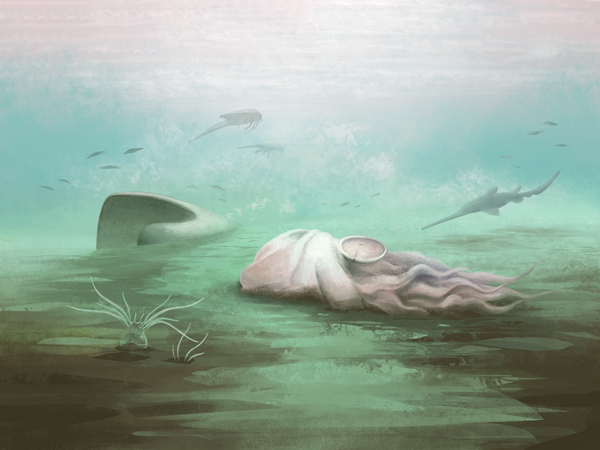
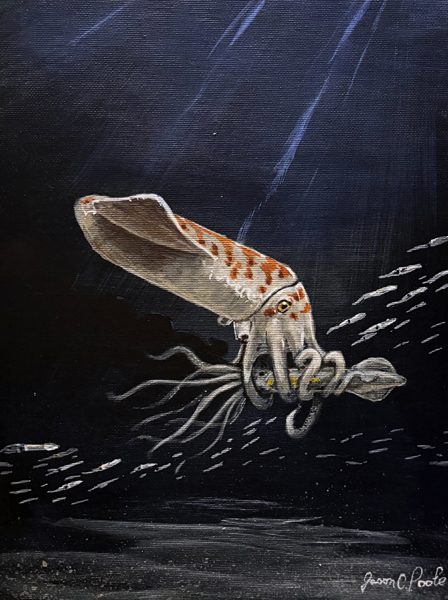
An artist’s impression of the decaying nautiloid. The shell can be seen in the background whilst a pair of horseshoe crabs swim by. The elasmobranch Bandringa rayi can be seen (right). Picture credit: Clements et al/University of Reading.
Picture credit: Clements et al/University of Reading
A Rare Glimpse into Invertebrate Soft Tissue Preservation
Importantly, the study provides something equally valuable. It offers the clearest evidence of nautiloid soft tissues from the Palaeozoic. Soft tissues rarely fossilise. Therefore, specimens like this are exceptionally important. The Mazon Creek Lagerstätte is famous for such preservation. Even so, interpreting these fossils can be challenging. This study, published in “The Royal Society Proceedings B (Biology)”, demonstrates the potential of advanced imaging methods. Scientists can now detect structures hidden within rock matrices. Consequently, previously misunderstood fossils can be re-examined. This may lead to further discoveries and revisions of the fossil record.
In addition, the study opens the door to re-evaluating other Mazon Creek fossils. Many specimens may hold secrets yet to be uncovered. Perhaps, these advanced techniques might provide new insights into Mazon Creek’s most famous resident Tullimonstrum gregarium otherwise known as the “Tully Monster”.
To read a blog post about the extraordinary Tullimonstrum: “Tully Monster” Loses its Backbone.
Not the Oldest Octopus Fossil
Whilst not the oldest octopus remains known to science, PE51727a and its counterpart PE51727b reveals an equally fascinating aspect of palaeontology. These two concretions demonstrate the complexity of interpretating ancient remains. Furthermore, they show how technology continues to refine our understanding of ancient life.
This scientific paper and its associated media release are reminders. Even well-known fossils can still surprise us.
Everything Dinosaur acknowledges the assistance of a media release published on the University of Reading’s website in the compilation of this article.
The scientific paper: “Synchrotron data reveal nautiloid characters in Pohlsepia mazonensis, refuting a Palaeozoic origin for octobrachians” by Thomas Clements, Imran Alexander Rahman, Alan R.T. Spencer, Christian Klug, Dirk Fuchs, Isabelle Rouget, Isabella Kruta, Sebastian Schöder, Jack Wittry, Orla G. Bath Enright and Pierre Gueriau published in The Royal Society Proceedings B.
The Everything Dinosaur website: Museum Quality Prehistoric Animal Figures.

Leave A Comment