

A remarkable new, open access study published in the journal “Vertebrate Zoology” is transforming what we know about stegosaurian skulls and stegosaur evolution. Researchers describe the most complete stegosaurian skull ever found in Europe. The skull fossil material (MAP-9029) along with an associated mid cervical vertebra (MAP-9030) are confidently assigned to the stegosaur taxon Dacentrurus armatus. This discovery provides rare insight into the anatomy and evolution of these iconic armoured dinosaurs. The Dacentrurus armatus skull fossil provides valuable information concerning skull evolution in stegosaurs.
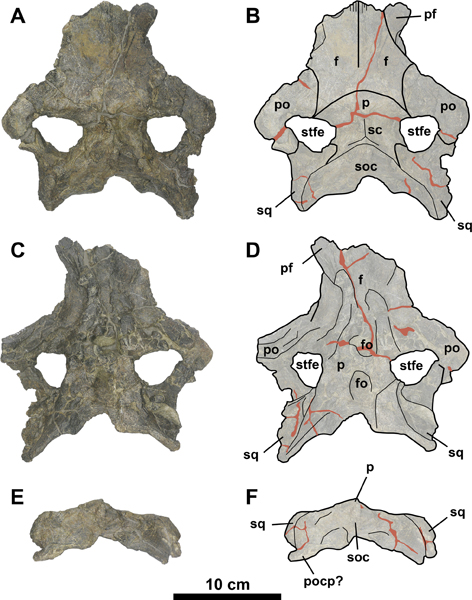
Skull fossil (MAP-9029) of Dacentrurus armatus Owen, 1875 from the Están de Colón (RD-34) fossil site (Riodeva, Teruel, Spain). Photographs (A, C, E) and interpretative drawings (B, D, F) of MAP-9029 in dorsal (A, B), ventral (C, D), and proximal (E, F) views. Picture credit: Sergio Sánchez-Fenollosa and Alberto Cobos.
Picture credit: Sergio Sánchez-Fenollosa and Alberto Cobos
Stegosaur Cranial Material is Exceptionally Rare
Stegosaur skull fossils are exceptionally rare. Most specimens are fragmentary or badly crushed. Only three stegosaur taxa have a considerable proportion of their skull known.
These taxa are:
- Stegosaurus stenops – from the Late Jurassic of the western United States and Portugal.
- Hesperosaurus mjosi – from the Late Cretaceous of the western United States (Wyoming and Montana).
- Huayangosaurus taibaii – from the Middle Jurassic of south-western China.
A fossiliferous site was discovered in the municipality of Riodeva (Teruel Province, Aragón, north-eastern Spain) in 2004. The site known as RD-34 consists of deposits from the Villar del Arzobispo Formation. The strata are believed to date from around 150 to 145 million years ago (upper Kimmeridgian to Tithonian faunal stages). Numerous dinosaur fossils have been excavated, including fossils that represent two stegosaurs.
Importantly, dinosaur skulls are rarely preserved. However, MAP-9029 includes key elements such as the snout, upper jaw and braincase. As a result, palaeontologists can now study Dacentrurus cranial anatomy in far greater detail than before. This helps scientists reconstruct feeding behaviour and sensory capabilities in stegosaurs.
Understanding Dacentrurus
Dacentrurus is thought to be one of the largest European stegosaurs. Size estimates vary due to the fragmentary nature of the fossil material, but it could have reached a length in excess of nine metres. The first fossils of this armoured dinosaur were unearthed in a clay pit in Wiltshire in 1874. The jumbled block of postcranial material is on display at the London Natural History Museum. Dacentrurus material has been reported elsewhere in the UK and mainland Europe. It was one of the earliest stegosaurs to be discovered. Like other stegosaurs, it had rows of plates and spikes running along its body.
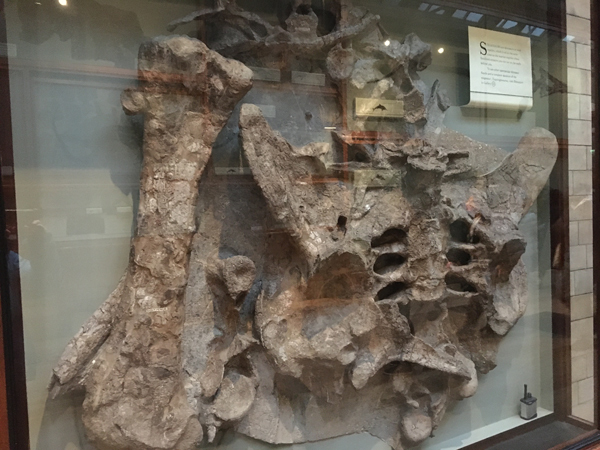
The Dacentrurus armatus specimen on display at the Natural History Museum (London). It is specimen number NHMUK PV OR46013. Picture credit: Everything Dinosaur.
Picture credit: Everything Dinosaur
However, until now, its skull remained poorly understood. Most known material consisted of postcranial remains such as vertebrae and armour. Therefore, this new cranial material fills a major gap in our knowledge.
New Insights into Stegosaur Skull Evolution
The cranial material consists of the back part of the skull roof, including a fragment of the right prefrontal, both frontals, both postorbitals, both squamosals, the parietal, the supraoccipital, and a possible fragment of the left paroccipital process
The study of the Dacentrurus armatus skull reveals several previously unknown characteristics of the Dacentrurus cranium. In addition, the scientists identified a new diagnostic trait (an autapomorphy). The new autapomorphy relates to the angle of the supraoccipital bone in relation to the roof of the skull. Moreover, the team conducted a new phylogenetic analysis. This resulted in a revised evolutionary tree for stegosaurs. Notably, the researchers proposed a new clade called Neostegosauria consisting of the Stegosaurinae and the Dacentrurinae subfamilies.
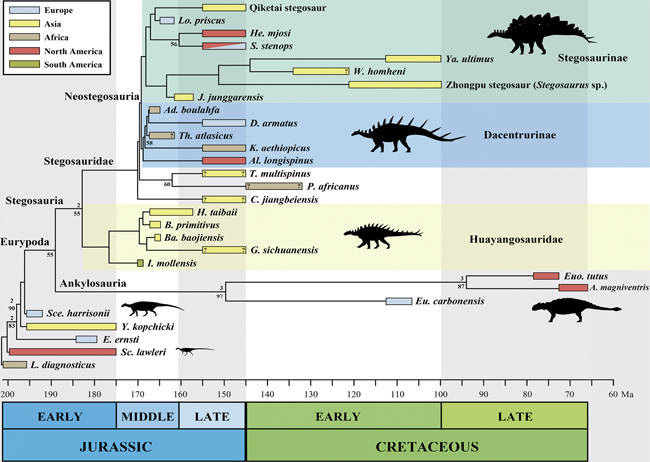
Timeline showing armoured dinosaur taxa and geographic distribution during the Jurassic and Cretaceous. Picture credit: Sergio Sánchez-Fenollosa and Alberto Cobos.
Picture credit: Sergio Sánchez-Fenollosa and Alberto Cobos
The Neostegosauria includes medium to large stegosaurs from Europe, Africa, North America and Asia. Consequently, it highlights how widespread and diverse these dinosaurs were during the Jurassic and Early Cretaceous.
Dacentrurus armatus Skull Refines the Stegosauria
The new analysis also refines relationships within Stegosauria. Traditionally, stegosaurs were divided into major groups such as Huayangosauridae and Stegosauridae. However, this study suggests a more complex evolutionary pattern. It integrates new data from cranial anatomy, which was previously lacking. As a result, scientists can now test evolutionary hypotheses with greater confidence.
This is particularly important because skull features often provide critical phylogenetic signals. Therefore, this discovery has implications far beyond a single genus.
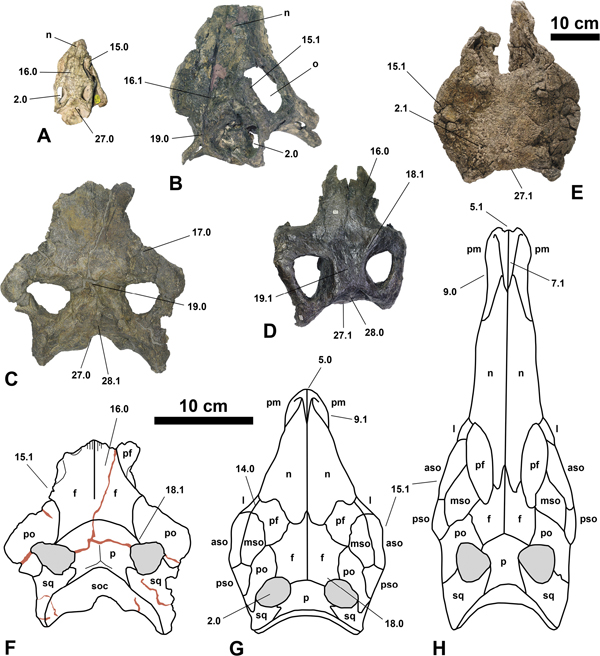
Skulls of ornithischian dinosaurs (A–E) and interpretative drawings in dorsal view (F–H). A, Lesothosaurus diagnosticus Galton, 1978 (NHMUK PV RU B23). B Scelidosaurus harrisonii Owen, 1861 (NHMUK PV R1111). C, F Dacentrurus armatus Owen, 1875 (MAP-9029). D Stegosaurus stenops Marsh, 1887 (NHMUK PV R36730). E Europelta carbonensis Kirkland et al., 2013 (AR-1-544/10). G Huayangosaurus taibaii Dong, Tang & Zhou, 1982 (modified from Sereno and Dong 1992). H S. stenops. The differently shaped skulls could suggest different feeding behaviours. Picture credit: Sergio Sánchez-Fenollosa and Alberto Cobos.
Picture credit: Sergio Sánchez-Fenollosa and Alberto Cobos
The study demonstrates the importance of skull material as an aid to phylogenetic analysis. Well-preserved skull fossils can significantly improve knowledge about dinosaur evolution. Furthermore, this research highlights how new fossil material can reshape long-standing ideas.
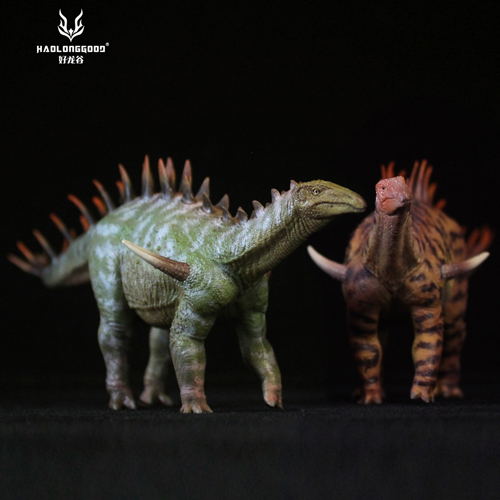
Haolonggood introduced two detailed Dacentrurus models in 2024.
The picture (above) shows two Dacentrurus models from Haolonggood. These figures were introduced in 2024. The models have been praised for their scientific accuracy.
To view the range of Haolonggood prehistoric animal figures in stock: Haolonggood Dinosaur Models.
Even relatively well-known dinosaurs like Dacentrurus can still surprise us. Moreover, the discovery strengthens Europe’s role in stegosaur research. The Iberian Peninsula continues to yield fossils that are crucial for understanding Jurassic ecosystems. As new fossils come to light, our picture of these remarkable armoured dinosaurs will only continue to evolve.
Everything Dinosaur acknowledges the assistance of one of the study’s authors in the compilation of this article.
The scientific paper: “New insights into the phylogeny and skull evolution of stegosaurian dinosaurs: An extraordinary cranium from the European Late Jurassic (Dinosauria: Stegosauria)” by Sergio Sánchez-Fenollosa and Alberto Cobos published in Vertebrate Zoology.

Leave A Comment