

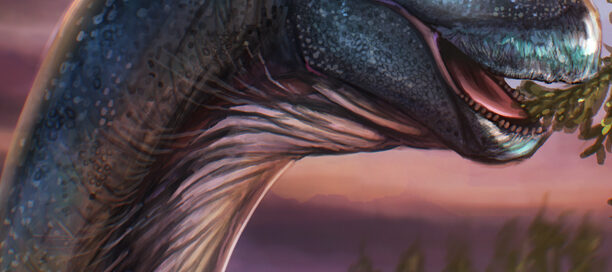
A New Dinosaur Discovery – The Last Titan from Thailand
Researchers have announced the discovery of a new species of sauropod dinosaur. It is the largest described to date from Southeast Asia. Furthermore, the newly described sauropod named Nagatitan chaiyaphumensis might be one of the geologically youngest of all the sauropods known from Southeast Asia.
The fossil material was discovered in north-eastern Thailand around ten years ago. Researchers analysed vertebrae, ribs, pelvic bones and limb elements. One upper arm bone (humerus) measured an astonishing 1.78 metres long.

Thitiwoot Sethapanichsakul with an upper arm bone (humerus). Picture credit: Thitiwoot (Perth) Sethapanichsakul.
Picture credit: Thitiwoot (Perth) Sethapanichsakul.
The Largest Dinosaur Known from Southeast Asia
Scientists estimate that Nagatitan chaiyaphumensis measured around twenty-seven metres in length. In addition, it probably weighed between twenty-five and twenty-eight tonnes. That is roughly equivalent to nine adult Asian elephants. The dinosaur lived during the Early Cretaceous. The fossils come from the Khok Kruat Formation, Thailand’s youngest dinosaur-bearing rock unit.
Lead author Thitiwoot (Perth) Sethapanichsakul, a Thai PhD student at UCL Earth Sciences commented:
“We refer to Nagatitan as ‘the last titan’ of Thailand. That is because it was discovered in Thailand’s youngest dinosaur-bearing rock formation. Younger rocks laid down towards the end of the time of the dinosaurs are unlikely to contain dinosaur remains because the region by then had become a shallow sea. So, this may be the last or most recent large sauropod we will find in Southeast Asia.”

Sethapanichsakul and Dr Manitkoon digging at the pond where the specimens were discovered. Picture credit: Big Bear Team.
Picture credit: Big Bear Team
A New Somphospondylan Sauropod
The scientific paper identifies Nagatitan chaiyaphumensis as a somphospondylan titanosauriform. These huge, long-necked herbivores became widespread during the Cretaceous. Furthermore, phylogenetic analysis places the dinosaur within the Euhelopodidae. This clade of sauropods is currently known only from Asia. Importantly, the researchers found that Nagatitan differed from other Asian sauropods. Distinctive anatomical traits in the vertebrae, pelvis and limb bones helped diagnose the new taxon.

Skeletal reconstruction of Nagatitan chaiyaphumensis. Known fossil bones shown in yellow. Picture credit: Thitiwoot Sethapanichsakul et al.
Picture credit: Thitiwoot Sethapanichsakul et al.
The Naming of Nagatitan chaiyaphumensis
The generic name combines “Naga” and “Titan”. In Southeast Asian folklore, a naga is a mythical serpent associated with water. Meanwhile, “Titan” references the giants of Greek mythology. The species name honours Chaiyaphum Province, where the fossils were unearthed. As a result, the full name translates roughly as the “giant naga from Chaiyaphum”.

Dr Manitkoon prepping fossil specimens with an air scribe. Picture credit: Big Bear Team
Picture credit: Big Bear Team
A Hot and Dry Cretaceous Environment
During the Early Cretaceous, the region experienced arid to semi-arid conditions. Sauropods appear to have thrived in these environments. Their enormous bodies and elongated necks may have helped regulate body temperature efficiently. The fossil site also preserves evidence of rivers and freshwater habitats. Therefore, Nagatitan chaiyaphumensis probably shared its environment with fish, crocodilians and freshwater sharks. In addition, large theropod dinosaurs also inhabited this ecosystem. These included carcharodontosaurians such as Siamraptor as well as spinosaurids. Smaller herbivorous dinosaurs such as non-hadrosaurid iguanodontians and early ceratopsians and were present too.

Thailand in the Early Cretaceous Nagatitan towers over a crocodile and a feeding spinosaurid. In the background the carcharodontosaurid Siamraptor approaches. Picture credit: Patchanop Boonsai.
Picture credit: Patchanop Boonsai
Evidence for Giant Sauropods in Asia
The authors of the study suggest that Nagatitan chaiyaphumensis formed part of a broader trend towards gigantism in Asian titanosauriforms during the middle Cretaceous. Rising global temperatures and expanding habitats may have supported the evolution of these huge animals. Moreover, the discovery improves scientists’ understanding of sauropod biogeography in Southeast Asia. Fossils from this region remain comparatively rare. Consequently, each new discovery helps fill important gaps in the fossil record.

Sethapanichsakul and Dr Manitkoon discussing the fossils, with the 3D scanner used to make digital surface scans of the specimens in the front. Picture credit: Thitiwoot (Perth) Sethapanichsakul.
Picture credit: Thitiwoot (Perth) Sethapanichsakul.
Thailand’s Growing Dinosaur Heritage
Thailand has produced a surprisingly diverse dinosaur fauna over the last forty years. Indeed, researchers suggest the country may possess one of the richest dinosaur fossil records in Asia. After all, Nagatitan is the fourteenth dinosaur to be named from Thailand.
A blog post from 2017 highlighting the discovery of giant sauropod fossils in Thailand: Giant Sauropod Fossils from Thailand.
Everything Dinosaur acknowledges the assistance of a media release from University College London in the compilation of this article.
The scientific paper: “The first sauropod dinosaur from the Lower Cretaceous Khok Kruat Formation of Thailand enriches the diversity of somphospondylan titanosauriforms in southeast Asia” by Thitiwoot Sethapanichsakul, Sasa-On Khansubha, Sita Manitkoon, Rattanaphorn Hanta, Philip D. Mannion and Paul Upchurch published in Scientific Reports.
The Everything Dinosaur website: Models of Sauropods and Other Prehistoric Animals.