Although T. rex forelimbs look tiny compared to its huge body and head, the arms of T. rex were still powerful and although they may not have played a role in prey capture and submission, they still had their uses. At Everything Dinosaur, we receive lots of questions about dinosaurs. Frequently, the questions focus on theropod dinosaurs. Moreover, we tend to get quizzed on the “King of the Tyrant Lizards” – Tyrannosaurus rex. For example, we often get asked why did T. rex have small arms?
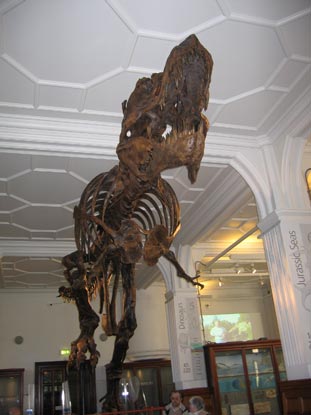
Estimates of up to 9 tons in weight. A huge Tyrannosaurus rex skeleton cast on display. Note the tiny arms which are disproportionately small. Picture credit: Everything Dinosaur.
Picture credit: Everything Dinosaur
Why Did T. rex Have Small Arms?
This question has puzzled palaeontologists for many years. Indeed, when Barnum Brown first uncovered substantial fossil remains that were to lead to the erection of this genus, he thought the arm material found in association with the other theropod remains belonged to a different dinosaur. However, scientists now know that tyrannosaurs and other meat-eating dinosaur lineages that evolved a large body size, also evolved reduced forelimbs.
Tyrannosaurs, abelisaurs, carcharodontosaurids, megalosaurs and ceratosaurs are all theropod lineages that evolved reduced/vestigial forelimbs. This is described as convergent evolution. Numerous theories have been put forward. Recently, we wrote a blog post highlighting research that examined the relationship between theropod skull robustness and forelimb size. The study concluded that the tiny arms of some theropod dinosaurs evolved because their heads became the main weapons for subduing prey.
To read our blog post about a recently published academic paper that reviewed arm size and skull robusticity in theropod dinosaurs: New Study Solves Mystery of Tiny Theropod Arms.
Tyrannotitan chubutensis
In the research published in the “Royal Society Proceedings B”, the carcharodontosaurid Tyrannotitan chubutensis was found to rank second on the cranial robusticity scale developed by the scientists. Tyrannotitan lived millions of years before super-sized tyrannosaurs evolved. This suggests that reduced forelimb adaptations evolved several times in the Theropoda.
Why did T. rex have small arms? One possible answer therefore is that jaws rather than claws become the most effective method of securing a meal.
Intriguingly, other theories have been put forward. For instance, it has been suggested that reduced forelimbs evolved in theropods to help keep them out of the way when attacking another animal. A Triceratops or Edmontosaurus for that matter would have been capable of inflicting severe damage to the arm of a tyrannosaur if it could bite it. Perhaps, reduced forelimbs evolved to permit carnivorous dinosaurs to lunge headfirst at prey, without risking losing a limb.
Furthermore, if some theropods were pack hunters small limbs may have been an advantage when social feeding took place. Short arms helped reduce the risk of injury. Adult tyrannosaurs probably fed together at carcasses. Large, powerful predators snapping at each other could accidentally damage long forelimbs. Reduced forelimbs may have been safer in crowded feeding situations.
T. rex Arms Were Small but Strong
The arms of Tyrannosaurus rex were only about one metre long. However, palaeontologists think these limbs were heavily muscled. Each arm ended in two large claws. Studies suggest the forelimbs were strong. They could have helped the animal to get up from a resting position, or perhaps they played a role in mating behaviour/courtship display. Some scientists think the arms helped hold struggling prey close to the body.
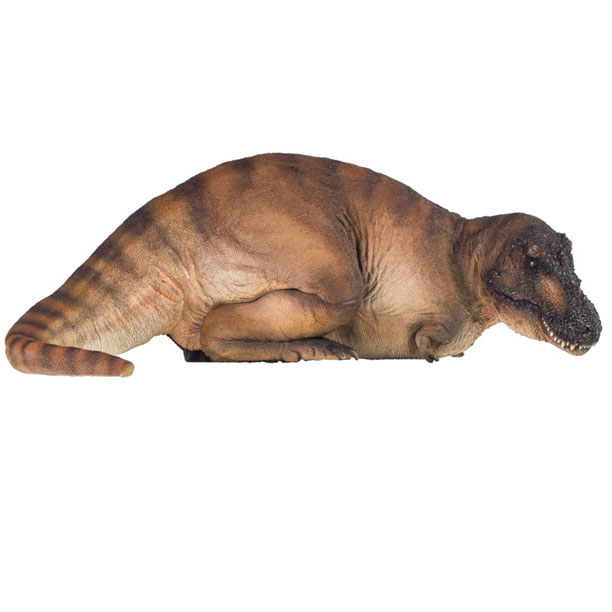
The PNSO 1:35 scale T. rex dinosaur model in a resting pose. Getting up from a resting position might help answer the question why did T. rex have small arms?
Even though the arms seem small, they were not weak or useless. They were probably held close to the body as shown in the picture (above) of the PNSO resting Tyrannosaurus rex figure. Indeed, the strong forelimbs and those tiny but robust two digits on each hand could have helped this dinosaur to stand upright after resting.
To view the range of PNSO models in stock: PNSO Scientific Art Figures.
Why Were the Arms So Short?
Scientists are still debating exactly why T. rex evolved such short forelimbs. The enormous skull and powerful jaws of T. rex may explain the reduced arm size. Its bite force was among the strongest of any land animal. As the head became larger and more specialised for hunting, the forelimbs may have become less important.
In simple terms, T. rex, like many other theropods probably relied on its jaws rather than its claws to capture prey.
Although small, the forelimbs probably still had a purpose. However, there is currently no single explanation accepted by all palaeontologists. Perhaps, the recently published paper evaluating theropod skull robusticity and forelimb reduction provides a plausible answer.
A Famous Dinosaur Mystery
Why did T. rex have small arms? It is a famous dinosaur mystery and a popular question. Palaeontologists know that many different types of theropod dinosaur had reduced arms. This is an example of convergent evolution. The reduced forelimbs of theropod dinosaurs are one of their most fascinating features.
Mike from Everything Dinosaur commented:
“While scientists continue to study tyrannosaurs and other theropods it is clear that small forelimbs evolved independently in many theropod lineages. Small arms must have had some form of evolutionary advantage as many theropods with reduced forelimbs were the apex predators in their ecosystems.”
The multi-award-winning Everything Dinosaur website: Scientifically Accurate Dinosaur Toys.



