

What Was Dunkleosteus? Facts About the Giant Armoured Fish (Part 1)
At Everything Dinosaur, we receive emails from fans of prehistoric animals. We frequently receive questions about dinosaurs; however, we get asked questions about lots of other prehistoric animals too. For example, we have compiled a list of questions about the giant, Late Devonian placoderm Dunkleosteus. It seems that this apex predator has lots of fans. As well as asking questions about Dunkleosteus and its fossils we also get asked for advice on which Dunkleosteus model to buy.
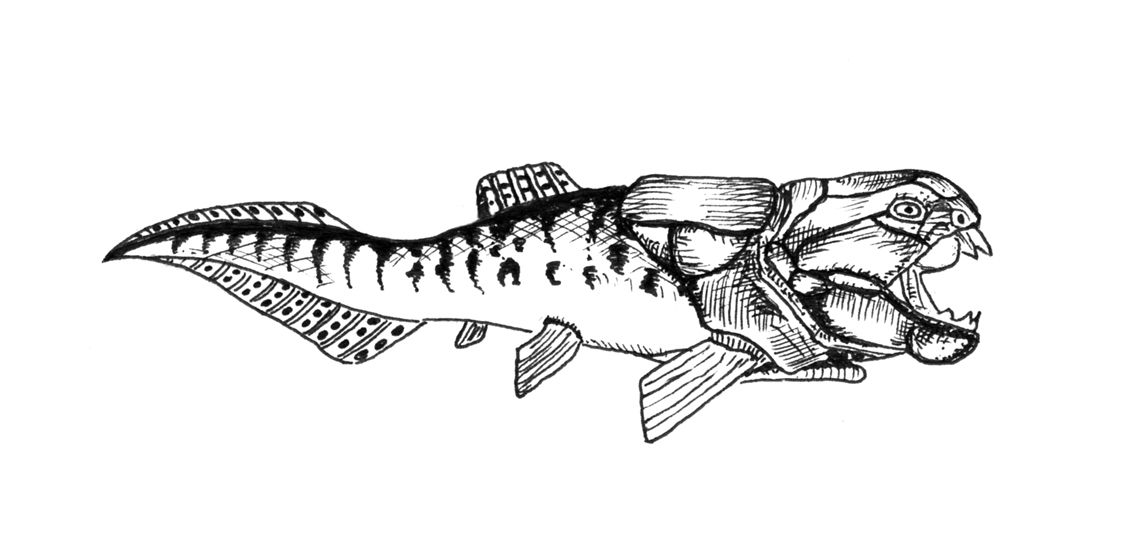
An illustration of the giant placoderm Dunkleosteus. Picture credit: Everything Dinosaur.
Picture credit: Everything Dinosaur
What was Dunkleosteus?
The extinct Dunkleosteus was a genus of armoured fish that lived during the Late Devonian. It is regarded as an apex predator with its huge jaws and heavy armour. Several species have been named, and it is classified as a member of the Arthrodira (jointed neck) within the class Placodermi. Placoderms thrived during the Silurian and Devonian. The head and thorax of these fishes were covered in armoured plates. Their skeletons were cartilaginous and they evolved into a huge variety of forms. The prehistoric fish Dunkleosteus remains one of the most famous marine predators of the Palaeozoic.
How many species of Dunkleosteus have been Named?
Around ten species have been erected. Fossils ascribed to the Dunkleosteus genus have been found in the United States, Canada, Europe including north-western Russia and some controversial material has been assigned from Morocco. However, the validity of most of them has been challenged as the fossil record is fragmentary. The type species and largest is Dunkleosteus terrelli.
To read an article about viviparity in placoderms: A Placoderm Parent!
How Big was Dunkleosteus?
It is mainly the dermal armour that is preserved as fossils. Consequently, life reconstructions and size estimates vary as the hind quarters of this fish are virtually unknown. As a result, many reconstructions are based on much smaller, related placoderms that have a more complete fossil record. Therefore, size estimates vary as body proportion ratios for this prehistoric fish remain poorly understood.
For example, size estimates for the largest species D. terrelli range from under four metres long to excess of nine metres in length. Most studies produce a body length of around five metres. However, a study using the jaw perimeter of extant sharks suggested that some Dunkleosteus terrelli specimens could reach lengths of around seven to nine metres.
Did Dunkleosteus Have Teeth?
No, Dunkleosteus did not possess true teeth like modern sharks, reptiles, or mammals. Instead, this giant placoderm had sharp bony plates inside its jaws. These plates formed self-sharpening cutting edges. The upper and lower jaw plates worked like enormous shears. Consequently, Dunkleosteus could slice through flesh, armour, and bone. Bite force studies indicate that Dunkleosteus had an extremely powerful bite, one of the strongest bites of any known fish. Even juveniles are thought to have had strong bites. How fast the jaws could open and whether suction feeding was possible remains open to debate.
As the jaw plates wore down, they continued to sharpen naturally during use. Therefore, Dunkleosteus always maintained effective cutting surfaces.

A Dunkleosteus cast on display. Picture credit: Everything Dinosaur.
Picture credit: Everything Dinosaur
What did Dunkleosteus Eat?
Dunkleosteus is thought to have been pelagic – an active swimmer inhabiting the water column. Fossilised boluses (regurgitated meal remains) have been found in association with Dunkleosteus specimens. These boluses contain fish bones which suggests that it ate other fish, including other placoderms. Bite force studies have proposed that shelled cephalopods such as orthocones or ammonoids were also prey.
In addition, puncture marks on one Dunkleosteus fossil in the collection of the Cleveland Museum of Natural History (Ohio), indicates that Dunkleosteus may have been a cannibal.
We frequently get asked “did Dunkleosteus eat sharks”? Several shark taxa have been found in the Cleveland Shale Member which also yields fossils of Dunkleosteus terrelli. For example, Cladoselache, Ctenacanthus and Stethacanthus. It is possible that sharks formed part of the diet of a large Dunkleosteus. Conversely, sharks such as Cladoselache probably hunted smaller placoderms and may have tackled juvenile Dunkleosteus.
Which is the Best Dunkleosteus Model?
As Dunkleosteus looks like a monster it has proved a popular choice for model making companies. For example, CollectA, Mojo Fun, Wild Safari, Schleich and PNSO have all made a Dunkleosteus model. Papo is currently working on a Dunkleosteus figure.
At Everything Dinosaur, we stock a range of prehistoric animal figures, including impressive marine species and ancient fish models. These replicas make excellent display pieces for collectors, prehistoric animal fans, fossil collectors and science educators. The Mojo Fun Dunkleosteus model is popular.
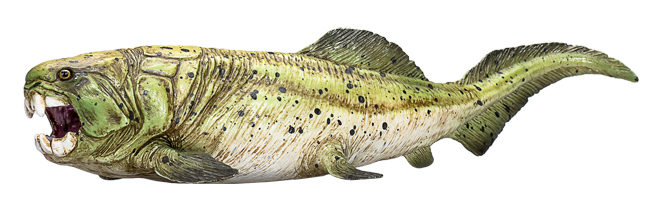
The Mojo Fun Dunkleosteus model introduced in 2019.
To view the range of Mojo Fun models in stock: Mojo Fun Prehistoric Animal Models.
CollectA have produced a larger Dunkleosteus in their Deluxe range. It measures a whopping twenty-eight centimetres in length, and it has an articulated jaw.
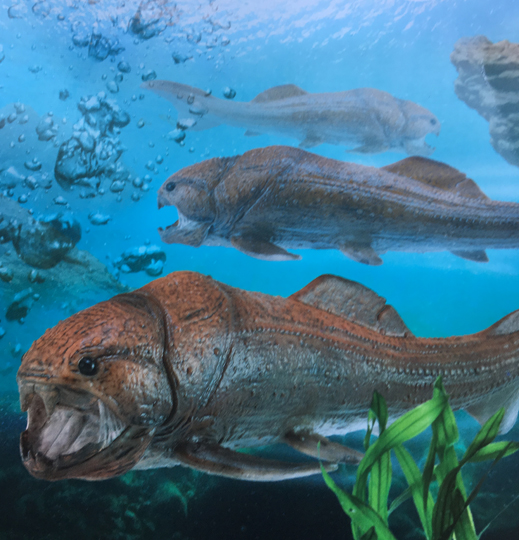
The CollectA 1:20 scale Dunkleosteus replica which was introduced in 2018.
CollectA Deluxe figures: CollectA Prehistoric Life Deluxe.
The PNSO Dunkleosteus Model
Furthermore, the PNSO Dunkleosteus is popular. This figure also has an articulated jaw. The jaw movements mimic mechanical studies that calculated how the jaw of Dunkleosteus moved. A Zaha the Dunkleosteus PNSO figure depicts this fish as a more streamlined, pelagic predator.
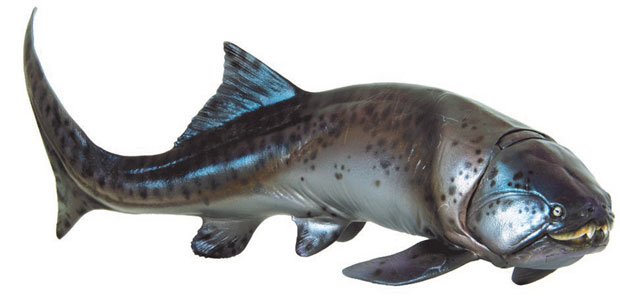
A stunning model of a placoderm – the PNSO Dunkleosteus model.
PNSO models and figures: PNSO Prehistoric Animal Figures.
The variation in the Dunkleosteus figures currently manufactured reflects the different views held by scientists. Certainly, model collectors and placoderm fans have a variety of figures to choose from.
Mike from Everything Dinosaur commented:
“Dunkleosteus is one of those iconic animals from the Palaeozoic. It ruled ancient seas long before the first dinosaurs. As such, this enigmatic monster fish is extremely popular, we get asked questions about it, and we do our best to provide helpful information. Our fact sheet contains more information about Dunkleosteus terrelli.”
Even today, this armoured fish remains one of the most extraordinary vertebrates known to science. In a second, future article, we attempt to answer more questions about this enigmatic Devonian predator.
The award-winning Everything Dinosaur website: Accurate Prehistoric Animal Models.