All about dinosaurs, fossils and prehistoric animals by Everything Dinosaur team members.
20 02, 2026

A Terrific Taurovenator Dinosaur Model from PNSO

By |2026-02-20T13:09:23+00:00February 20th, 2026|Categories: PNSO Age of Dinosaurs Models|0 Comments

Everything Dinosaur has unveiled the exciting news that the theropod figure Hugo the Taurovenator is in stock.  Dinosaur model fans and collectors are taking notice.  This impressive replica represents Taurovenator violantei, which could be one of the largest carcharodontosaurids described to date. Formally named in 2016 (Motta et al), fossils come from the Huincul Formation of Argentina. This impressive figure represents a powerful South American Late Cretaceous predator. Furthermore, Everything Dinosaur has produced a detailed Taurovenator fact sheet to accompany this new release.

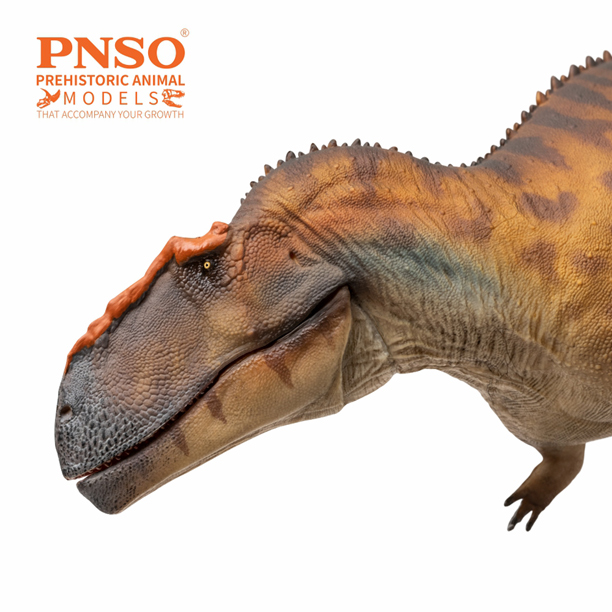
PNSO Hugo the Taurovenator shown in a close-up view.

The rugose projections above the eye and running along the top of the snout have been painted a bright orange colour.

To view the range of PNSO models available: PNSO Prehistoric Animal Figures.

PNSO Hugo the Taurovenator

Hugo the Taurovenator reflects the latest scientific understanding of this predatory dinosaur. The model carefully reproduces the distinctive skull shape and raised brow ridges described in the fossil record. In addition, the figure highlights the reduced yet robust forelimbs explained in our educational fact sheet. Consequently, collectors can appreciate the unusual anatomy of this remarkable carcharodontosaurid. Importantly, the Taurovenator fact sheet explains the scientific debate surrounding this dinosaur. Initially, scientists named Taurovenator from a single skull bone (right postorbital). However, research published in 2024 described additional fossil material. As a result, researchers confirmed that Taurovenator was a valid and distinct genus.

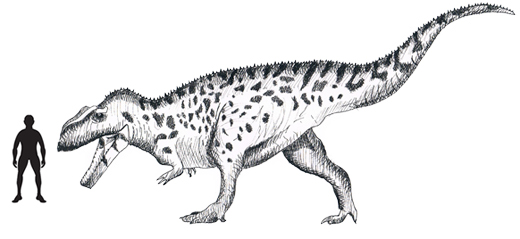
Taurovenator violantei scale drawing,

A scale drawing of the Argentinian Late Cretaceous theropod dinosaur Taurovenator. This illustration features in the company’s free Taurovenator fact sheet. Picture credit: Everything Dinosaur.

Picture credit: Everything Dinosaur

Moreover, the model demonstrates PNSO’s commitment to scientific accuracy. The sculpt displays realistic skin textures and carefully chosen colours. Likewise, the accompanying fact sheet provides helpful background information for collectors and younger dinosaur enthusiasts.

Mike from Everything Dinosaur commented:

“We supply the Taurovenator fact sheet with purchases of the Taurovenator model.”

Everything Dinosaur is delighted to offer Hugo the Taurovenator alongside their informative fact sheet. Together, they celebrate palaeontology while providing a superb display model for collectors.

The Everything Dinosaur website: Prehistoric Animal Models and Toys.

19 02, 2026

Remarkable Fossil Demonstrates Tyrannosaur/Prey Interaction

By |2026-02-20T10:10:08+00:00February 19th, 2026|Categories: Palaeontological articles|0 Comments

A remarkable Edmontosaurus skull fossil on display at the Montana State University’s Museum of the Rockies sheds new light on how members of the genus Tyrannosaurus tackled their prey. Moreover, this intriguing specimen forms the centrepiece of a new collaborative study involving scientists from Montana State University and the University of Alberta.  The research, published in the academic journal PeerJ, provides potential evidence of tyrannosaur hunting strategy as well as insights into feeding behaviour.

In 2005, a nearly complete Edmontosaurus skull (MOR 1627) was found in the Hell Creek Formation of eastern Montana on lands managed by the Bureau of Land Management. Importantly, the skull preserves a dramatic detail. A broken tyrannosaur tooth remains embedded in the dinosaur’s face. A partial tooth crown is embedded in the nasal bone. Consequently, it attracted the attention of doctoral researcher Taia Wyenberg-Henzler (University of Alberta) and Dr John Scannella, Curator of Palaeontology at the Museum of the Rockies.

The researchers wanted to identify the owner of the tooth.  Is this evidence of Tyrannosaurus rex hunting behaviour?

Rare Evidence of Ancient Behaviour

Although bite marks frequently appear on fossil bones, embedded teeth are extremely uncommon. Therefore, this specimen offers exceptional scientific value.

Co-author of the study, Wyenberg-Henzler explained:

“The great thing about an embedded tooth, particularly in a skull, is it gives you the identity of not only who was bitten but also who did the biting. This allowed us to paint a picture of what happened to this Edmontosaurus, kind of like Cretaceous crime scene investigators.”

Confirming the Culprit

Crocodilians or pterosaurs were quickly ruled out.  They compared the tooth crown with teeth from Hell Creek Formation theropods. The morphology most closely matched teeth from a large-bodied predator. Curvature and ovoid cross-sectional shape of the tooth further suggests that the tooth is a maxillary tooth from a middle or posterior tooth position. The researchers concluded that the embedded crown is most likely an adult Tyrannosaurus maxillary tooth rather than an immature Tyrannosaurus or Nanotyrannus tooth. Denticle shape also suggests that the embedded tooth is a tyrannosaurid tooth.

To read Everything Dinosaur’s recent blog post about evidence for Nanotyrannus being a valid taxon: Nanotyrannus Hyoid Bone Makes Crucial Breakthrough.

Furthermore, CT scans of the skull provided additional detail. These scans were carried out at Advanced Medical Imaging at Bozeman Health Deaconess Hospital. Dr Scannella (Museum of the Rockies) emphasised the importance of the find. The fossil captures a moment of behaviour, specifically a tyrannosaur biting into the face of a duck-billed dinosaur.

Edmontosaurus skull reveals embedded tyrannosaur tooth in nasal.

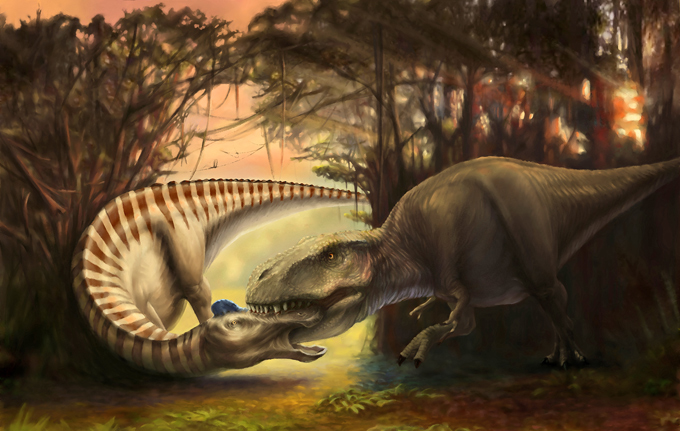
An artist’s reconstruction of the tyrannosaur attack on the unfortunate Edmontosaurus. Picture credit: Jenn Hall.

Picture credit: Jenn Hall

Predator or Scavenger?

Interestingly, the skull shows no signs of healing around the embedded tooth. The lack of reactive bone in the region surrounding the tooth suggests the animal died around the time the tooth became embedded in the nasal. Therefore, two possibilities remain. The Edmontosaurus may already have been dead when bitten. Alternatively, the attack itself may have been fatal.

Nevertheless, the position of the tooth offers further clues. The researchers noted that the impact angle suggests a face-to-face encounter. Typically, such injuries occur during active predation rather than casual scavenging. An examination of the hunting strategies of extant mammalian and reptilian carnivores confirmed that bites to the head are often employed to swiftly despatch prey.

The study authors conclude that the embedded tooth is most consistent with a bite inflicted during an attempt to control the struggling Edmontosaurus or deliver a killing blow followed by carcass consumption. In addition, the force required to snap a tyrannosaur tooth inside bone indicates a powerful, potentially lethal bite. Consequently, the evidence paints a vivid picture of the duck-billed dinosaur’s final moments.

Edmontosaurus Skull Provides New Insights into Tyrannosaurus Feeding Behaviour

The feeding ecology of Tyrannosaurus has long generated debate among palaeontologists. Some researchers have argued for active predation, while others have emphasised scavenging. However, this remarkable Hell Creek fossil adds an important data point. It provides rare, direct evidence of tyrannosaur feeding behaviour preserved in the fossil record.

For scientists and dinosaur enthusiasts alike, the specimen offers a compelling glimpse into the harsh realities of Late Cretaceous ecosystems.

Everything Dinosaur acknowledges the assistance of a media release from the Museum of the Rockies in the compilation of this article.

The scientific paper: “Behavioral implications of an embedded tyrannosaurid tooth and associated tooth marks on an articulated skull of Edmontosaurus from the Hell Creek Formation, Montana” by Taia C.A. Wyenberg-Henzler​ and John B. Scannella published in PeerJ.

The award-winning Everything Dinosaur website: Tyrannosaurus Models and Dinosaur Figures.

18 02, 2026

A Mysterious Tooth on the Base of the CollectA Deluxe Phorusrhacos Model

By |2026-02-20T15:37:06+00:00February 18th, 2026|Categories: CollectA Deluxe Prehistoric Animal Models|0 Comments

The prehistoric animal models made by CollectA are appreciated by model collectors.  Often it is the details that make these figures so impressive.  For example, the new for 2025 Phorusrhacos terror bird model is beautiful and scientifically accurate.  In addition, there is a canine tooth on the display base.  These predatory birds are often depicted in battles with the felid Smilodon.  However, Phorusrhacos lived long before the land bridge linking North and South America developed. Phorusrhacos (P. longissimus) was extinct millions of years before the Great American Biotic Interchange took place.

The taxon Phorusrhacos very probably never interacted with a Smilodon.

The terror bird Phorusrhacos model from CollectA has a tooth on its display base.

The canine on the CollectA Deluxe Phorusrhacos figure. It is not the tooth of a Smilodon, but the tooth of a coeval sparassodont. Picture credit: Everything Dinosaur.

Picture credit: Everything Dinosaur

Explaining the Tooth on the Base of the Phorusrhacos Terror Bird Model

Team members at Everything Dinosaur like to help collectors and model fans.  They created a short video to explain that the tooth on the base probably represents a canine from a sparassodont. Sparassodonts are distantly related to marsupials.  They were native to South America, and they occupied many predatory niches.  Some forms evolved into wolf-sized carnivores. The tooth on the display is not from a Smilodon but from a sparassodont. Perhaps from a Borhyaena tuberata, a large predator very probably a contemporary of Phorusrhacos longissimus.

Borhyaena tuberata (Sparassodonta) life reconstruction.

A life reconstruction of the Middle Miocene sparassodont Borhyaena tuberata that was probably a contemporary of the terror bird Phorusrhacos. Picture credit: Everything Dinosaur.

Picture credit: Everything Dinosaur

To view the range of CollectA Deluxe figures in stock at Everything Dinosaur: CollectA Deluxe Prehistoric Animal Models.

An Explanatory Video

The short, explanatory video (duration forty-seven seconds), is available on Everything Dinosaur’s social media pages. Furthermore, it has been added to the company’s YouTube channel.

To view the Everything Dinosaur YouTube channel: Visit Our YouTube Channel.

Mike from Everything Dinosaur commented:

“The video provides information about the tooth.  It tackles the misconception that Phorusrhacos may have competed against sabre-toothed cats.  It is true that later phorusrhacids, very probably encountered Smilodon.  However, the genus Phorusrhacos probably did not.  However, in the Miocene sparassodonts probably did compete with terror birds.”

There is a broken canine tooth incorporated into the base of the CollectA Deluxe Phorusrhacos.

When viewed in left lateral view the broken canine tooth of a mammalian predator can be seen on the base of the figure.

The multi-award-winning Everything Dinosaur website: Prehistoric Animal Models.

17 02, 2026

Celebrating the Chinese Lunar New Year

By |2026-02-17T13:40:36+00:00February 17th, 2026|Categories: Animal News Stories|0 Comments

As the Lunar New Year begins, we pause to celebrate renewal, hope, and partnership. This year, we proudly welcome the Year of the Horse. Across the world, families gather to share meals and exchange good wishes. Streets glow with lanterns. Fireworks light the sky. Meanwhile, homes fill with laughter and optimism for the year ahead.

The Horse symbolises energy, strength, and determination. It represents progress and resilience. Moreover, it reminds us to move forward with confidence and purpose. These qualities resonate deeply with our own journey as we developed the Everything Dinosaur Evolution range. In celebration of the Lunar New Year, we sent messages of goodwill to all our Chinese contacts.

Celebrating the Chinese Year of the Horse.

Everything Dinosaur celebrating the Chinese New Year (Year of the Horse) with a traditional red and gold image. Picture credit: Everything Dinosaur.

Picture credit: Everything Dinosaur

Celebrating the Chinese New Year (Year of the Horse)

At Everything Dinosaur, collaboration sits at the heart of what we do. We work closely with talented partners and friends in China. Together, we support the diverse and eclectic collecting community.

Therefore, this celebration feels especially meaningful to us. It gives us an opportunity to reflect on shared achievements. It also allows us to express sincere gratitude.

Over the past year, we have worked side by side on exciting new projects. We have overcome challenges together. Furthermore, we have strengthened relationships built on trust and mutual respect. Such partnerships truly drive innovation.  For example, we launched our own range of dinosaur figures – Everything Dinosaur Evolution.

Everything Dinosaur Evolution T. rex is now in stock.

The Everything Dinosaur Evolution range is now in stock. Picture credit: Everything Dinosaur.

Picture credit: Everything Dinosaur

To view the Everything Dinosaur Evolution range: Everything Dinosaur Evolution Models.

As the Year of the Horse begins, we wish all our Chinese colleagues, manufacturers, artists, and friends a joyful and prosperous New Year. May this year bring health, happiness, and continued success. May it also bring new opportunities and fresh inspiration.

Finally, thank you for your dedication, creativity, and hard work. We value our collaboration enormously. We look forward to another remarkable year together.

Happy Lunar New Year, and best wishes for a thriving Year of the Horse!

The multi-award-winning Everything Dinosaur website: Prehistoric Animals and Dinosaur Figures.

16 02, 2026

Everything Dinosaur Earns the Special Feefo Platinum Trusted Service Award Certificate (2026)

By |2026-02-17T12:54:24+00:00February 16th, 2026|Categories: Everything Dinosaur News and Updates|0 Comments

Everything Dinosaur is delighted to announce national recognition for customer care. We have received the prestigious Platinum Trusted Service Award from Feefo. This award reflects consistently outstanding verified customer feedback. We will proudly display the certificate at the company’s offices.

The Feefo Platinum Trusted Service Award

Importantly, Platinum status recognises long-term excellence. It highlights businesses that maintain exceptional service standards year after year. Therefore, this achievement represents sustained dedication over a prolonged period of time.

Sue from Everything Dinosaur with the Feefo Platinum Trusted Service Award certificate.

Sue proudly showing off the Feefo Platinum Trusted Service Award certificate. Picture credit: Everything Dinosaur.

Picture credit: Everything Dinosaur

In the photograph above, Sue proudly holds the official certificate. It symbolises the hard work behind every order we dispatch.

Sue from Everything Dinosaur commented:

“We are incredibly proud to receive this Platinum Trusted Service Award. This certificate represents the trust our customers place in us every single day. It means a great deal to Mike and myself.”

Crucially, the award is based solely on independently verified reviews. As a result, customers can shop with complete confidence.

We remain committed to expert advice, careful packing, and prompt delivery. Finally, we thank our customers worldwide. Your feedback made this achievement possible.

The multi-award-winning Everything Dinosaur website: Dinosaur and Prehistoric Animal Figures.

15 02, 2026

A Giant Ammonite Fossil on Display

By |2026-02-20T18:15:55+00:00February 15th, 2026|Categories: Photos/Pictures of Fossils|0 Comments

A Titanites giganteus fossil on display!  Everything Dinosaur team members photographed a giant ammonite fossil.  It was an exhibit at the Grant Museum of Zoology in London. It is a spectacular specimen.  This species is known from Upper Jurassic sediments. It is one of the largest ammonite taxa known in the UK.

A Titanites giganteus fossil on display.

A giant ammonite fossil Titanites giganteus on display at the Grant Museum of Zoology (London). Picture credit: Everything Dinosaur.

Picture credit: Everything Dinosaur

Titanites could grow to huge sizes.  Some species can reach a shell diameter of more than one metre.  However, Titanites giganteus specimens are normally around sixty to seventy centimetres in diameter. Ammonites were cephalopods. It is likely to have come from Dorset from a Portland Stone quarry.  The picture (below) shows a life reconstruction of an ammonite.  It is the Bullyland ammonite figure.

Bullyland ammonite model.

The Bullyland replica ammonite model.  A wonderful example of this extinct cephalopod.

To view the range of Bullyland figures in stock at Everything Dinosaur: Bullyland Prehistoric Animal Models.

Mike from Everything Dinosaur commented:

“Large ammonite fossils are rare, but they can still be found in parts of southern England today.  The Portland Stone is limestone, and invertebrate fossils are relatively common.  However, finding a well-preserved Titanites fossil would be the find of a lifetime.”

The award-winning Everything Dinosaur website: Prehistoric Animal Figures.

14 02, 2026

The PNSO Lurdusaurus Figure – A Remarkable Replica of an Unusual Ornithopod

By |2026-02-14T18:03:16+00:00February 14th, 2026|Categories: Dinosaur Fans|0 Comments

The PNSO Lurdusaurus figure represents one of the most unusual ornithopod dinosaurs known to science. This detailed prehistoric animal model captures the bulky proportions and distinctive anatomy of Lurdusaurus arenatus. It was an extremely robust herbivorous dinosaur from the  Early Cretaceous of Niger (western Africa).

The PNSO Bakari the Lurdusaurus model.

The PNSO Bakari the Lurdusaurus dinosaur model.

Collectors and dinosaur enthusiasts often prefer to collect models of predators. However, this styracosternan ornithopod within the broader Hadrosauriformes deserves respect. This new release from PNSO showcases an animal with a truly unique body plan and highlights the diversity of iguanodontian dinosaurs.

To view the range of PNSO prehistoric animal models in stock: PNSO Dinosaur Models.
Describing Lurdusaurus

The holotype Lurdusaurus arenatus is known from the uppermost portion of the Elrhaz Formation. Palaeontologists estimate that this dinosaur lived close to the Aptian–Albian boundary (112 million years ago). It was formally described in 1999 (Taquet and Russell).

The name Lurdusaurus means “heavy lizard”. This name perfectly reflects its massive build. Unlike many related ornithopods, Lurdusaurus possessed a broad, barrel-shaped body and extremely powerful forelimbs. Scientists have suggested it may have been an obligate quadruped, meaning it probably walked on all four legs. Interestingly, palaeontologists have compared its appearance to that of a ground sloth. Some researchers have even suggested it may have filled a slow-moving, heavily built ecological role similar to a modern hippopotamus.

The PNSO Lurdusaurus Figure

The PNSO Lurdusaurus figure has been carefully designed using current scientific interpretations. The model highlights several distinctive anatomical features recognised from fossil evidence.

Firstly, the figure shows the dinosaur’s low, heavy torso. This reflects the broad ribcage seen in the holotype specimen. In addition, the strong forelimbs are proportionally large. These limbs were likely essential for supporting the animal’s considerable weight. Furthermore, the model includes the immense thumb spike.

As a result, the PNSO model provides collectors with a scientifically credible reconstruction of this unusual dinosaur.

The PNSO Lurdusaurus figure will appeal to both experienced collectors and those new to prehistoric animal models. PNSO has earned a strong reputation for producing museum-quality replicas that combine artistic craftsmanship with scientific research.

Mike from Everything Dinosaur commented:

“Lurdusaurus compliments other Early Cretaceous species within the PNSO range. In addition, it offers collectors the opportunity to acquire a rarely represented dinosaur taxon. The PNSO Lurdusaurus figure highlights the remarkable evolutionary experimentation that occurred among Early Cretaceous herbivorous dinosaurs. Its stocky build and unusual posture set it apart from more familiar ornithopods such as Iguanodon.”

The multiple-award-winning website: Dinosaur and Prehistoric Animal Models.

13 02, 2026

The Earliest Reptile Body Impressions with Scaly Skin are Described

By |2026-02-13T16:17:50+00:00February 13th, 2026|Categories: Palaeontological articles|0 Comments

Scientists have identified the oldest reptile skin impressions from a remarkable fossil discovered in Germany. The fossil also preserves possible evidence of a cloaca (vent).  The vent shape and structure are reminiscent of the vents found in extant turtles and living squamates. Dr Lorenzo Marchetti from the Museum für Naturkunde Berlin led the research. The study has been published in the academic journal “Current Biology”.

The oldest reptile skin impressions known to science.

The earliest resting trace of a stem reptile and the fossil specimen preserves the earliest evidence of epidermal scales and a cloaca (vent). These scales are preserved on a newly described resting trace Cabarzichnus pulchrus representing the oldest and most complete body-impression occurrence of a Palaeozoic stem reptile. Picture credit: Lorenzo Marchetti

Picture credit: Lorenzo Marchetti

The Oldest Reptile Skin Impressions Known to Science

The stunning and beautifully  preserved skin impressions were found on a slab with associated footprints of an early reptile (Varanopus microdactylus). The material is from the Goldlauter Formation and dates from the Early Permian. Modern radiometric dating of volcanic ash layers allows the finds to be precisely dated. They are around 299-298 million years old. This makes them the oldest direct evidence of reptile skin found to date.

Skin structures such as scales, feathers or horned beak remnants are documented by a large number of fossils. For example, several examples of dinosaur integument are known. Recently, we wrote a blog post about a remarkable study of the skin of Diplodocus. However, the German skin impressions are around twice as old as the Diplodocus skin impression material.

To read about the study of diplodocid integument: The Amazing Skin of a Young Diplodocus.

Sauropod skin impression.

A sauropod skin impression (NHMUK R1868) on display as part of the London Natural History Museum Patagotitan exhibition. Picture credit: Everything Dinosaur.

Picture credit: Everything Dinosaur

Commenting on the significance of the research, Dr Lorenzo Marchetti stated:

“Such soft tissue structures are extremely rare in the fossil record – and the further back we go in geological history, the more extraordinary they become. The traces from the Thuringian Forest open up new perspectives on the early development of reptiles and their skin structures.”

Cabarzichnus pulchrus

The newly described resting traces have been named Cabarzichnus pulchrus.  It is a new genus and species of trace fossil. The associated footprints have proportions similar to those of bolosaurs – an early group of reptiles from the lineage of today’s lizards. The preserved scale shapes range from diamond-shaped to hexagonal to laterally pointed and show remarkable parallels to integuments of living reptiles.

We Have a Cloaca

The skin impression representing the base of the tail preserves possible evidence of a cloaca (vent). Most terrestrial vertebrates have a cloaca – a common opening for the excretion of faeces and urine, which is also the exit point for the reproductive organs. Only live-bearing mammals have separate openings. In the fossil record, the cloaca is almost never preserved and clearly recognisable as part of the soft tissue. However, the skin impression shows traces of a cloaca opening near the base of the tail. The impression of the narrow slit suggests that the cloaca of the Cabarzichnus track maker differs in shape and orientation from that of dinosaurs and crocodiles, resembling instead the cloaca of turtles, lizards and snakes.

Trace fossils which preserve the oldest reptile skin impressions can provide a more complete picture of the evolution of early land vertebrates.

Dr Marchetti added:

“Trace fossils are much more than mere footprints. They preserve details of anatomy that would otherwise be completely lost and contribute significantly to a better understanding of the evolution of early terrestrial vertebrates.”

This record of dermal and epidermal scales provides evidence for the co-existence of epidermal and dermal scales in Carboniferous stem amniotes and for epidermal scale differentiation in Asselian stage (Early Permian) stem reptiles. Therefore, this adaptation precedes the main phases of the global warming and aridification associated with the Early Permian and probably enabled the diversification of stem reptiles.

Everything Dinosaur acknowledges the assistance of a media release from the Museum für Naturkunde Berlin in the compilation of this article.

The scientific paper: “The earliest reptile body impressions with scaly skin” by Lorenzo Marchetti, Antoine Logghe, Michael Buchwitz, Mark J. MacDougall, Arnaud Rebillard, Thomas Martens and Jörg Fröbisch published in Current Biology.

For models and figures of Palaeozoic vertebrates: Models of Early Terrestrial Vertebrates.

12 02, 2026

Celebrating Women in Science: Palaeontologist’s First Single Author Paper

By |2026-02-13T07:15:06+00:00February 12th, 2026|Categories: Key Stage 1/2|0 Comments

This week we celebrated the International Day of Women and Girls in Science. It is time to acknowledge the achievements of female researchers and their contribution to scientific disciplines. At Everything Dinosaur, we try and support aims and aspirations.  For example, we recently congratulated British palaeontologist Megan Jacobs on the publication of her first sole-authored scientific paper.  Published in the prestigious Proceedings of the Geologists’ Association, the study examined the history of research into dinosaur tracks found on the Isle of Wight.

A dinosaur footprint from the Isle of Wight.

A tridactyl dinosaur print from the Isle of Wight (size 8 foot for scale). Picture credit: Megan Jacobs.

Picture credit: Megan Jacobs

This island is known as the “Dinosaur Isle”.  It is one of the most important places in Europe for dinosaur footprints and tracks.  These trace fossils highlight the diversity of the Dinosauria.  They are especially important for example, in strata representing the Vectis Formation, as dinosaur body fossils are rare.  The tracks indicate the presence of theropods, ornithopods and armoured dinosaurs.

A first solo authored scientific paper is an important milestone in the career of a scientist. Its publication reminds us of how an iguanodontian track helped inspire teaching activities as part of a term topic programme supporting Key Stage 2 teaching. Our drawing of a large footprint from the Isle of Wight was one of a series of teaching resources we developed to help explain different types of fossils.

Ornithopod pes. Dinosaur footprints found on beach.

Line drawing of the hind footprint of a large ornithopod (iguanodontid).  Picture credit: Everything Dinosaur.

Picture credit: Everything Dinosaur

The Historiography of Dinosaur Footprints

The new paper explores how scientists have documented, studied and debated these ancient footprints over time. It delves into the historiography of fossil track studies, shedding light on how earlier interpretations have shaped our current understanding of dinosaur behaviour and palaeoecology. Furthermore, her work offers more than a detailed review of fossil tracks. It highlights the value of historical science, showing how past researchers built knowledge piece by piece. For many years, dinosaur footprints were seen as curiosities. Now, with detailed historical analysis, they are recognised as important evidence of behaviour, movement and ecosystem dynamics.

This publication also marks a key moment for Jacobs’ career. Publishing a solo authored paper in a prestigious journal is a major achievement for any palaeontologist. Her work exemplifies how women are making essential contributions to dinosaur science — from tracks and bones to evolutionary insights.

An example of Isle of Wight dinosaur footprints.

An ornithopod print from the Isle of Wight. Picture credit: Megan Jacobs.

Picture credit: Everything Dinosaur

The University of Portsmouth graduate has studied body fossils from the Isle of Wight too. For example, back in 2021 we authored a blog post about the discovery of a large Isle of Wight dromaeosaurid (Vectiraptor greeni). Its fossils had been found by local fossil collector Mick Green on the foreshore of Compton Bay.

To read our 2021 post about V. greeniNewly Described Dromaeosaurid Dinosaur from the Isle of Wight.

Tracks Preserve Behaviours

The study of dinosaur footprints continues to be a vibrant field. Tracks preserve behaviours that body fossils alone cannot show — from walking and running to group movement and hunting strategies. Megan Jacobs’ paper not only honours the scientists who came before but also pushes the field forward by encouraging deeper reflection on how we study fossils.  The relatively abundant and easily accessible dinosaur prints on the Isle of Wight continue to inform and spark enthusiasm for studying the Earth Sciences.

As we celebrate the role of women and girls in science, Megan’s first solo authored paper demonstrates her contribution to UK palaeontology. Her work inspires the next generation of researchers to explore Earth’s ancient past with fresh perspective and rigour.  After all, a single ornithopod track from the Isle of Wight inspired us to create dinosaur themed teaching studies.

We wish Megan every success with her career.

The scientific paper: “The historiography of dinosaur footprints of the Lower Cretaceous Wealden Group on the Isle of Wight, UK” by Megan L. Jacobs published in the Proceedings of the Geologists’ Association.

11 02, 2026

New PNSO Dinosaur Models in Stock

By |2026-02-12T07:32:17+00:00February 11th, 2026|Categories: PNSO Age of Dinosaurs Models|0 Comments

Four new PNSO dinosaur models are now in stock at Everything Dinosaur. The models are Caudipteryx, Tameryraptor, Taurovenator and Lurdusaurus.  Everything Dinosaur will supply a free fact sheet about that dinosaur with every figure sold.  Mike from the UK-based mail order company welcomed the arrival of these new PNSO models.

Four new PNSO dinosaur models.

New PNSO dinosaur models are in stock at Everything Dinosaur Taurovenator (top), Tameryraptor (middle), Lurdusaurus (bottom) and Caudipteryx (right). Picture credit: Everything Dinosaur.

Picture credit: Everything Dinosaur

To view the range of PNSO prehistoric animal models in stock: PNSO Dinosaur Models.

Team members are busy contacting customers who requested being informed when these four figures arrived.  PNSO dinosaur figures are popular.

Mike explained:

“These models are now available.  All the stock from the PNSO shipment has now been booked into our warehouse.  Customers are being alerted and I have been busy preparing the free fact sheets for these dinosaurs.”

The multi-award-winning Everything Dinosaur website: Prehistoric Animal Figures.

Go to Top