

A remarkable Edmontosaurus skull fossil on display at the Montana State University’s Museum of the Rockies sheds new light on how members of the genus Tyrannosaurus tackled their prey. Moreover, this intriguing specimen forms the centrepiece of a new collaborative study involving scientists from Montana State University and the University of Alberta. The research, published in the academic journal PeerJ, provides potential evidence of tyrannosaur hunting strategy as well as insights into feeding behaviour.
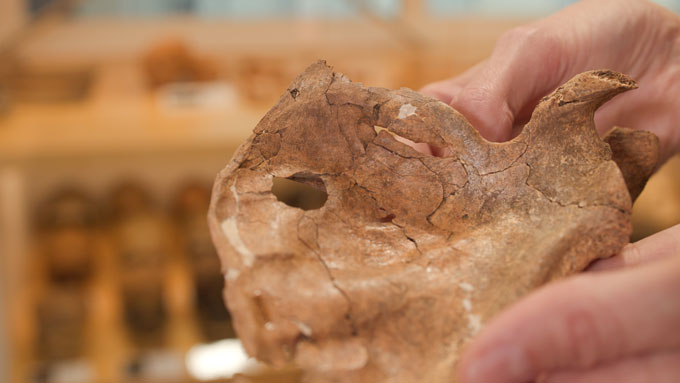
In 2005, a nearly complete Edmontosaurus skull (MOR 1627) was found in the Hell Creek Formation of eastern Montana on lands managed by the Bureau of Land Management. Importantly, the skull preserves a dramatic detail. A broken tyrannosaur tooth remains embedded in the dinosaur’s face. A partial tooth crown is embedded in the nasal bone. Consequently, it attracted the attention of doctoral researcher Taia Wyenberg-Henzler (University of Alberta) and Dr John Scannella, Curator of Palaeontology at the Museum of the Rockies.
The researchers wanted to identify the owner of the tooth. Is this evidence of Tyrannosaurus rex hunting behaviour?
Rare Evidence of Ancient Behaviour
Although bite marks frequently appear on fossil bones, embedded teeth are extremely uncommon. Therefore, this specimen offers exceptional scientific value.
Co-author of the study, Wyenberg-Henzler explained:
“The great thing about an embedded tooth, particularly in a skull, is it gives you the identity of not only who was bitten but also who did the biting. This allowed us to paint a picture of what happened to this Edmontosaurus, kind of like Cretaceous crime scene investigators.”
Confirming the Culprit
Crocodilians or pterosaurs were quickly ruled out. They compared the tooth crown with teeth from Hell Creek Formation theropods. The morphology most closely matched teeth from a large-bodied predator. Curvature and ovoid cross-sectional shape of the tooth further suggests that the tooth is a maxillary tooth from a middle or posterior tooth position. The researchers concluded that the embedded crown is most likely an adult Tyrannosaurus maxillary tooth rather than an immature Tyrannosaurus or Nanotyrannus tooth. Denticle shape also suggests that the embedded tooth is a tyrannosaurid tooth.
To read Everything Dinosaur’s recent blog post about evidence for Nanotyrannus being a valid taxon: Nanotyrannus Hyoid Bone Makes Crucial Breakthrough.
Furthermore, CT scans of the skull provided additional detail. These scans were carried out at Advanced Medical Imaging at Bozeman Health Deaconess Hospital. Dr Scannella (Museum of the Rockies) emphasised the importance of the find. The fossil captures a moment of behaviour, specifically a tyrannosaur biting into the face of a duck-billed dinosaur.
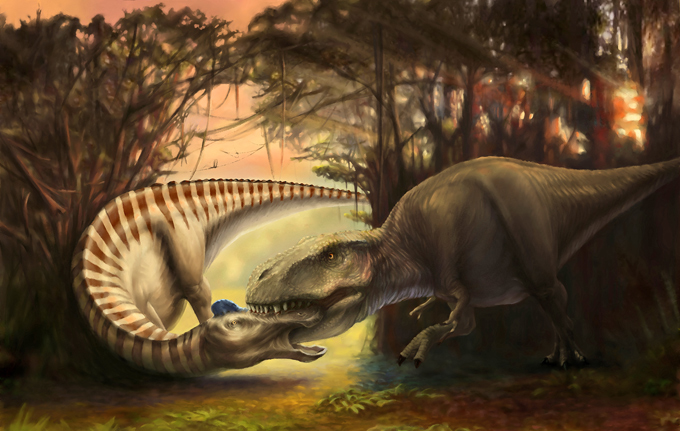
An artist’s reconstruction of the tyrannosaur attack on the unfortunate Edmontosaurus. Picture credit: Jenn Hall.
Picture credit: Jenn Hall
Predator or Scavenger?
Interestingly, the skull shows no signs of healing around the embedded tooth. The lack of reactive bone in the region surrounding the tooth suggests the animal died around the time the tooth became embedded in the nasal. Therefore, two possibilities remain. The Edmontosaurus may already have been dead when bitten. Alternatively, the attack itself may have been fatal.
Nevertheless, the position of the tooth offers further clues. The researchers noted that the impact angle suggests a face-to-face encounter. Typically, such injuries occur during active predation rather than casual scavenging. An examination of the hunting strategies of extant mammalian and reptilian carnivores confirmed that bites to the head are often employed to swiftly despatch prey.
The study authors conclude that the embedded tooth is most consistent with a bite inflicted during an attempt to control the struggling Edmontosaurus or deliver a killing blow followed by carcass consumption. In addition, the force required to snap a tyrannosaur tooth inside bone indicates a powerful, potentially lethal bite. Consequently, the evidence paints a vivid picture of the duck-billed dinosaur’s final moments.
Edmontosaurus Skull Provides New Insights into Tyrannosaurus Feeding Behaviour
The feeding ecology of Tyrannosaurus has long generated debate among palaeontologists. Some researchers have argued for active predation, while others have emphasised scavenging. However, this remarkable Hell Creek fossil adds an important data point. It provides rare, direct evidence of tyrannosaur feeding behaviour preserved in the fossil record.
For scientists and dinosaur enthusiasts alike, the specimen offers a compelling glimpse into the harsh realities of Late Cretaceous ecosystems.
The scientific paper: “Behavioral implications of an embedded tyrannosaurid tooth and associated tooth marks on an articulated skull of Edmontosaurus from the Hell Creek Formation, Montana” by Taia C.A. Wyenberg-Henzler and John B. Scannella published in PeerJ.
The award-winning Everything Dinosaur website: Tyrannosaurus Models and Dinosaur Figures.

Leave A Comment