

The Giant and Remarkable Colossosuchus techniensis
In 2023, Palaeontologists described a remarkable new phytosaur from the Triassic of India. The species is named Colossosuchus techniensis. Moreover, this enormous reptile may have reached lengths exceeding eight metres. It is one of the largest phytosaurs known to science. Unsurprisingly, the discovery has attracted significant scientific attention. For example, CollectA will be introducing a Colossosuchus techniensis model later this year.
Everything Dinosaur will stock this exciting new prehistoric animal replica.
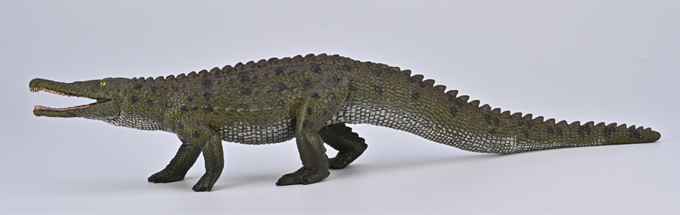
The CollectA Colossosuchus model shown in lateral view. This figure measures approximately 21 cm in length.
The range of CollectA Age of Dinosaurs figures: CollectA Age of Dinosaurs Figures.
A Giant Phytosaur from the Triassic of India
During the Late Triassic, phytosaurs dominated rivers and lakes across Pangaea. These reptiles looked similar to modern crocodiles. However, they belonged to a completely different reptile lineage. The recently described Colossosuchus techniensis inspired the new CollectA prehistoric animal model. Colossosuchus is pronounced Kol-oss-oh-suk-us.
Researchers discovered its fossil remains in the Tiki Formation. This formation lies within the Rewa Gondwana Basin of India. Consequently, the fossils provide valuable insight into Gondwanan ecosystems during the Triassic. The locality proved exceptionally rich. Scientists uncovered twenty-seven skull and jaw specimens. In addition, the team recovered more than three hundred postcranial bones. Altogether, these fossils represent at least twenty-one individual animals.
Interestingly, most specimens belonged to juveniles or subadults. Therefore, the bonebed may represent a group of young animals living together. Alternatively, it might represent a mass dying event, perhaps due to the water source drying up.
One of the Biggest Phytosaurs
Some fossil bones suggest that adults grew to enormous sizes. Researchers estimate that the largest individual exceeded eight metres in length. As a result, Colossosuchus techniensis ranks among the largest phytosaurs discovered so far.
These predators probably behaved like modern crocodiles. For instance, they likely waited near riverbanks before ambushing prey. Fish probably formed part of their diet. However, they may also have targeted terrestrial animals that ventured close to water. The nostrils were positioned much further up the snout, possibly an adaptation to permit most of the jaw to remain submerged.
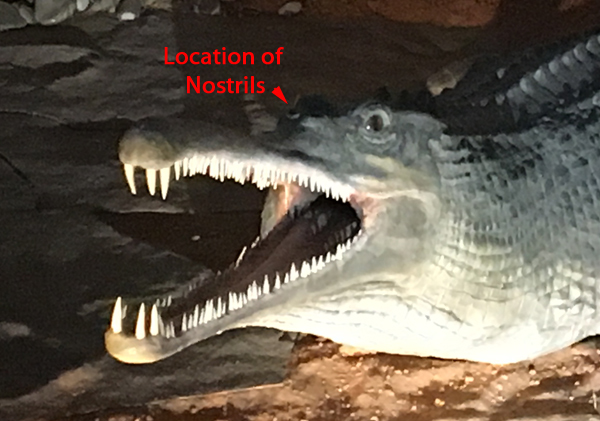
The location of the nostrils in a phytosaur. Picture credit: Everything Dinosaur.
Picture credit: Everything Dinosaur
A Unique Gondwanan Phytosaur Lineage
In the 2023 study, the research team conducted a detailed phylogenetic analysis. Their results placed Colossosuchus techniensis within the phytosaur subfamily Mystriosuchinae. However, the fossils revealed something even more intriguing. The Indian material forms a distinct evolutionary clade. Consequently, this discovery represents the earliest evidence of phytosaur endemism in Gondwana.
The scientists concluded that this lineage branched close to relatives such as Volcanosuchus and Rutiodon. These taxa belong to a broader group known as Leptosuchomorpha. Interestingly, this group shows the first appearance of a depressed supratemporal fenestra. Previously, researchers used this feature to identify more derived phytosaurs.
Phytosaurs and the Carnian Pluvial Event
The researchers also explored the wider evolutionary context. Early phytosaur diversification may have occurred during the Carnian Pluvial Event (CPE). This interval brought dramatic climate change to the Late Triassic. In particular, rainfall increased across many regions. These wetter conditions may have helped phytosaurs expand along coastal environments.
Scientists suggest that phytosaurs migrated along the circum-Tethyan coastline. Later, many lineages evolved independently within Gondwana.
Unfortunately, this success did not last forever. During the Early Norian, many phytosaur taxa disappeared. Researchers suspect increasing aridity played a role in this extinction event. Nevertheless, further study is required to confirm the cause.
A Colossosuchus techniensis Model Coming Soon
Fascinating discoveries like this inspire new prehistoric animal replicas. Therefore, collectors will be pleased to hear that a Colossosuchus model is being introduced.
Everything Dinosaur expects this impressive Triassic predator to join the CollectA range later this year. The model should capture the distinctive long snout and powerful body typical of large phytosaurs. As a result, enthusiasts will soon be able to add this giant Triassic reptile to their collections.
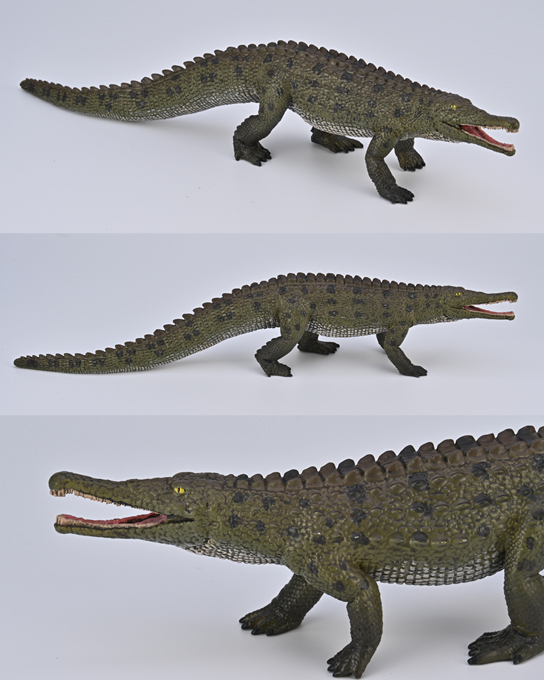
Three views of the new for 2026 CollectA Colossosuchus techniensis model. A replica of a Late Triassic phytosaur from India.
The discovery of Colossosuchus techniensis was described by Debajit Datta and Sanghamitra Ray. Their research appeared in the academic journal Papers in Palaeontology.
This important study highlights the diversity of phytosaurs in India. Furthermore, it improves our understanding of Triassic ecosystems across Gondwana.
The Everything Dinosaur website: Prehistoric Animal Figures.