

New Scimitar-crested Spinosaurus Species Described
Palaeontologists have revealed an extraordinary new species of dinosaur. This giant theropod, named Spinosaurus mirabilis, lived around ninety-five million years ago in what is now the central Sahara Desert. It is the first new species in the Spinosaurus genus described in more than a century.
The discovery challenges long-held ideas about how spinosaurids lived and hunted. The name mirabilis means “marvellous” in Latin, reflecting the unique and striking anatomy of this Cretaceous piscivore.
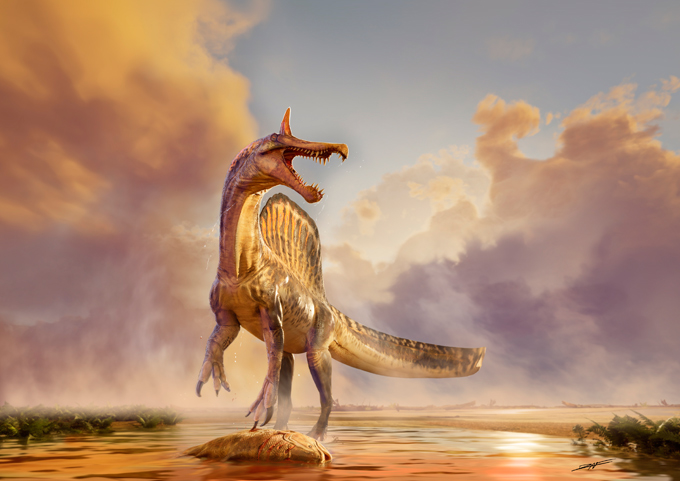
A Spinosaurus mirabilis has caught a coelacanth. Picture credit: D. Navarro.
Picture credit: D. Navarro
A Remarkable Discovery
The story began in 2019 when scientists pulled a massive, oddly shaped bone from Sahara sands. The scimitar-shaped crest of this dinosaur was so large and unexpected that the scientists initially did not recognise it for what it was. Only after a return expedition was despatched (2022) and the discovery of additional fossils did the truth emerge — a new dinosaur species had been found.
The research team, led by the University of Chicago’s Paul Sereno, published the findings in the academic journal “Science”.
Based on the crest’s surface texture and interior vascular canals, the study team concluded that this crest was sheathed in keratin. It may have been brightly coloured and played a role in species identification and visual display.
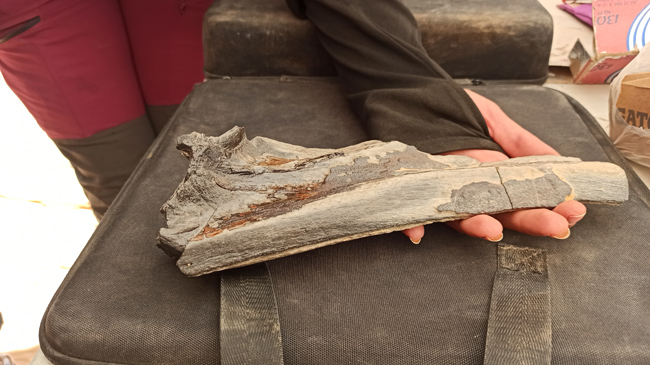
Ana Lázaro holding crest of Spinosaurus mirabilis in field. Picture credit: Alvaro Simarro.
Picture credit: Alvaro Simarro
Another striking feature of the skull is its interdigitating upper and lower tooth rows. These make a deadly trap for slippery fish. Interdigitating teeth, where those of the lower jaw protrude outward and between those of the uppers, is a time-honoured adaptation on among piscivores in the fossil record. For example, this type of dentition is found in ichthyosaurs, crocodilians and pterosaurs. Among dinosaurs, it sets Spinosaurus and closest kin apart.
Commenting on the significance of this discovery, lead author Paul Sereno, (PhD, Professor of Organismal Biology and Anatomy at the University of Chicago) stated:
“This find was so sudden and amazing, it was really emotional for our team. I’ll forever cherish the moment in camp when we crowded around a laptop to look at the new species for the first time, after one member of our team generated 3D digital models of the bones we found to assemble the skull — on solar power in the middle of the Sahara. That’s when the significance of the discovery really registered.”
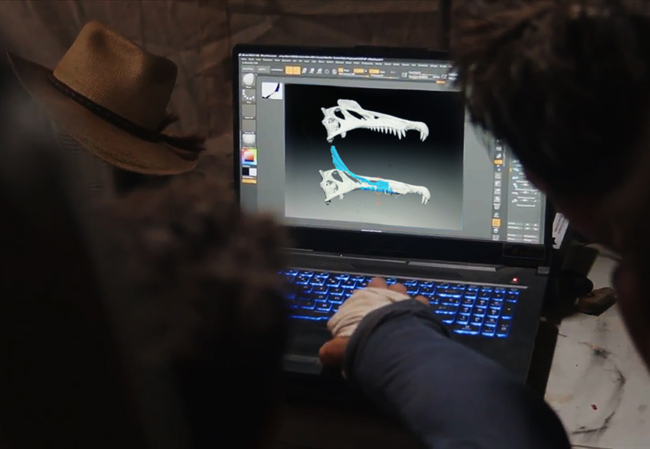
Field team members getting their first look at the tall crested Spinosaurus skull. Picture credit: Jessica Schwartz.
Picture credit: Jessica Schwartz
What Made Spinosaurus mirabilis Special?
Previously, spinosaurid bones and teeth had only been found principally in coastal deposits. This led to some experts postulating that these fish-eating theropods may have been fully aquatic, pursuing prey underwater. However, the new fossil area in Niger documents animals that were living inland, some 500 to 1000 km from the nearest coastline. The proximity of the spinosaurid material to the fossilised remains of sauropods suggest that this was a forested, inland ecosystem crossed by many rivers.
Paul Sereno added:
“I envision this dinosaur as a kind of ‘hell heron’ that had no problem wading on its sturdy legs into two metres of water but probably spent most of its time stalking shallower traps for the many large fish of the day.”
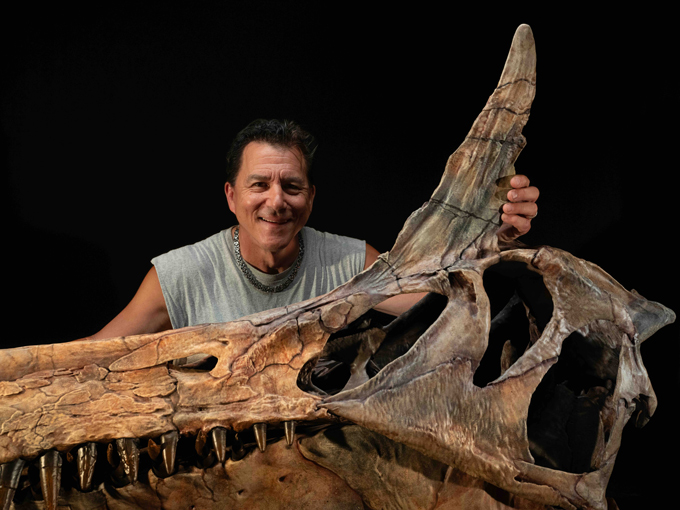
Paul Sereno with a cast of the skull of Spinosaurus mirabilis. Picture credit: K. Ladzinski.
Picture credit: K. Ladzinski
An Amazing Journey
The journey that culminated in this remarkable fossil discovery began with a single sentence in a monograph from the 1950s. A French geologist mentioned finding a single fossil tooth resembling those of the giant carnivore Carcharodontosaurus found in Egypt’s Western Desert at the turn of the last century.
The field team ended up meeting a local Tuareg man who led them on his motorbike deep into centre of the Sahara, where he had seen huge fossil bones. After nearly a day of travel with no shortage of doubts regarding the success of this venture, the local man led them to the fossil site (Jenguebi). There, with little time to spare before returning to camp, the team found teeth and jaw bones of what turned out to be a new Spinosaurus species.
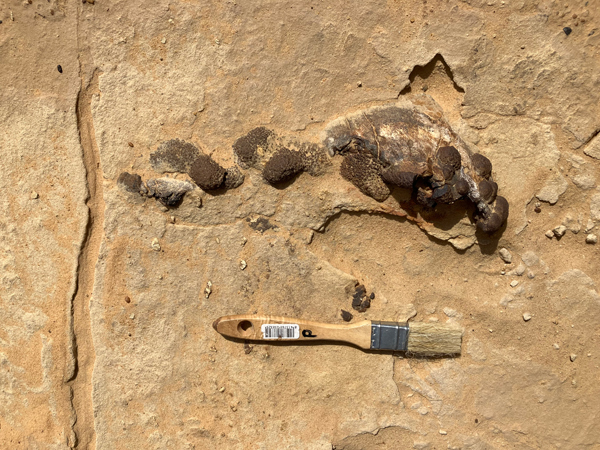
The snout end of Spinosaurus mirabilis weathering out of the substrate. Picture credit: Daniel Vidal.
Picture credit: Daniel Vidal
What Does this Mean for the Spinosauridae?
The discovery of Spinosaurus mirabilis expands our view of spinosaurid evolution. It shows that these theropods were not restricted to coastal habitats. Instead, they thrived inland inhabiting river systems. This new Spinosaurus species suggests that the spinosaurids diversified in ways we are only beginning to understand.
This species helps fill a gap in the fossil record. It hints at a broader evolutionary story across Africa’s Cretaceous landscapes.
The locality, representing the Farak Formation may yield numerous vertebrate remains. The spinosaurid material is approximately ninety-five million old (Cenomanian faunal stage of the Late Cretaceous). At the end of the Cenomanian faunal stage, an abrupt rise in sea levels and climate change probably brought the spinosaurid radiation to an end.
The Phylogeny of Spinosaurus mirabilis
A time-calibrated phylogenetic analysis resolves three Spinosauridae evolutionary phases. Firstly, an initial Jurassic radiation when their distinctive elongate fish-snaring skull evolved and split into two distinctive designs, baryonychine and spinosaurine. Secondly, an Early Cretaceous circum-Tethyan diversification when both reigned as dominant predators. Finally, an early Late Cretaceous phase when spinosaurines attained maximum body size as shallow water ambush specialists limited geographically to northern Africa and South America.
The discovery of the tall-crested Spinosaurus mirabilis in a river system within an inland basin supports a lifestyle interpretation of a wading, shoreline predator with visual display an important aspect of its biology.
Everything Dinosaur acknowledges the assistance of a media release from the University of Chicago in the compilation of this article.
The scientific paper: “Scimitar-crested Spinosaurus species from the Sahara caps stepwise spinosaurid radiation” by Paul C. Sereno, Daniel Vidal, Nathan P. Myhrvold, Evan Johnson-Ransom, María Ciudad Real, Stephanie L. Baumgart, Noelia Sánchez Fontela, Todd L. Green, Evan T. Saitta, Boubé Adamou, Lauren L. Bop, Tyler M. Keillor, Erin C. Fitzgerald, Didier B. Dutheil, Robert A. S. Laroche, Alexandre V. Demers-Potvin, Álvaro Simarro, Francesc Gascó-Lluna, Ana Lázaro, Arturo Gamonal, Charles V. Beightol, Vincent Reneleau, Rachel Vautrin, Filippo Bertozzo, Alejandro Granados, Grace Kinney-Broderick, Jordan C. Mallon, Rafael M. Lindoso and Jahandar Ramezani. Paper published in the journal Science.
The award-winning Everything Dinosaur website: Museum Quality Dinosaur Models.