

Tyrannosaurus rex remains one of the most iconic dinosaurs. People imagine this giant predator thundering across Late Cretaceous landscapes chasing prey. But new science suggests it didn’t stomp like a lumbering beast. Instead, it may have moved in a way more akin to extant flightless birds such as an ostrich. Researchers from the College of the Atlantic (Maine), Oklahoma State University, Colorado Northwestern Community College and the late Scott Swann examined how the feet of T. rex interacted with the ground as it walked. This new study into Tyrannosaurus rex foot function provides new information about theropod gait and speed.
They combined measurements of bones, predictive equations and comparisons with living animals like ostriches. Their study has been published this week in Royal Society Open Science.
Tyrannosaurus rex Foot Function – Walking on Tiptoes
Traditional reconstructions assumed T. rex made contact with the ground using the heel first. This would give a broad, flat footfall and a slow, ponderous stride. But the new analysis turned this idea on its head. The deepest parts of known fossil footprints sit under the toes, not the heel. That suggests the dinosaur struck the ground mainly with the front of its foot, much like birds do today.
This “tiptoe” style of locomotion is very different from how we once thought giant theropods walked. Instead of low, heavy steps, T. rex likely took shorter, quicker strides, with its weight balanced over the toes. That’s remarkably similar to the way fast, bipedal birds like ostriches move.
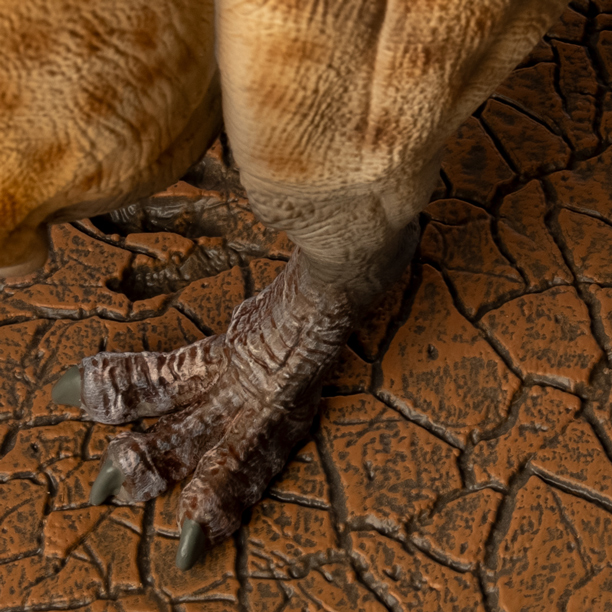
A new study provides new information about Tyrannosaurus rex locomotion and gait. The researchers postulate that T. rex struck the ground with its toes first. The Everything Dinosaur Evolution Tyrannosaurus rex display base features three-toed theropod prints that have been modelled based on real tyrannosaur tracks. Picture credit: Everything Dinosaur.
Picture credit: Everything Dinosaur
Locomotion and Speed
As the researchers postulate that the toes struck the ground first and that the stride was rapid, the authors propose that T. rex may have moved quicker than previously estimated. Their calculations suggest speeds of roughly 5–11 metres per second. That translates to about 11–25 miles per hour (17.7 to 40.2 kph). Still not quite fast enough to chase down a jeep as depicted in the 1993 film “Jurassic Park” but quicker than previous research has suggested.
So, T. rex could run faster than David Beckham: Locomotion and Velocity Study (Theropod Dinosaurs).
To put this in perspective, ostriches can sprint at over 40 km/h (25 mph). A dinosaur as massive as T. rex using a bird-like gait is a fascinating twist on our view of its locomotion. Of course, how fast any individual dinosaur really ran would depend on age, health and body size. But this paper gives us a new way to think about how it moved. Indeed, the research team provides estimates of velocity for different T. rex specimens within their dataset.
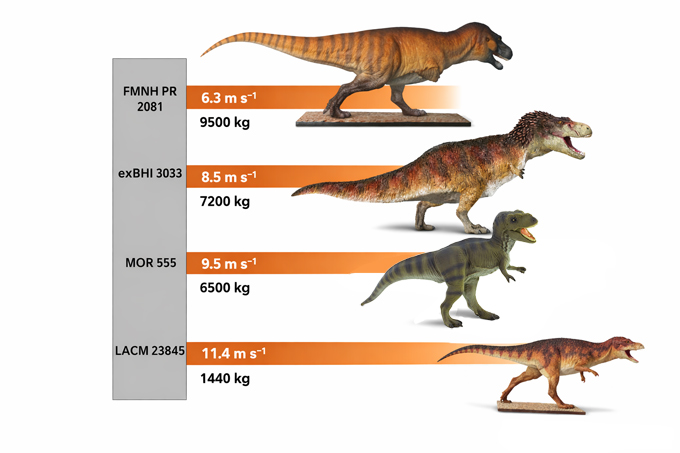
Estimated speeds of T. rex specimens within the dataset used in the Tyrannosaurus rex foot function study. Different dinosaur models including the Everything Dinosaur Evolution T. rex model are used to illustrate the estimated velocity. Picture credit: Everything Dinosaur based on the Boeye et al paper.
Picture credit: Everything Dinosaur based on the Boeye et al paper
Footprints and the Everything Dinosaur Evolution T. rex Model
Everything Dinosaur’s Evolution T. rex model beautifully captures one aspect of this research. The display base features replicated Tyrannosaurus footprints from the fossil record. These prints are not just decorative. They reflect real ichnological data, and they give us clues about gait and stance. For example, the two tracks on the display base have been carefully modelled. They have deeper toes than heels and this reflects the evidence presented in this scientific paper.
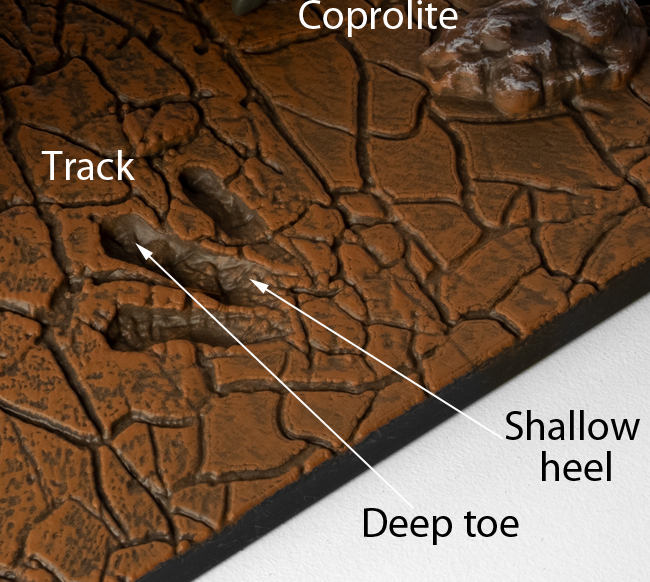
The tracks on the Everything Dinosaur Evolution display base are based on actual prints from the fossil record. The deeper toe area indicates that these tracks reflect the latest research. Picture credit: Everything Dinosaur.
Picture credit: Everything Dinosaur
To view the Everything Dinosaur Evolution model range: Everything Dinosaur Evolution Models.
The new study’s findings resonate with that real footprint evidence. If T. rex walked with a bird-like foot function, then those tracks on our model base become even more meaningful. They show where the animal shifted weight onto its toes, aligning with the idea of higher stride frequency and elevated speed potential.
The Movement of Extinct Animals
The movement of extinct animals has interested numerous researchers. Tyrannosaurus rex locomotion has been extensively studied, in part, due to an iconic scene from “Jurassic Park”. The research team used complex statistical analysis to compare fossil specimens with extant animals including ostriches. Additionally, the models are consistent with recent studies suggesting slower to more intermediate top speeds for adult Tyrannosaurus that fall within the range of 5–11 metres per second. This study lays the groundwork for future studies to add comparisons with additional theropods and potentially identify ecological differences between species.
This research doesn’t just revise a number on a speed chart. It touches on how the largest land predator of its time interacted with its environment. A bird-like gait has implications for energy use, hunting strategy, balance and stability. It also reinforces the evolutionary link between theropod dinosaurs and modern birds.
In summary, T. rex may have been both terrifying and surprisingly agile. With Tyrannosaurus rex foot function studies like this, we continue to peel back layers of preconception about how dinosaurs lived and moved. And models like Everything Dinosaur’s Evolution T. rex help us share that story with collectors and enthusiasts around the world.
The scientific paper: “Evidence of bird-like foot function in Tyrannosaurus” by Adrian Tussel Boeye, Kyle Logan Atkins-Weltman, J. Logan King and Scott Swann published in the Royal Society Open Science.
The award-winning Everything Dinosaur website: Dinosaur and Prehistoric Animal Models.

Leave A Comment