

The discovery of a new titanosaur from Morocco is helping palaeontologists rethink dinosaur diversity at the end of the Mesozoic. Indeed, researchers conclude that Maastrichtian dinosaur diversity is underestimated. Meet Phosphatotitan khouribgaensis the first definitive titanosaur described from the late Maastrichtian phosphates of Morocco. This exciting discovery provides fresh insights into African dinosaur faunas just before the mass extinction event.
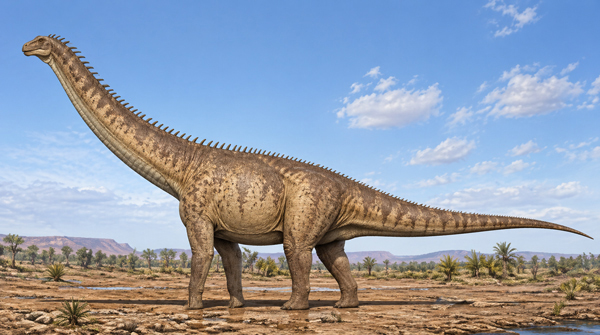
A life reconstruction of the Late Cretaceous Moroccan titanosaur Phosphatotitan khouribgaensis. Picture credit: Everything Dinosaur (AI assisted).
Picture credit: Everything Dinosaur (AI assisted)
Learning About Late Cretaceous African Dinosaurs
The last few million years of the Cretaceous (Maastrichtian faunal stage), saw the final diversification of the Dinosauria prior to the K/Pg extinction event. Discussions of end-Cretaceous dinosaur diversity have focused on well-sampled faunas from Laurasia; far less is known about dinosaurian faunas of the Southern Hemisphere, especially Africa. Subsequently, African dinosaur faunas remain poorly understood.
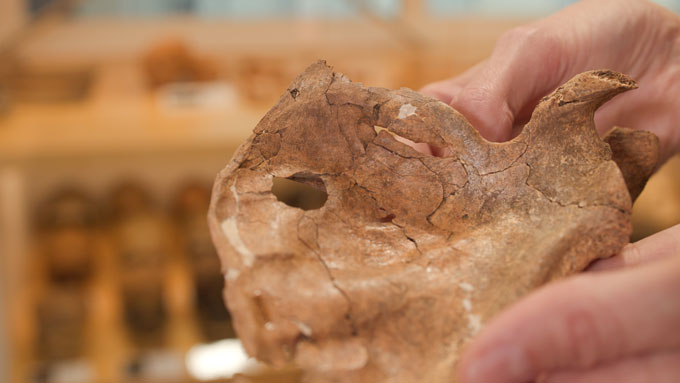
Fortunately, the Maastrichtian-aged phosphate deposits of Morocco offer a rare window into this ancient palaeoecosystem. The fossils are found in the Khouribga Province (Sidi Chennane locality). They have yielded a variety of dinosaur fossils. For example, abelisaurids and lambeosaurines. Titanosaur fossils have been discovered, but no taxon had been erected. However, the research team which included Dr Nicholas Longrich (University of Bath) were confident enough to describe a new species. Although incomplete, the remains are scientifically significant. The researchers identified dorsal, sacral, and caudal vertebrae, along with parts of the pelvis. Importantly, the remains although fragmentary, preserve enough anatomical detail to confirm a new genus and species.
To learn more about the remarkable dinosaur biota associated with the Moroccan Maastrichtian phosphate deposits.
To read about Chenanisaurus barbaricus, a giant abelisaurid from North Africa: The Last African Dinosaur?
Two new abelisaurid theropods described: Two Abelisaurs Described from Fragmentary Remains.
Minqaria bata a new duck-billed dinosaur from the Late Cretaceous of Morocco: New Pony-sized Moroccan Lambeosaurine Dinosaur.
Links to South American Giants
Intriguingly, Phosphatotitan shows anatomical similarities with South American titanosaurs. In particular, it shares features with members of the Lognkosauria, a group that includes the enormous, Early Cretaceous Patagotitan (P. mayorum). For example, it possessed short dorsal and caudal centra, expanded dorsal and caudal neural spines, and a broad pubis. This new species differs from titanosaurs described from the Cretaceous of Africa and Europe.
This connection likely dates back to a time before Africa and South America fully separated. Around 100 million years ago, these landmasses split as the South Atlantic Ocean opened. Therefore, Phosphatotitan provides evidence of ancient biogeographic links across Gondwana. The fossilised bones demonstrate that Phosphatotitan was much smaller than Patagotitan and other South American giants. Scientists estimate that Phosphatotitan weighed between 3.5 and 4 tonnes. In contrast, Patagotitan is estimated to have weighed around 60 tonnes.
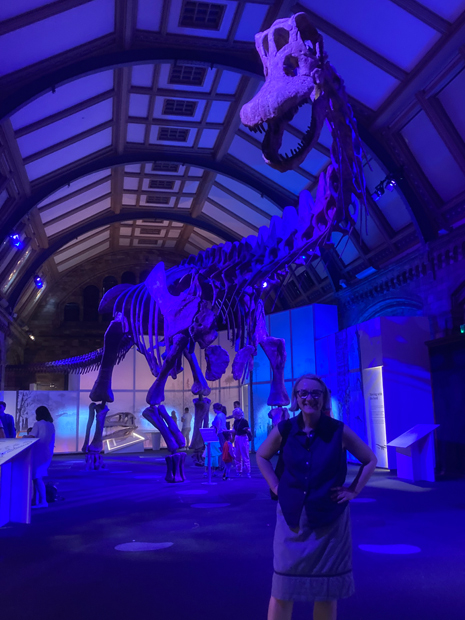
Sue from Everything Dinosaur poses in front of the colossal Patagotitan skeleton which is being exhibited at the Natural History Museum (London). The recently described Phosphatotitan khouribgaensis from the Late Cretaceous of Morocco could be closely related. Picture credit: Everything Dinosaur.
Picture credit: Everything Dinosaur
Why was Phosphatotitan khouribgaensis Small?
Despite its titanosaurian heritage and its close taxonomic relationship with Patagotitan, Phosphatotitan was surprisingly modest in size. Body mass estimates of between three and a half to four tonnes have been proposed. It was much smaller than most of its South American relatives. Its small size relative to other Lognkosauria suggests a lineage selected for small size. This could be a result of island dwarfism. During the latest Cretaceous rising sea levels may have isolated parts of Morocco. Consequently, the smaller landmasses and their limited resources could have favoured smaller dinosaurs.
Alternatively, environmental pressures may have played a key role. In some ecosystems, smaller herbivores outcompete larger ones. This pattern appears in South America, where smaller titanosaurs became more common. Similarly, Egyptian titanosaurs also tend to be small-bodied. Therefore, Phosphatotitan may reflect a broader trend towards smaller sauropods in certain Late Cretaceous ecosystems.
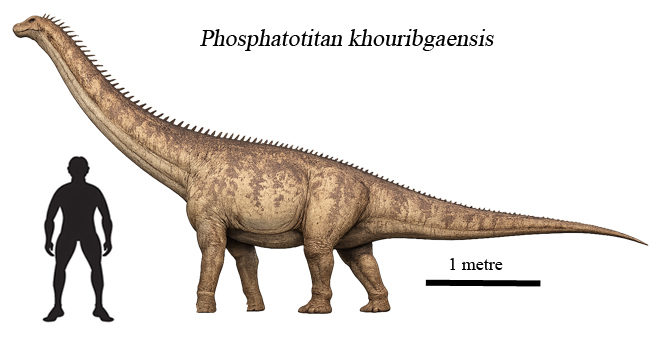
Phosphatotitan khouribgaensis scale drawing. This titanosaur is thought to weigh around four tonnes and was around nine to ten metres long. Picture credit: Everything Dinosaur (AI assisted).
Picture credit: Everything Dinosaur (AI assisted)
Dinosaur Diversity in the Late Cretaceous May Have Been Underestimated
The discovery of Phosphatotitan khouribgaensis highlights the complexity of Late Cretaceous dinosaur dominated ecosystems. As continents drifted apart, dinosaur populations became increasingly isolated. This isolation led to high levels of endemism. At the same time, occasional dispersal events may have allowed some species to spread between landmasses. Consequently, dinosaur faunas in Gondwana were both diverse and regionally distinct.
The close relationships of Morocco’s titanosaurs and abelisaurids to South American species may reflect a wide distribution of these clades prior to the opening of the South Atlantic and the separation of Africa and South America around a hundred million years ago. The high endemism seen in both the Northern and Southern Hemispheres suggests that Maastrichtian dinosaur diversity is underestimated.
The scientific paper: “A Titanosaurian Sauropod with South American Affinities (Lognkosauria: Argentinosauridae) from the Late Maastrichtian of Morocco and Evidence for Dinosaur Endemism in Africa” by Nicholas R. Longrich, Agustín Pérez-Moreno, Verónica Díez Díaz, Xabier Pereda-Suberbiola, Nathalie Bardet and Nour-Eddine Jalil published in Diversity.
The award-winning Everything Dinosaur website: Scientifically Accurate Models of Dinosaurs.

Leave A Comment