

A New Sauropod Dinosaur from the Early Cretaceous of Brazil
A new genus of sauropod dinosaur has been named from Brazil. It expands the known diversity of Early Cretaceous sauropods in the northern part of South America. In addition, the newly named dinosaur Dasosaurus tocantinensis provides fresh evidence of dinosaur dispersal between Europe, Africa and South America. The scientific paper describing the new taxon was recently published in the “Journal of Systematic Palaeontology”.
Dasosaurus tocantinensis
The fossil material was discovered by a construction team building a road/rail terminal in the city of Davinópolis, Maranhão state (northeastern Brazil). The fossils consisted of ten disarticulated caudal vertebrae, limb bones, ribs, a pubis, ischium and several phalanges were found at the bottom of an eight-metre-high slope. Initially, it was thought these large bones were Quaternary in age. However, it was soon determined that the material represented a large sauropod dinosaur.
Palaeontologists have confirmed that the fossils (specimen number CPHNAM VT 1600), are from the Aptian-aged strata of the Itapecuru Formation. At an estimated twenty metres in length, Dasosaurus is the largest sauropod to be scientifically described from this formation. Moreover, it is one of the largest dinosaurs known from Brazil.
Dasosaurus has been assigned to the Somphospondyli, a group of titanosauriform sauropods closely related to titanosaurs. Scientists identified several unique anatomical traits in the fossil material. These included unusual ridges on the tail vertebrae and a pronounced lateral bulge on the femur.
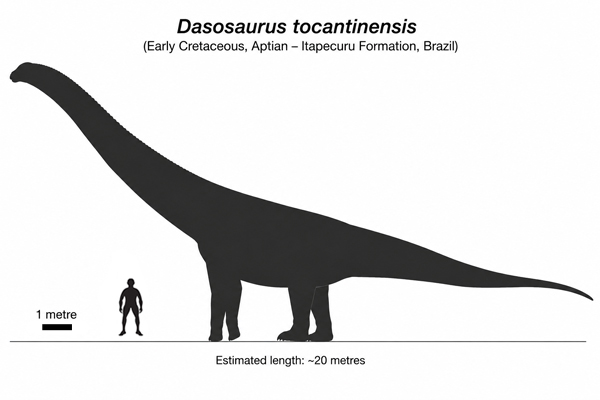
A scale drawing of the Brazilian titanosauriform Dasosaurus tocantinensis. Picture credit: Everything Dinosaur (AI assisted).
Picture credit: Everything Dinosaur (AI assisted)
What’s in a Name?
The genus name combines the Greek word “dasos”, meaning forest, with “sauros”, meaning lizard. It is in recognition of this region of Brazil is famous for the remarkable Amazon forest. The species name honours the Tocantins region, close to where the fossils were discovered.
The study highlights an intriguing evolutionary relationship. Phylogenetic analysis brackets Dasosaurus with the larger, and geologically older Garumbatitan morellensis, a sauropod from the Arcillas de Morella Formation of Spain. As a result, the scientists proposed that the lineage originated in Europe. Subsequently, these dinosaurs dispersed into South America through northern Africa before the Atlantic Ocean fully opened.
This discovery highlights important faunal links between Europe and Gondwana during the Early Cretaceous. In addition, it demonstrates that dinosaur populations could still migrate between landmasses during the Early Cretaceous.
Studying Dinosaur Bone Histology
The research team also examined the microscopic structure of the fossil bones. This branch of palaeontology is known as osteohistology. The scientists identified a mixture of primitive and more advanced traits within the bone tissue. These findings provide valuable information about sauropod growth and development. Moreover, they help scientists understand the evolutionary transition between early neosauropods and later titanosaurs.
The Significance of Dasosaurus tocantinensis
South America has yielded many spectacular sauropod fossils. For example, some of the largest dinosaurs of all time such as Argentinosaurus and Patagotitan. However, discoveries of earlier branching titanosauriforms remain relatively rare.
To read about the discovery of the giant titanosaur Patagotitan: A New Giant Dinosaur Gets a Name.
An enormous titanosaur from Brazil Austroposeidon magnificus: Huge Titanosaur from Brazil (Austroposeidon).
Dasosaurus tocantinensis helps fill an important gap in the fossil record. It also expands the known diversity of Brazilian sauropods from the Early Cretaceous. Furthermore, the discovery supports the idea that ancient dinosaur faunas remained interconnected across vast regions. During the Early Cretaceous, Europe, Africa and South America still shared intermittent land connections. These routes allowed dinosaurs and other animals to disperse between continents.
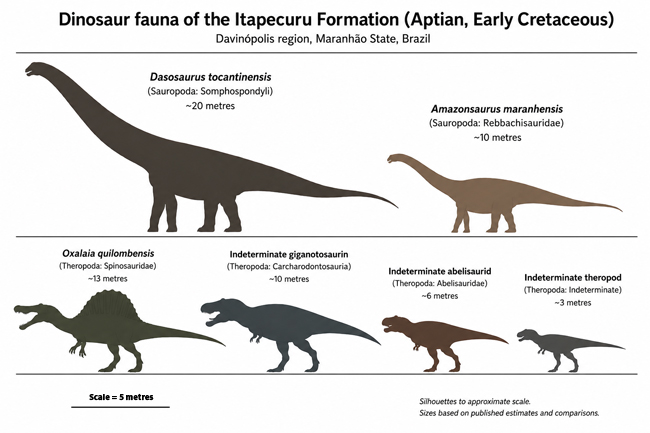
The known dinosaur biota associated with the Itapecuru Formation of Brazil. Picture credit: Everything Dinosaur (AI assisted).
Picture credit: Everything Dinosaur (AI assisted)
With its distinctive anatomy and European affinities, Dasosaurus tocantinensis represents one of the most significant South American sauropod discoveries announced this year.
The scientific paper: “A new titanosauriform with European affinities in the Early Cretaceous of Brazil: insights on Somphospondyli phylogeny, histology and biogeography” by Elver L. Mayer, Julian C. G. Silva Junior, Leonardo R. Kerber, Bruno A. Navarro, Kamila L. N. Bandeira, Juan C. Cisneros, Eliane P. Sousa, Agostina A. Pereira, Manuel A. Medeiros, Rafael M. Lindoso, Francisco Pedro Cavalcanti Neto, Aline M. Ghilardi, Tito Aureliano, Pedro L. Godoy, Gabriel S. Ferreira and Max C. Langer published in the Journal of Systematic Palaeontology.
The multi-award-winning Everything Dinosaur website: Models of Sauropods and Other Prehistoric Animals.