

New Study Solves Mystery of Tiny Theropod Dinosaur Arms
Why did T. rex have tiny arms? This is a question we get asked a lot at Everything Dinosaur. Ironically, several, not closely related theropod lineages show forelimb reduction. Tyrannosaurus rex had famously small arms, but so did lots of other large meat-eating dinosaurs. A new study suggests that the tiny arms of some theropod dinosaurs evolved because their heads became the main weapons for securing a meal.
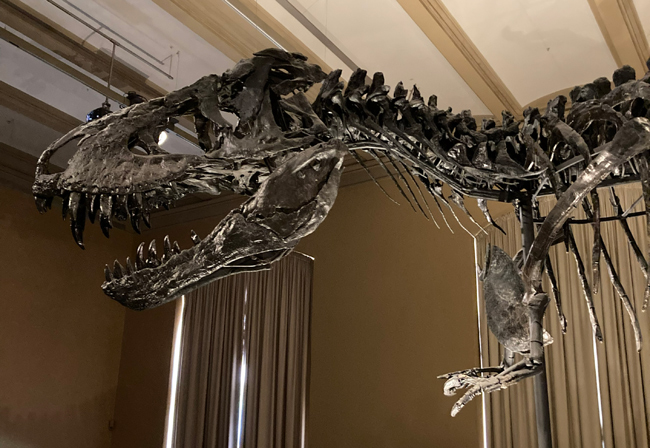
The “Tristan” Tyrannosaurus rex specimen on display at the Museum für Naturkunde Berlin. This theropod has a huge skull and famously small arms. Picture credit: Everything Dinosaur.
Picture credit: Everything Dinosaur
Why Did T. rex Have Tiny Arms?
This might be a popular question from model collectors. However, scientists tend to take a broader view. For example, if forelimb reduction is observed in the fossil remains of numerous theropods, then it could be concluded that reduced forelimbs evolved convergently. The new study published in the “Proceedings of the Royal Society B” examined eighty-two species of theropod dinosaur. Researchers found a strong link between powerful skulls and reduced forelimbs. In simple terms, as some meat-eating dinosaurs evolved stronger bites and more robust heads, their arms became less important.

The Everything Dinosaur Evolution Tyrannosaurus rex model (EDE001) shown in anterior view. Picture credit: Everything Dinosaur.
Picture credit: Everything Dinosaur
The picture (above) shows the recently introduced Everything Dinosaur Evolution 1:33 scale Tyrannosaurus rex model shown in anterior view. The forelimbs are in proportion, and they are barely noticeable compared to the deep, broad body and the huge head.
To view the range of Everything Dinosaur Evolution models: Everything Dinosaur Evolution Tyrannosaur Models.
The team developed a theropod cranial robusticity scoring system. Reduced or vestigial forelimbs evolved in at least five theropod lineages in concert with increased cranial robusticity and gigantism. Therefore, tiny arms evolved several times within the Theropoda.
Reduced/Vestigial Forelimbs Evolved Several Times
It is natural for most people to associate tiny arms with Tyrannosaurus rex. However, the scientists identified five different theropod lineages with reduced/vestigial forelimbs in animals with a large body mass.
- Tyrannosaurids
- Carcharodontosaurids
- Abelisaurids
- Megalosaurids
- Ceratosaurids
Importantly, these groups were not all closely related. Furthermore, it can be concluded that the same body plan evolved independently several times. This is known as convergent evolution.

The new for 2026 CollectA Deluxe Meraxes gigas figure. This replica of a super-sized carcharodontosaurid theropod had reduced forelimbs. This is an example of convergent evolution.
The giant carcharodontosaurid Meraxes gigas, fossils of which come from Upper Cretaceous deposits in Patagonia is another example of a large theropod with greatly reduced forelimbs. The picture (above) shows the new for 2026 CollectA Deluxe Meraxes model. The tiny arms and small hands with three digits have been beautifully sculpted.
To view the CollectA Deluxe model range: CollectA Deluxe Prehistoric Animal Models.
Robust and Powerful Skull Replaced Strong Arms
The research team concluded that theropod skulls became increasingly important for attacking prey. As a result, the arms gradually reduced in size. Lead author Charlie Roger Scherer (University College London) explained that the head effectively “took over” from the forelimbs during hunting.
He stated:
“Everyone knows the T. rex had tiny arms but other giant theropod dinosaurs also evolved relatively small forelimbs. The Carnotaurus had ridiculously tiny arms, smaller than the T. rex. We sought to understand what was driving this change and found a strong relationship between short arms and large, powerfully built heads. The head took over from the arms as the method of attack. It’s a case of ‘use it or lose it’ – the arms are no longer useful and reduce in size over time.”
The scientists found that reduced forelimbs were more strongly linked to skull robustness than overall body size. This was a key discovery. Previously, some researchers suggested that small arms were simply a side effect of giant body size. However, the new study challenges that idea.
Some theropods with tiny arms were not especially huge. For example, Majungasaurus from the Late Cretaceous of Madagascar weighed around 1.6 tonnes. Although large, it had a body weight four times lighter than Tyrannosaurus rex. Despite this, it still had very reduced forelimbs and a heavily built skull.
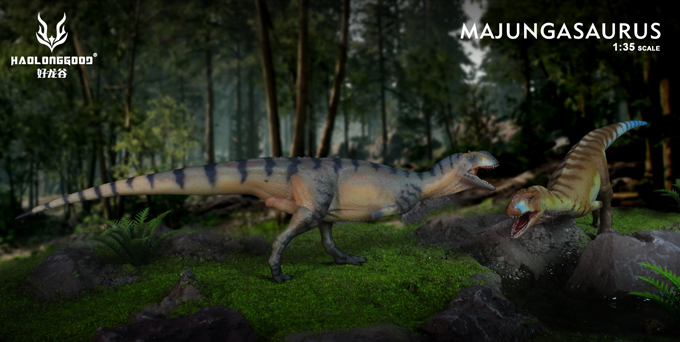
Majungasaurus models from Haolonggood. The Deng Fei Majungasaurus figure is shown in lateral view with the blue-tailed Ou Peng shown on the right. These abelisaurid theropods had a robust skull and tiny arms.
To view the Haolonggood range of prehistoric animals: Haolonggood Prehistoric Animal Figures.
An Evolutionary Arms Race
The researchers think gigantic prey animals may have driven this evolutionary trend. During the Jurassic and Cretaceous, enormous plant-eating dinosaurs (sauropods) dominated many ecosystems. They suggest that the evolution of reduced forelimbs was potentially influenced by an upward trend in prey body size. Huge sauropods and other large herbivores may have led to predators evolving stronger skulls and jaws.
Trying to grasp a giant sauropod with relatively small claws may not have been effective. Instead, attacking with powerful jaws and holding onto prey with the mouth could have offered advantages. As a result, some theropod lineages developed deeper skulls, stronger jaw muscles which increased bite forces. The researchers described this process as an evolutionary arms race between predators and prey.
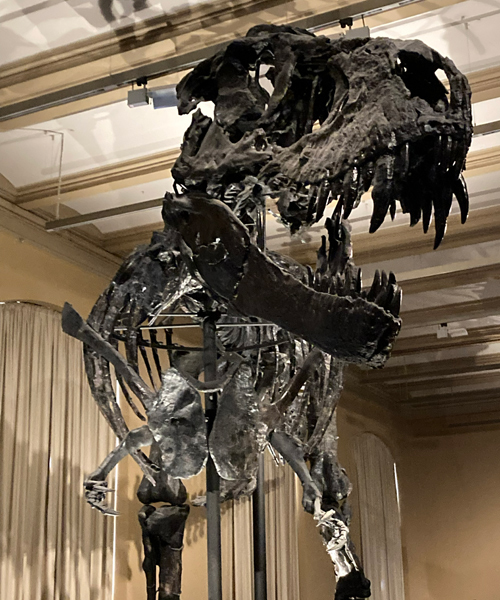
The “Tristan” Tyrannosaurus rex specimen shown in anterior view. The robust and powerful skull contrasts with the reduced forelimbs. Picture credit: Everything Dinosaur.
Picture credit: Everything Dinosaur
Measuring Skull Strength
For this study, the scientists developed a new method for measuring skull robustness. Several factors were included in their calculations, such as skull shape, bite force, skull compactness and the thickness of skull bones. Compact skulls tend to resist bite force stresses better than long, narrow skulls. On the cranial robusticity scale Tyrannosaurus rex was ranked highest. This helps to answer the question why did T. rex have tiny arms?
Intriguingly, Tyrannotitan (T. chubutensis) a giant carcharodontosaurid from the Early Cretaceous of Argentina was ranked second on the cranial robusticity scale. Tyrannotitan lived more than thirty million years before T. rex. It demonstrates that this trend evolved long before tyrannosaurs dominated North America.
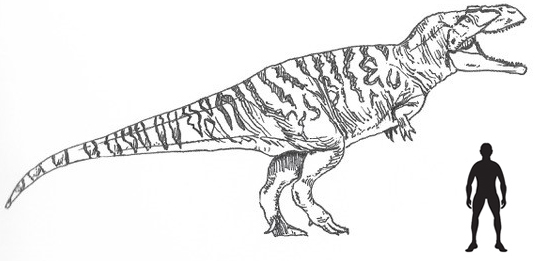
A Tyrannotitan chubutensis scale drawing has been commissioned in preparation for the arrival of the new PNSO Tyrannotitan figure. Picture credit: Everything Dinosaur.
Picture credit: Everything Dinosaur
Different Dinosaurs Reduced Their Arms in Different Ways
Although several theropod lineages evolved tiny forelimbs, they did not all shrink them in the same manner. For example, abelisaurids reduced the hands and lower arms dramatically. In contrast, tyrannosaurids reduced the entire forelimb more evenly. This suggests that different developmental pathways produced similar outcomes.
In evolutionary biology, this is another fascinating example of convergent evolution. Different dinosaur groups independently evolved comparable solutions to similar ecological challenges.
The study provides important new insights into theropod evolution. It also helps explain one of the most famous dinosaur features in popular culture. The tiny arms of Tyrannosaurus rex were probably not useless. Instead, they were simply less important as the skull became the primary hunting tool. As theropods evolved increasingly powerful bites, natural selection may have favoured predators that relied more on jaws than claws.
The result was a series of formidable carnivores with massive skulls, bone-crushing bites and surprisingly tiny arms.
An Answer to the Question Why Did T. rex Have Tiny Arms?
This is a fascinating study. Perhaps, the skulls of alvarezsaurid dinosaurs can be examined using this new statistical analysis. After all, these lightly built theropods had greatly reduced forelimbs too. This analytical method could also provide a new perspective on avian dinosaurs – birds.
We may have an answer to one of our most often asked questions – why did T. rex have tiny arms?
Everything Dinosaur acknowledges the assistance of a media release from University College London in the compilation of this article.
The scientific paper: “Drivers and mechanisms of convergent forelimb reduction in non-avian theropod dinosaurs” by Charlie Roger Scherer, Elizabeth Steell and Paul Upchurch published in the Proceedings of the Royal Society B.
The award-winning Everything Dinosaur website: Scale Models of Theropods and Other Dinosaurs.