

What Was Dunkleosteus? Facts About the Giant Armoured Fish (Part 2)
Earlier this week, we published an article that answered questions about Dunkleosteus. Team members receive emails and often we get asked about prehistoric animals. Questions about the giant Devonian fish Dunkleosteus frequently occur. We try our best to respond to all the queries received. In today’s article we aim to answer more questions about this enigmatic Palaeozoic predator. In addition, in response to a question we comment on the accuracy of Dunkleosteus models.
To read our early blog post answering questions about Dunkleosteus: What was Dunkleosteus? Facts About a Giant Prehistoric Fish.

A comparison between the new for 2018 CollectA 1;20 scale replica of Dunkleosteus and a museum specimen. Everything Dinosaur team members receive questions about Dunkleosteus and are often asked to comment about Dunkleosteus models. Picture credit: Everything Dinosaur.
Picture credit: Everything Dinosaur
Why Is Dunkleosteus Famous?
This is an excellent question. It is probably well known as it was unlike any living fish. It’s large size and the huge, shearing plates that formed its jaws make it look monstrous. The armour plates fossilise much more readily than soft tissue. As a result, museums tend to include a reconstruction of this fish in galleries highlighting ancient marine life.
Dunkleosteus features prominently in books about Palaeozoic creatures. Its terrifying appearance has made Dunkleosteus a popular prehistoric animal for palaeoart reconstructions. Furthermore, lots of models of this placoderm have been produced.
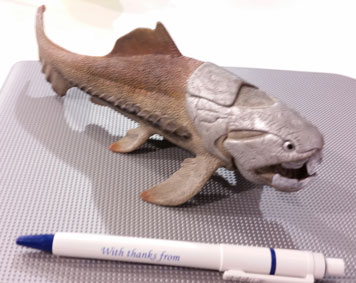
Swimming into view a placoderm model – Dunkleosteus. Picture credit: Everything Dinosaur.
Picture credit: Everything Dinosaur
The picture (above) shows a Dunkleosteus model from Schleich which was introduced in 2017.
To view the range of Schleich figures available from Everything Dinosaur: Schleich Dinosaurs and Prehistoric Animal Figures.
Today, Dunkleosteus remains one of the best-known predators from the Devonian.
What Type of Fish Was Dunkleosteus?
Dunkleosteus belonged to a class of prehistoric fish called Placodermi. Placoderms were armoured jawed fish that thrived during the Silurian and Devonian. They were diverse, filled numerous ecological niches and were geographically widespread. Placoderms represent some of the earliest jawed vertebrates. Therefore, they played an important role in vertebrate evolution. Having armoured bodies has helped preservation. As a result, they tend to be disproportionately more common in the Devonian fossil record compared to other vertebrates.
Australian placoderm fossil provides new information on vertebrate evolution: Fossil Turns Vertebrate Evolution on its Head.
We get asked “was Dunkleosteus a shark”? Dunkleosteus was not a shark. Sharks belong to an entirely different class of cartilaginous fish (Chondrichthyes). However, Dunkleosteus did co-exist with early sharks. Fossils of shark genera are found in the same strata as Dunkleosteus fossils.
Was Dunkleosteus Bigger Than a Great White Shark?
This is a popular question. It seems that fans of prehistoric animals like comparing extinct predators with living predators. To answer this question, we have to consider what we know about the size of the largest species of Dunkleosteus (D. terrelli) and what we know about the biggest specimens of Carcharodon carcharias. Unfortunately, size estimates for Dunkleosteus terrelli vary. The fossil record is fragmentary, and little is known about the postcranial skeleton. For example, size estimates for D. terrelli range from under four metres in length to in excess of ten metres.
Carcharodon carcharias is one of the largest living hypercarnivorous fish. Sexual dimorphism occurs in this species; mature females tend to be larger than mature males. Marine biologists have estimated that this shark could reach a length of around six metres. Intriguingly, a study published in 2023 (Russell K. Engelman) proposed that the deeper body proportions as opposed to the more streamlined sharks would have made Dunkleosteus terrelli heavier than a shark of similar length.
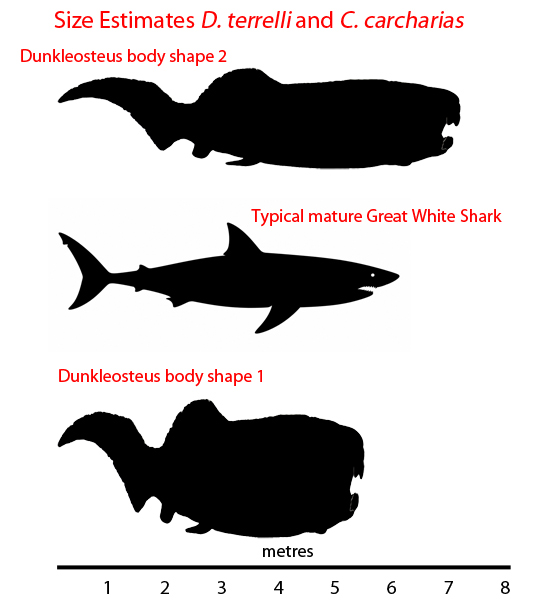
Size estimates for Dunkleosteus terrelli compared to Carcharodon carcharias. Picture credit: Everything Dinosaur
Picture credit: Everything Dinosaur
What is the Most Accurate Dunkleosteus Figure?
Fortunately, collectors have lots of Dunkleosteus models to choose from. In addition, there is a Dunkleosteus model to suit most budgets. One of our favourites and a figure that still stands up to scientific scrutiny is the Wild Safari Prehistoric World Dunkleosteus.
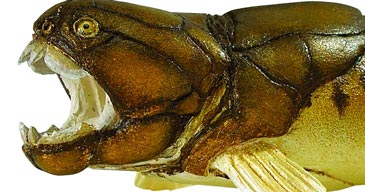
The Wild Safari Prehistoric World Dunkleosteus model. A replica of a fish with a powerful bite.
The dermal armour of this figure has attracted praise and the shearing plates equipped with their long fangs reflect fossil material.
To view the range of Wild Safari Prehistoric World models: Wild Safari Prehistoric Animal Models.
A more recent Dunkleosteus figure is Zaha the Dunkleosteus from PNSO. This model was introduced in 2021. It is much larger than the Wild Safari prehistoric world figure, in fact it’s one of the largest Dunkleosteus models we stock. It measures twenty-three centimetres long. It has been beautifully painted, and the model has an articulated jaw too.
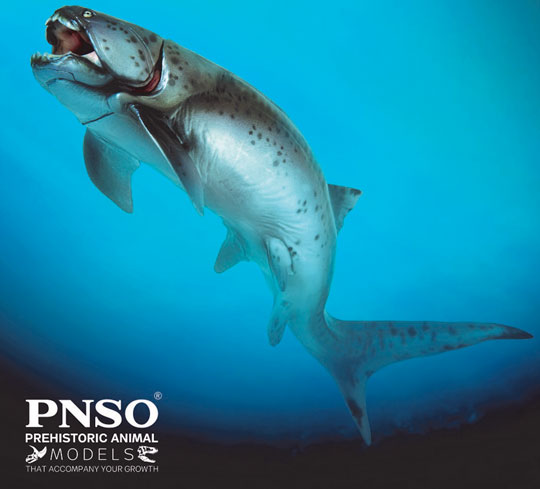
PNSO Zaha the Dunkleosteus the second prehistoric fish to the PNSO mid-size model range after Haylee the Helicoprion.
The PNSO Dunkleosteus is an excellent figure, and we recommend it for serious collectors.
To read a customer review of the PNSO Dunkleosteus: Zaha the Dunkleosteus Model Reviewed.
To view the range of PNSO prehistoric animal figures in stock: PNSO Age of Dinosaurs Figures.
Dunkleosteus Models for Dioramas
Several species of Dunkleosteus have been erected. However, not all of them are valid. We often get asked to recommend a Dunkleosteus figure that works well in dioramas. Model makers are often looking for a figure to represent smaller species than D. terrelli. We advise them to use the small Dunkleosteus model in the CollectA set of mini prehistoric marine animals. It is under ten centimetres in length yet has lots of good detail for a small figure. It is a useful model to have when making small scale dioramas of Devonian life.
When it comes to Dunkleosteus its popularity does not seem to be wavering. For example, Papo intends to introduce a Dunkleosteus figure in 2027. We welcome this development and we look forward to seeing how the design team at Papo interpret this famous Devonian predator.
The multi-award-winning Everything Dinosaur website: Prehistoric Animal and Dinosaur Models.