

A newly named giant Tylosaurus species has been named by researchers. The new species of Tylosaurus has been erected based on fossils found in northern Texas. This enormous predator ruled the ancient seas around 80 million years ago (Campanian faunal stage of the Late Cretaceous). The scientific paper was published in the Bulletin of the American Museum of Natural History. The new species has been named Tylosaurus rex. Its name translates as “King of the Protuberance Lizards.”
The name also honours the work of Texas palaeontologist John Thurmond. Decades ago, he suspected these fossils represented a different species of Tylosaurus. Fossil material had previously been assigned to T. proriger.
The T. proriger fossil material mainly comes from Kansas. These fossils are estimated to be about 84 million years old. The Texas fossil material is around 4 million years younger. Geological age of the fossils strongly suggests that the Texas fossils do indeed represent a distinct species.
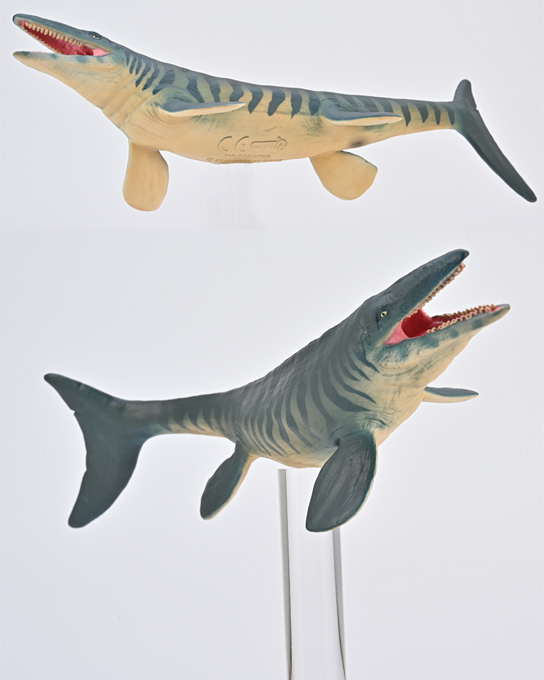
The new for 2026 CollectA Tylosaurus marine reptile model. This new figure is based on Tylosaurus proriger.
The picture (above) shows the recently introduced CollectA Age of Dinosaurs Tylosaurus figure. We think that this model is based on T. proriger.
To view the CollectA Age of Dinosaurs models in stock: CollectA Prehistoric Life Models.
The research was led by scientists from the American Museum of Natural History (New York City), the Perot Museum of Nature and Science (Dallas, Texas), and Southern Methodist University (Texas).
A New Species – Tylosaurus rex
Tylosaurus rex was not a dinosaur. Media releases might have linked this mosasaur with Tyrannosaurus rex. However, the Tylosaurus genus is more closely related to modern snakes and lizards than it is to archosaurs like T. rex. Nevertheless, like Tyrannosaurus rex, Tylosaurus rex was probably an apex predator within its ecosystem. Mosasaurs were powerful ocean hunters. They evolved from land-dwelling lizards. Over time, they adapted fully to life in the sea.
The researchers estimate that Tylosaurus rex reached lengths of around 13 metres. Its huge skull contained strong jaws and serrated teeth. These adaptations helped it tackle large prey.
Lead author of the study Amelia Zietlow (American Museum of Natural History) commented that everything tends to be bigger in Texas, including mosasaurs. Several autapomorphies were identified the allowed the research team to confidently reassign T. proriger material this new species.
A Violent Ancient Predator
One remarkable fossil specimen shows evidence of serious injuries. The animal had damage to its snout and jaw. Researchers think another giant Tylosaurus caused these wounds. In other words, these marine reptiles may have fought each other violently. Interestingly, this behaviour mirrors injuries found in Tyrannosaurus rex fossils. That similarity partly inspired the dramatic species name.
The Western Interior Seaway
During the Late Cretaceous, much of Texas lay beneath a shallow sea. This ancient waterway formed part of the famous Western Interior Seaway. The seas teemed with life. Giant sharks, fish, turtles and marine reptiles shared these waters.
Tylosaurus rex probably hunted almost anything it could overpower. Scientists think it likely preyed upon fish, turtles, and other marine reptiles.
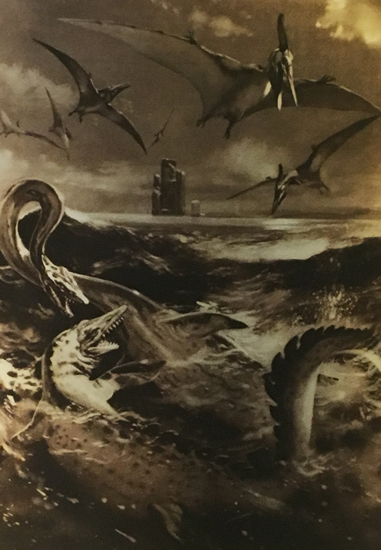
Dramatic scene from the Western Interior Seaway painted by Burian. Picture credit: Zdeněk Burian.
Picture credit: Zdeněk Burian
Revisiting Old Fossils
This discovery highlights an important point in palaeontology. Museum collections can still contain unknown species. Some Tylosaurus rex fossils had sat in museum collections for decades. Researchers only recognised their true identity after careful re-examination. The study also updated mosasaur evolutionary data. According to the research team, scientists have relied on outdated datasets for many years.
As a result, this new study could reshape how researchers understand mosasaur evolution.
Mike from Everything Dinosaur commented”
“The discovery of Tylosaurus rex demonstrates how much there is still to learn about Russellosaurina clade of mosasaurs. Many spectacular fossils remain hidden in museum collections. Furthermore, new technology and fresh analysis continue to reveal ancient secrets. This newly described giant mosasaur was one of the largest marine predators of its time. Without doubt, it would have been an intimidating sight in the ancient seas of Texas.”
The scientific paper: “A gigantic new species of Tylosaurus (Squamata, Mosasauridae) from Texas: and a revised character list for phylogenetic analyses of Mosasauridae” by Amelia R. Zietlow, Michael J. Polcyn and Ronald S. Tykoski published in the Bulletin of the American Museum of Natural History.
The award-winning Everything Dinosaur website: Marine Reptile and Other Prehistoric Animal Models.

Leave A Comment