

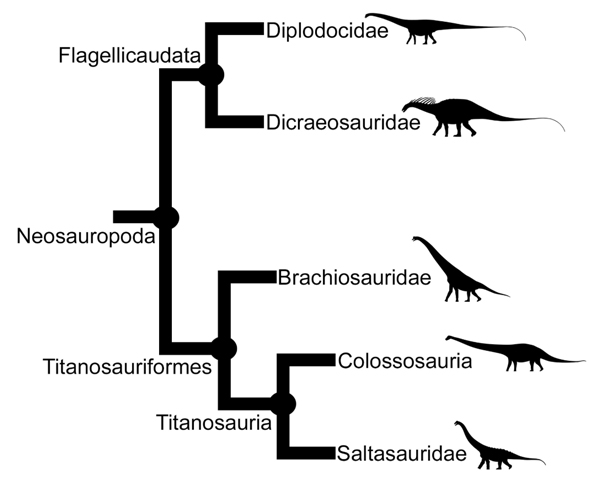
Could giant sauropod dinosaurs stand up on their hind legs? A newly published study has explored this long-debated question using advanced digital biomechanical modelling. The research suggests that although many sauropods were capable of rearing up, the largest species probably found it much more difficult to maintain this posture. The paper published as an open-access article in the journal “Palaeontology”, is the first to use finite element analysis (FEA) to examine sauropod rearing behaviour.
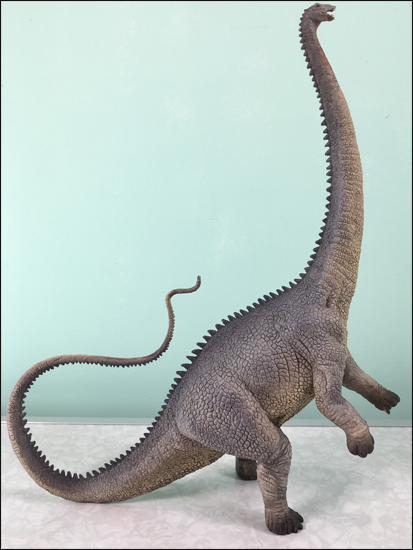
A model depicting a rearing Diplodocus. This is the 2020 CollectA Age of Dinosaurs rearing Diplodocus model. Previous studies (Mallison, 2011) had proposed that Diplodocus with its centre of mass located posteriorly may have been able to rear up more easily than other taxa. However, these results provide no strong evidence to indicate that rearing was a frequent behaviour for Diplodocus. Picture credit: Everything Dinosaur.
Picture credit: Everything Dinosaur
Sauropods, such as Diplodocus, Giraffatitan, Dreadnoughtus and Patagotitan, were the some of the largest terrestrial animals to have ever lived. Their immense size, long necks and pillar-like limbs have fascinated palaeontologists for more than a century. One of the enduring questions surrounding these giants is whether they could raise themselves into a bipedal or tripodal stance. Sauropod rearing behaviour may have occurred to permit them to reach higher branches in trees to feed. In addition, adopting a rearing pose may have helped to intimidate rivals or to defend themselves from carnivorous theropods. Perhaps rearing behaviour could have played role in social display, courtship or mating.
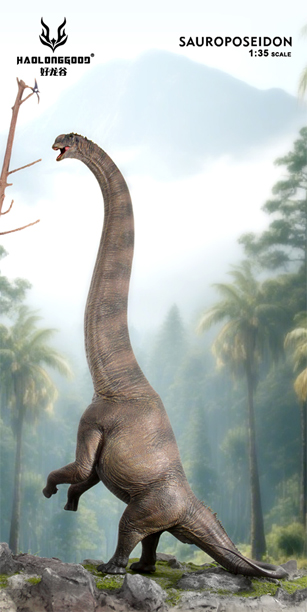
A Haolonggood Sauroposeidon figure depicted in a tripodal rearing pose. The dinosaur’s huge weight is supported by its massive hind legs and muscular tail. However, the new study concludes that larger sauropods were probably less capable of maintaining a rearing pose for sustained periods.
Testing Sauropod Rearing Behaviour
The new study, published in the journal Palaeontology, examined the hind limb biomechanics of seven sauropod genera representing a range of sizes and evolutionary groups. Rather than relying solely on skeletal anatomy, the researchers created detailed three-dimensional digital models of the femora (thigh bones) and subjected them to finite element analysis (FEA). This engineering technique predicts how a structure responds to forces and stresses and is widely used in the design of buildings, aircraft and vehicles.
The seven sauropod genera included in the study:
- Amargasaurus – a dicraeosaurid known from the Early Cretaceous of Argentina estimated to have reached a length of 12 metres and weighing 5 tonnes.
- Australotitan – of the Somphospondyli clade from the Late Cretaceous of Australia with some estimates suggesting a body length around 30 metres and weighing more than 50 tonnes.
- Diplodocus – a diplodocid from the Late Jurassic of North America reaching a length of around 27 metres and weighing an estimated 10-20 tonnes.
- Dreadnoughtus – a lithostrotian titanosaur from the Late Cretaceous of Argentina approximately 26 metres long and weighing 48-49 tonnes.
- Giraffatitan – a brachiosaurid from the Late Jurassic of Tanzania estimated to reach a length of 23 metres and to weigh over 40 tonnes.
- Neuquensaurus – a saltasaurid from the Late Cretaceous of Argentina estimated to reach a length of around 9 metres and to weigh 3.5 tonnes.
- Uberabatitan – a lithostrotian titanosaur known from the Late Cretaceous of Brazil around 26 metres in length and weighing more than 30 tonnes.
Our detailed guide explaining whether sauropods could stand on their hind legs will be published shortly.
Two Different Femora Load Scenarios
The scientists modelled two different loading scenarios. One simulated how the femora would respond to the animal’s body weight during a rearing posture. The second incorporated the forces generated by the surrounding muscles. By comparing the stress experienced by each femur, the team assessed how well different sauropods may have coped with standing on their hind limbs.
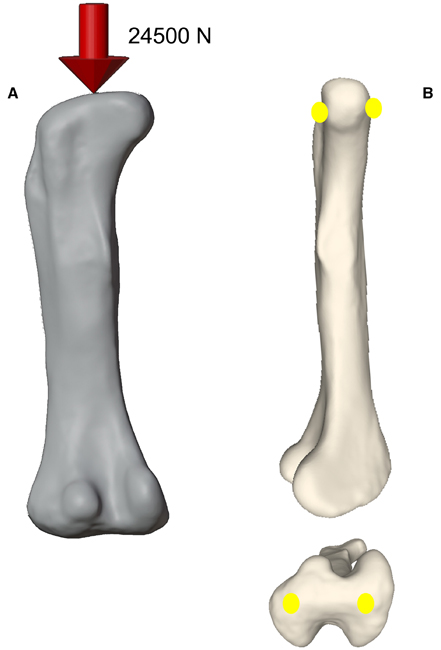
Extrinsic functional scenario modelled in the study. A, 3D rendering of the femur of Uberabatitan (CPPLIP-1238) in posterior view, with the red arrow showing the position of the applied loads. B, representation of the constraints (yellow circles) applied to all models for the extrinsic scenarios. Picture credit: Silva Junior et al. (2025), Palaeontology. Reproduced under the terms of the applicable Creative Commons licence.
Picture credit: Silva Junior et al. (2025), Palaeontology. Reproduced under the terms of the applicable Creative Commons licence.
Smaller Sauropods Had an Advantage
The results indicate that body size played a major role in determining how effectively a sauropod could rear up. Smaller species generally experienced lower levels of stress within their femora. In particular, the saltasaurid titanosaur Neuquensaurus performed exceptionally well in the simulations. Its relatively robust femur and favourable muscle attachment sites suggest that it may have been capable of maintaining a rearing posture for longer periods.
In contrast, enormous titanosaurs such as Dreadnoughtus experienced much higher levels of stress within their hind limbs. This finding suggests that although these giants may have been able to rear briefly, maintaining such a posture would have placed considerable demands on their skeleton.
Juveniles may have been more capable of rearing than adults. This opens up the intriguing possibility of sauropod rearing behaviour permitting ontogenetic niche partitioning. Sauropods may have changed their rearing behaviour as they grew and matured.
Interestingly, the study also compared Diplodocus and Giraffatitan, two sauropods that have featured prominently in previous discussions about rearing behaviour. The new biomechanical analysis broadly supports earlier research suggesting that differences in body shape and centre of mass influenced how easily these dinosaurs could adopt an upright stance. For example, the researchers conclude that Diplodocus was more capable of rearing than a brachiosaur such as Giraffatitan. However, the stress forces in the femur were still relatively high. Therefore, the study authors postulate that rearing for a Diplodocus was not a routine or frequent behaviour.
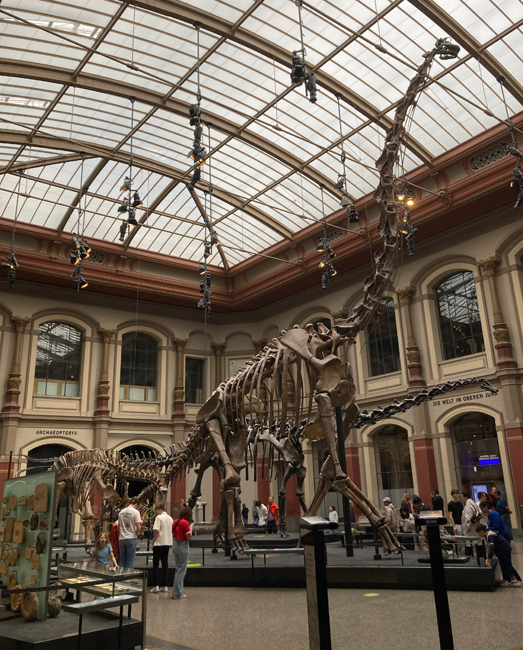
The giant Giraffatitan brancai skeleton on display at the Museum für Naturkunde Berlin. Picture credit: Everything Dinosaur.
Picture credit: Everything Dinosaur
Sauropod Rearing Behaviour Probably More Than Just Feeding
For many years, palaeontologists have suggested that rearing allowed sauropods to browse vegetation beyond the reach of other herbivores. However, the researchers point out that this behaviour may also have served several other important functions.
Standing upright could have helped during defensive displays, combat between rivals or mating. Furthermore, the authors note that sauropods may not always have reared unsupported. Leaning against a tree while feeding, or using a mate for additional support during courtship, would have reduced the stresses acting on the hind limbs.
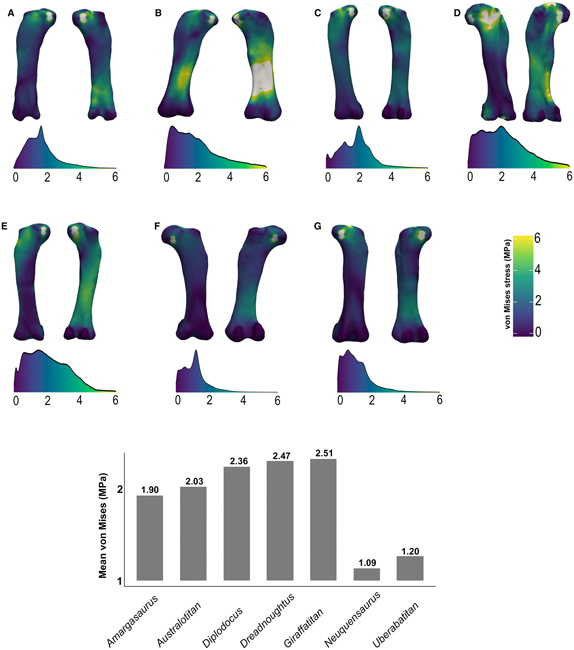
Finite element analysis of stress on femora with applied load of 24,500 N to sauropod femora in anterior (left) and posterior (right) views of: Amargasaurus (A); (B), Australotitan; (C), Diplodocus; (D), Dreadnoughtus; (E), Giraffatitan; (F), Neuquensaurus and Uberabatitan (G). Regions displayed in white indicate stress value that exceed the upper limit of the defined scale. Picture credit: Silva Junior et al. (2025), Palaeontology. Reproduced under the terms of the applicable Creative Commons licence.
Picture credit: Silva Junior et al. (2025), Palaeontology. Reproduced under the terms of the applicable Creative Commons licence.
To read an article exploring the wider implications of sauropod rearing behaviour: Could Sauropods Stand on their Hind Legs?
A New Perspective
This is the first study to use finite element analysis specifically to investigate sauropod rearing behaviour. As with any computer model, there are limitations. The digital reconstructions do not include the complex internal structure of bone or the cushioning effects of cartilage. Consequently, the stress values should be viewed as comparative rather than absolute.
Nevertheless, the research provides fresh insight into the lives of the largest terrestrial animals known to science. Rather than treating all sauropods alike, the study demonstrates that anatomy, body size and muscle configuration all influenced their ability to rear up. The findings suggest that some smaller sauropods may have been surprisingly agile, while the largest species were constrained by the sheer scale of their bodies.
Commenting on the research, Mike from Everything Dinosaur explained:
“Sauropods have always challenged our understanding of biomechanics. After all, there are no extant animals analogous to them. This study shows how modern digital techniques can test ideas that were once based largely on educated guesswork. It demonstrates that even among the giant sauropods, anatomy mattered, and not every species would have behaved in exactly the same way.”
The study provides another excellent example of how engineering, computer modelling and palaeontology are working together to answer questions about dinosaur behaviour that would have seemed impossible to investigate just a few decades ago.
The scientific paper: “Standing giants: a digital biomechanical model for bipedal postures in sauropod dinosaurs” by Julian C. G. Silva Junior, Gabriel S. Ferreira, Agustín G. Martinelli, Thiago S. Marinho, Felipe C. Montefeltro published in the journal Palaeontology.
Models of sauropods and other prehistoric animals: Sauropod and Other Dinosaur Models.

Leave A Comment