

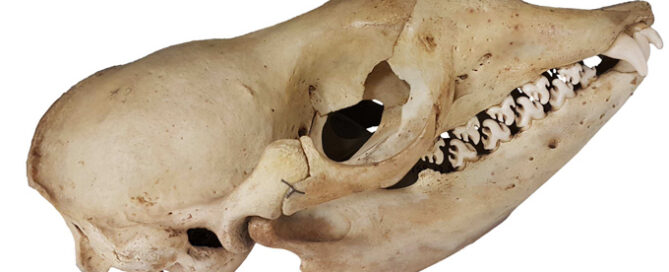
Seal Underwater Hearing Explained by New Research
A team of international scientists has uncovered the remarkable mechanism behind seal underwater hearing. A new study, led by researchers from the London Natural History Museum reveals how extant seals hear equally well in air and underwater. The findings help to explain a long-standing evolutionary mystery and could support future conservation efforts.
The research, published as an open-access paper in the “Royal Society Proceedings B”, examined more than two hundred living and fossil seal specimens. By combining advanced CT scanning with evolutionary analysis, the researchers identified the specialised tissue that makes this extraordinary ability possible.
Blood-Filled Tissue Helps Seals Hear Underwater
Unlike humans and most other land mammals, seals can hear efficiently in two very different environments. Normally, mammalian hearing relies on an air-filled middle ear. However, this arrangement performs poorly underwater because the air pocket behind the eardrum reflects almost all sound. The researchers discovered that seals overcome this problem with specialised cavernous tissue inside the middle ear. During a dive, this tissue fills with blood. As blood has a density similar to seawater, sound passes more efficiently through the ear and reaches the cochlea. As a result, seals continue to hear clearly beneath the waves.
Lead and corresponding author Dr James Rule (London Natural History Museum/Monash University) explained that scientists have puzzled over this adaptation for decades. The new research finally identifies the anatomical feature responsible for amphibious hearing.
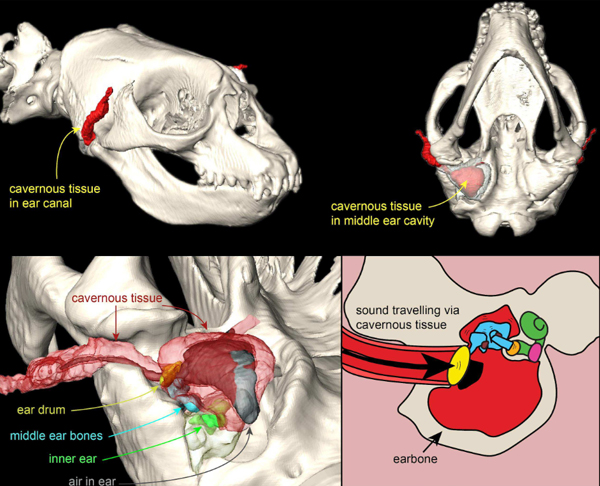
A 3D rendering of the skull of a Southern Elephant seal showing the underwater hearing adaptations. Picture credit: James Rule.
Picture credit: James Rule
Fossils Reveal the Evolution of Seal Underwater Hearing
The team’s analysis included both living species and fossil relatives of modern seals. Consequently, the researchers could trace when this remarkable adaptation first evolved. Evidence suggests that the ancestors of seals initially heard well only in air. Ancient species such as Potamotherium (Oligocene to Miocene) and the stem pinniped Puijila (late Oligocene to early Miocene) probably lacked effective underwater hearing. However, later marine relatives, including Enaliarctos, appear to have evolved the first form of amphibious hearing approximately 26.7 million years ago.
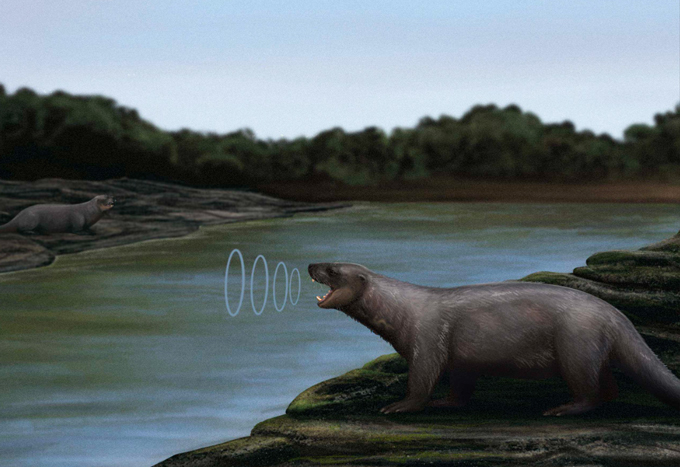
The earliest relatives of pinnipeds, such as the 23-million-year-old Puijila darwini, could only hear in-air. Like most mammals, their ears did not function properly underwater. Picture credit: Jaime Bran.
Picture credit: Jaime Bran
From this point onwards, different seal groups continued to refine their hearing. For example, true seals (phocids) developed enhanced underwater hearing. In contrast, the earliest eared seals retained adaptations that favoured hearing in air.
The study indicates that these improvements evolved independently after the earliest marine pinnipeds had already acquired the basic mechanism for hearing in both environments.
Rare Acoustic Abilities
The scientists also suggest that improved underwater hearing opened new evolutionary opportunities. Over millions of years, seals developed an impressive range of acoustic behaviours.
Today, some species produce haunting underwater vocalisations. Others can learn new sounds, keep a rhythmic beat and even imitate aspects of human speech. These unusual abilities may have become possible because their ancestors first evolved an ear capable of functioning effectively both above and below the water’s surface.
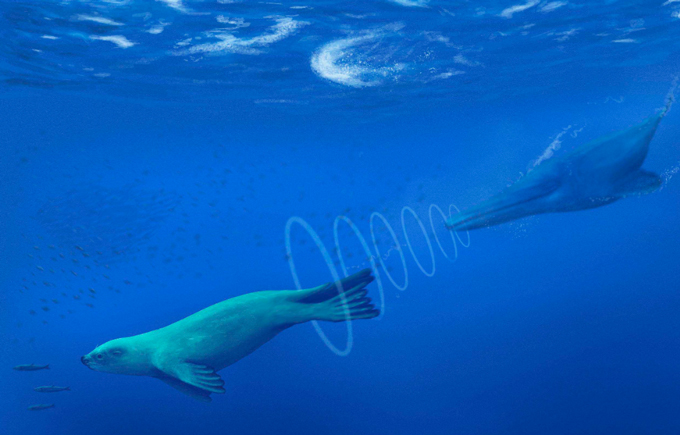
Life reconstruction of Enaliarctos mealsi, one of the earliest marine seals from around 23 million years ago, being chased by a cetacean. It was capable of hearing both in-air and underwater (amphibious hearing), thanks to a specialised tissue in their ears (called a cavernous tissue). However, their hearing ranges in both environments were quite limited. Picture credit: Jaime Bran.
Picture credit: Jaime Bran
Museum Collections Unlock New Discoveries
The research depended upon the Natural History Museum’s extensive collections. Scientists examined more than two hundred specimens representing a hundred and nineteen living and extinct species of Carnivora.
By studying fossil skulls alongside modern seals, the researchers reconstructed the evolutionary history of the middle ear. This work demonstrates the continuing scientific value of museum collections assembled over many generations.
Dr Natalie Cooper, Merit Researcher at the London Natural History Museum, London stated:
“The Natural History Museum has some of the best seal collections in the world, and this study really shows its value. This research simply wouldn’t have been possible without these specimens,
which have been collected across hundreds of years from all over the world. It’s important that we know how seals hear because noise pollution in the ocean is growing. As the seas get louder, it’s harder for seals to find mates and communicate with each other putting their survival at risk. By understanding how these animals hear, we can start to put solutions in place.”
To read an article from 2020 but the discovery of a prehistoric pinniped in New Zealand that re-writes seal evolution: Sealing the Fate of Pinniped Evolution.
Understanding Hearing Function Can Help Protect Seals
The discovery has important conservation implications. Oceans are becoming increasingly noisy because of shipping, offshore construction and other human activities. Consequently, underwater noise can interfere with how seals communicate, locate mates and navigate.
Understanding seal underwater hearing provides researchers with valuable information about how these animals perceive their environment. In turn, this knowledge could help shape future conservation measures designed to reduce the impact of underwater noise pollution.
Mike from Everything Dinosaur commented:
“This fascinating study shows how fossils continue to answer important questions about the evolution of living animals. By combining evidence from extinct and modern seals, the researchers have explained one of the most remarkable hearing adaptations found in any mammal.”
Everything Dinosaur acknowledges the assistance of a media release from the London Natural History Museum in the compilation of this article.
The scientific paper: “The origin and evolution of amphibious hearing in pinnipeds” by James P. Rule, Travis Park, Moganavalli Kattan, Camille Grohé, Roxana Taszus, Stephanie M. Palmer, David P. Hocking, Justin W. Adams, Alistair R. Evans, Ian G. Brennan, Tahlia I. Pollock, Daniela Sanfelice, Felix G. Marx, Naoki Kohno, Martin Sabol, Alexander Stoessel, John J. Flynn and Natalie Cooper published in the Proceedings of the Royal Society B.
The award-winning Everything Dinosaur website: Models of Prehistoric Mammals.