

Evolution of Spider Eyes Explored in New Study
A new scientific study has provided fascinating insights into the evolution of spider eyes. An international team of researchers has discovered that hunting spiders independently evolved forward-facing eye arrangements.
The study, led by Atal Pande from the Museum für Naturkunde Berlin, demonstrates that spider visual systems are highly flexible. Their eyes can evolve as separate modules, allowing these remarkable animals to adapt to different lifestyles and habitats.
Researchers examined fifty-two spider species to better understand how their eyes changed over millions of years.
Investigating the Evolution of Spider Eyes
Vision plays a crucial role in the lives of many animals. It helps them find food, avoid danger and navigate their surroundings.
In vertebrates, eye position often provides clues about an animal’s lifestyle. For example, many predators have forward-facing eyes. This arrangement helps them judge distances accurately when targeting prey. In contrast, many prey animals have eyes positioned on the sides of their heads. This gives them a wider field of view to help detect danger.
However, spiders present scientists with a very different challenge. Most spiders have eight eyes, and these can be arranged in a variety of ways.
The research team wanted to understand how these different arrangements evolved.
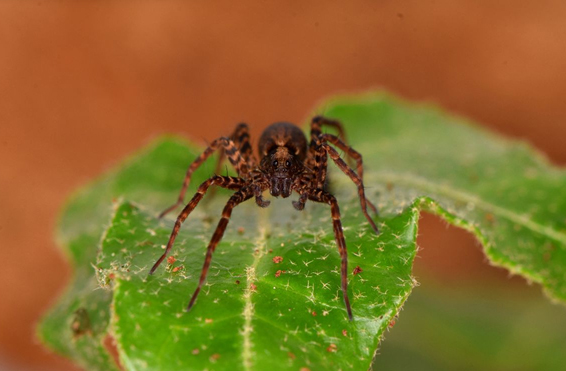
A wolf spider (Pardosa) looks into the camera; its six front-facing eyes give it a forward-looking gaze. Picture credit: Sam England.
Picture credit: Sam England
Studying the Visual Systems of Numerous Spider Species
Scientists used high-resolution X-ray computed tomography, geometric morphometrics and evolutionary modelling during the study. These techniques allowed them to examine eye position, orientation and field of view.
The results revealed that spider eye arrangements have changed dramatically throughout evolutionary history.
Early diverging spider groups, such as trapdoor spiders, retain a more centralised arrangement of eyes. Meanwhile, orb-weaving spiders evolved a different configuration, with eyes positioned around the front part of the body.
However, some visually active hunting spiders developed a particularly interesting adaptation. Several groups independently evolved arrangements where multiple pairs of eyes point forwards.
Hunting Spiders Developed Powerful Visual Centres
The study showed that hunting spiders display some of the greatest diversity in eye arrangement. Their visual systems also evolved at a faster rate.
By having several pairs of forward-facing eyes, these spiders can gather different types of information from the same area. This may improve movement detection, increase visual detail and help with judging distances.
Essentially, the front section of the spider’s body became a sophisticated visual centre. Different eyes specialised in different tasks but continued working together.
Flexible Eyes Helped Spiders Adapt
The research also demonstrated that spider vision is modular. This means that individual pairs of eyes can evolve independently rather than changing as a single system.
This flexibility gave evolution more opportunities to adapt spider eyesight to different ecological challenges.
Lead author Atal Pande explained:
“Spiders are an exceptional model system for understanding how vision has evolved over time. Unlike animals with only two eyes, spiders have multiple visual modules, some of which can evolve independently of one another. This gives evolution significantly more scope to adapt the visual system – and explains the remarkable diversity of eye arrangements in spiders.”
Spider Research Could Inspire Future Technology
The study provides important information about how natural selection shapes complex sensory systems.
Furthermore, understanding the evolution of spider eyes could have applications beyond biology. The research may help scientists develop new types of visual sensor systems for robotics and autonomous technologies.
Animals have evolved extraordinary solutions to survival challenges. Studying these adaptations can inspire new approaches to solving modern engineering problems.
Everything Dinosaur acknowledges the assistance of a media release from the Museum für Naturkunde Berlin in the compilation of this article.
The scientific paper: “Hunting ecology predicts eye arrangements in the modular visual system of spiders” by Atal Pande, Lucille Rose, Sam J. England, Imran A. Rahman, Ricardo Pérez-de la Fuente, Andrew J. Bodey, Kaz Wanelik, Christian M. Schlepütz, Jonathan Günther, Christoph Rau, Alexander Blanke and Lauren Sumner-Rooney published in Current Biology.
The award-winning Everything Dinosaur website: Models of Prehistoric Creatures.