

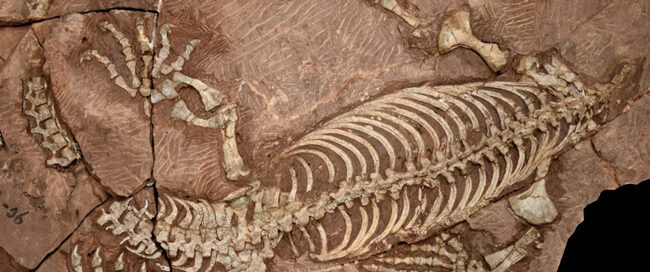
Earliest Synapsid Cloaca Revealed by 294-Million-Year-Old Fossil
A remarkable trace fossil from Germany has provided the oldest known evidence of a cloaca in the mammalian lineage. The discovery helps palaeontologists better understand the evolution of early terrestrial vertebrates and fills an important gap in the fossil record. The fossil comes from the famous Bromacker fossil locality in Thuringia (Germany). Among footprints and other trace fossils the scientists identified a tail impression. The anterior portion of this tail impression preserves evidence of the earliest synapsid cloaca.
The international team of researchers, led by scientists from the Museum für Naturkunde Berlin, published their findings in the journal “iScience”. The trace fossils are approximately 294 million years old (Early Permian). This represents the first occurrence of a cloaca in the fossil record of stem mammals.
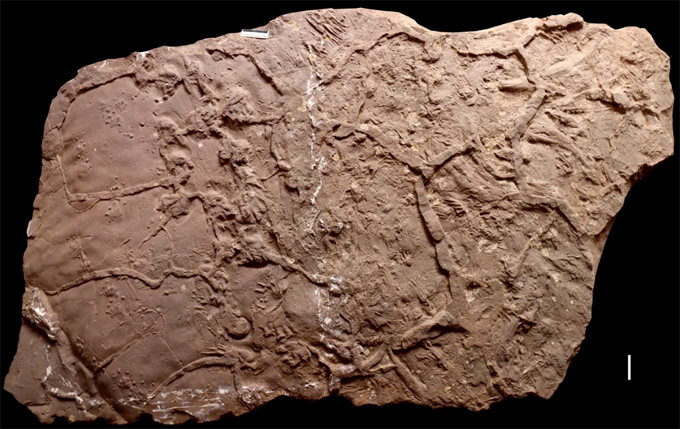
The trace fossil specimen MNG 13490 with the preserved underside of the tail impression. Note scale bar equals 10 cm. Picture credit: Marchetti et al.
Picture credit: Marchetti et al
A Rare Glimpse of Soft Tissue Preservation
Fossils usually preserve bones and teeth. Soft tissues, however, almost always decay before fossilisation can occur. Consequently, direct evidence of anatomical features such as the cloaca is exceptionally rare. The newly described specimen includes a beautifully preserved impression of the tail together with fossil footprints. Near the base of the tail, the researchers identified two rows of raised scales separated by a narrow vertical slit. They interpret these features as the lips and opening of a cloaca.
This fossil provides the first direct evidence of an earliest synapsid cloaca, offering scientists an unprecedented look at the anatomy of an animal closely related to the ancestors of mammals.
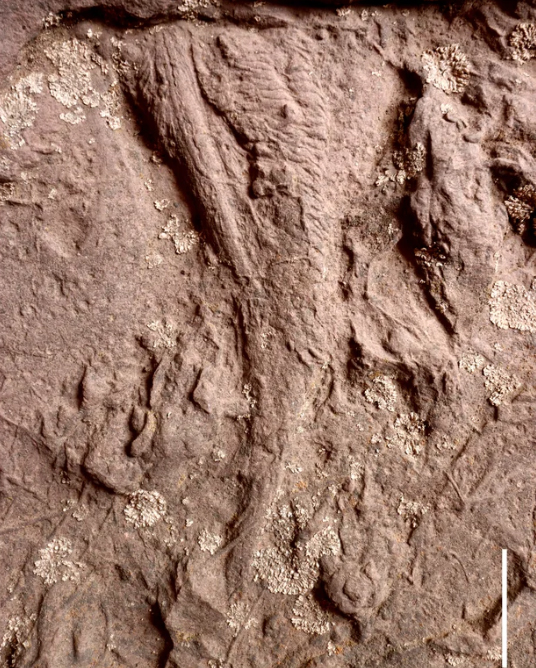
The caseid synapsid tail impression. Note scale bar equals 5 cm. Picture credit: Marchetti et al.
Picture credit: Marchetti et al
What is a Cloaca?
A cloaca is a single external opening used by the digestive, urinary and reproductive systems. Today, amphibians, reptiles and birds possess a cloaca. Among mammals, however, only monotremes such as the platypus and echidnas have retained this feature. Most extant mammals (placentals and marsupials) have separate openings for these bodily functions. Until now, scientists had little direct fossil evidence showing how this important anatomical structure appeared in the mammalian lineage.
An Early Relative of Mammals
The fossil traces have been linked to a caseid synapsid. Caseids were large-bodied, herbivorous members of the Synapsida, the evolutionary group that eventually gave rise to the Mammalia. Researchers matched the fossil impression with the distinctive Dimetropus footprints found at the Bromacker locality. Comparisons with skeletal fossils collected from the same site strengthened this interpretation.
Although caseids looked very different from mammals today, they belonged to the same broad evolutionary lineage. Therefore, this discovery provides valuable information about the early stages of mammalian evolution.
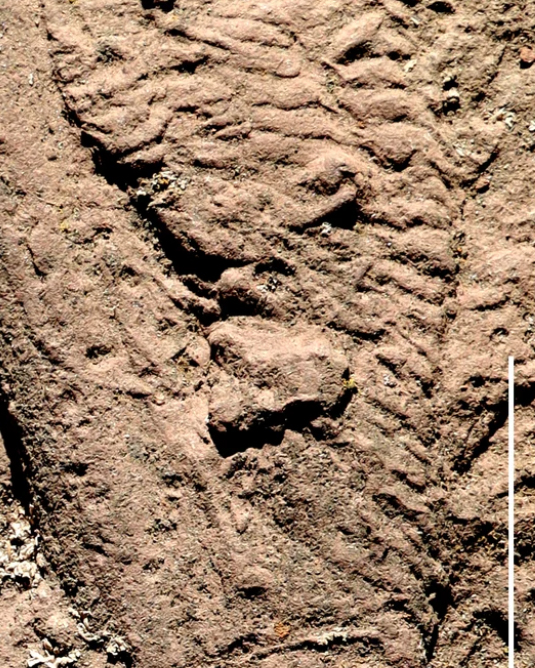
The cloacal area in the anterior part of the tail impression. Note scale bar equals 5 cm. Picture credit: Marchetti et al.
Picture credit: Marchetti et al
New study highlights the growth rates of diminutive Dimetrodon species from the Bromacker locality: Bromacker Dimetrodon Growth Study.
Why Did the Cloaca Evolve?
The study also explores why the cloaca changed during vertebrate evolution. Although the answer remains uncertain, the researchers suggest several possible explanations.
For example, changes in reproductive anatomy may have played a role. Likewise, increasingly dry environments could have influenced the evolution of different body structures. The scientists also propose that evaporative cooling through the cloacal opening may have helped animals regulate their body temperature. Furthermore, changes in body shape, including shorter tails and modified limbs, may have contributed to these evolutionary developments.
In squamates and birds, the cloaca tends to have a horizontal orientation. Cloacal evaporation for thermoregulation purposes has been observed in squamates and birds. In contrast, the Crocodylomorpha and the Caudata (salamanders and their extinct relatives), have a vertical cloaca. These animals are associated with aquatic environments. Intriguingly, the fossilised tail impression is clearly impressed in a water-saturated sediment.
The fossil specimen shows swimming traces associated with Dimetropus footprints. Therefore, it is possible that a transition from a vertical to a horizontal cloaca occurred as an adaptation to drier environments. The horizontal orientation of the cloacal orifice could favour more efficient cloacal evaporation to help maintain body temperature. This would be in agreement with the vent orientation change in stem reptiles between the Carboniferous and the Permian, in a time of global warming and increasing aridity and seasonality. Nevertheless, the causes of this correlation should be further investigated in modern taxa.
The Significance of the Bromacker Fossil Site
The Bromacker fossil locality is recognised as one of the world’s most important Late Palaeozoic fossil sites. It has produced an exceptional record of terrestrial animals and plants that lived during the Early Permian. This latest discovery also demonstrates the value of revisiting historic museum collections. Modern imaging techniques and careful re-examination can reveal important anatomical details that earlier researchers could not detect.
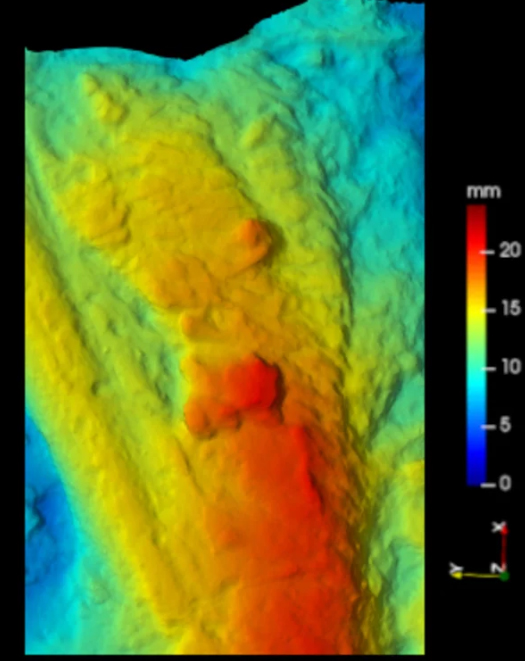
A false-colour depth map of the cloacal area taken from the photogrammetric 3D model. Picture credit: Marchetti et al.
Picture credit: Marchetti et al
Understanding the Evolution of Mammals
The discovery of the earliest synapsid cloaca provides much more than an anatomical curiosity. It offers scientists a rare opportunity to investigate the evolution of reproductive and excretory systems in one of the most important vertebrate lineages. As new discoveries emerge from the Bromacker site and other fossil localities, researchers will continue to refine our understanding of how the ancestors of mammals adapted to life on land hundreds of millions of years ago.
Commenting on the importance of this research, Mike from Everything Dinosaur stated:
“Soft tissue fossils are incredibly rare, so discoveries like this earliest synapsid cloaca impression are exceptionally important. The specimen shows that trace fossils can preserve anatomical details that skeletal remains alone cannot reveal. It also reminds us that remarkable scientific discoveries can still be made by re-examining specimens already held in museum collections.”
This remarkable discovery demonstrates how exceptional fossil preservation continues to reveal new chapters in the evolutionary history of the Mammalia.
Everything Dinosaur acknowledges the assistance of a media release from the Museum für Naturkunde Berlin in the compilation of this article.
The scientific paper: “The evolutionary significance of the earliest cloacal opening in Synapsida” by Lorenzo Marchetti, Antoine Logghe, Arnaud Rebillard, Mark J. MacDougall and Jörg Fröbisch published in IScience.
The multi-award-winning Everything Dinosaur website: Models of Prehistoric Life.