

Examining the Remarkable Australian Marsupial Lion – A Super Predator from Down Under
The study of Thylacoleo carnifex anatomy has revealed one of the most unusual mammalian predators known to science. Often called the “marsupial lion”, this apex predator was not a member of the cat family. Indeed, its closest living relatives are wombats and koalas. Despite evolving from primarily plant-eating ancestors, Thylacoleo carnifex became a highly specialised carnivore. Its powerful jaws, extraordinary teeth and muscular body made it a significant predator of the Pleistocene Epoch. Early studies suggested that it may have been frugivore (fruit eater), or that it was a scavenger. However, more modern interpretations depict Thylacoleo carnifex as a hypercarnivore.
Understanding Thylacoleo carnifex Anatomy
The first fossils of Thylacoleo carnifex were scientifically described in the 19th century. Since then, more complete fossil discoveries have transformed our understanding of this animal. Older reconstructions often depicted Thylacoleo as cat-like. However, detailed studies show that this marsupial had a very different body plan. It combined tremendous strength with adaptations for climbing, gripping and ambushing prey.
A large individual may have measured around 1.5 metres long. Many adults probably weighed between 100 and 130 kilograms, although exceptionally large specimens may have approached 160 kilograms. Larger individuals may represent males, suggesting possible sexual dimorphism. After all, sexual dimorphism is seen in extant relatives of this species.
This extinct marsupial continues to inspire scientists and palaeoartists. For instance, it has featured on the front cover of the prestigious “Prehistoric Times” magazine.
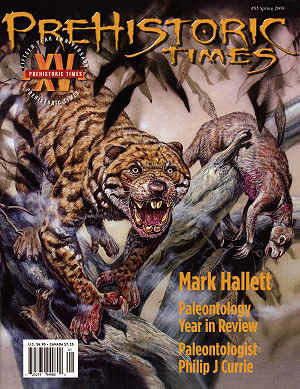
The front cover features a Marsupial lion. Thylacoleo carnifex features on the front cover art of “Prehistoric Times” magazine issue 85. Picture credit: Mike Fredericks.
Picture credit: Mike Fredericks
A Powerful Skull and an Incredible Bite
The skull of Thylacoleo carnifex was short, broad and extremely robust. Huge jaw muscles helped generate a tremendous bite force. Indeed, studies suggest that relative to body size, Thylacoleo possessed one of the most powerful bites of any known mammalian predator. The eyes faced forwards, providing binocular vision. This adaptation would have helped with judging distance when attacking prey. Consequently, palaeontologists often interpret Thylacoleo as an ambush hunter rather than a pursuit predator.
The Remarkable Teeth of Thylacoleo carnifex
One of the most fascinating aspects of Thylacoleo carnifex anatomy is the dentition. Unlike felids, Thylacoleo did not rely on large canine teeth to despatch prey. Its upper canines were small and rounded, whilst the lower jaw lacked canine teeth entirely.
The dental formula of T. carnifex:
- Upper jaw (each side): 3 incisors, 1 canine, 3 premolars and 1 molar
- Lower jaw (each side): 1 incisor, no canines, 3 premolars and 2 molars.
The lower incisors were enlarged, chisel-shaped and projected forwards. In addition, fossils show extensive wear. The enormous third premolars were highly specialised. They acted like shears and were functionally similar to the carnassial teeth found in modern carnivorous mammals.
No living predator has a set of teeth quite like Thylacoleo carnifex.
To read an article about the discovery of an ancestor of the “marsupial lion”: Attenborough’s New Kitty.
Strong Forelimbs and a Deadly Thumb Claw
The forelimbs of Thylacoleo were exceptionally powerful. The shoulders and front legs were heavily muscled, suggesting an animal that relied on strength to subdue prey. Furthermore, the manus (hand) had five digits, each equipped with a claw. The first digit, equivalent to a thumb, was particularly remarkable. It was semi-opposable and carried a large, strongly curved claw.
This enlarged claw was probably used to grip prey and assist with climbing. It may have been protected when not in use, although it worked differently from the retractable claws of modern cats.
A Marsupial Built for Power Not for Speed
The body of Thylacoleo carnifex was compact and muscular. It had a deep chest, broad shoulders and a relatively short back. Its body proportions suggest that this predator was not built for chasing prey over long distances. Instead, it was adapted for explosive power, climbing ability and controlling struggling animals. The hind feet provide further evidence that Thylacoleo was no cat-like predator. It walked with the sole of the foot contacting the ground, a posture known as plantigrade locomotion. Bears and humans also use this type of stance.
The potential maximum velocity of Thylacoleo remains unknown. The combat bodies of extant wombats (see image below) share many characteristics with their close relatives (Thylacoleonidae). At first sight, these animals might look like they are incapable of running at speed. However, appearances can be deceptive. Wombats have been recorded running at twenty-five miles per hour (forty kilometres per hour) over short distances.
Like other diprotodontian marsupials, the second and third toes were probably fused together.
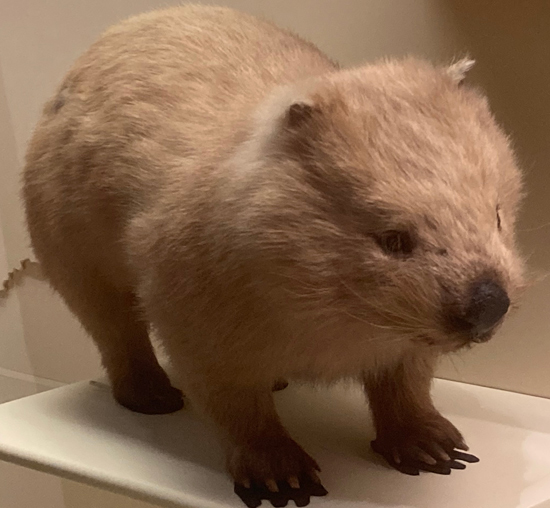
Thylacoleo is classified as a member of the Diprotodontia suborder the Vombatiformes. Extant wombats such as this forest wombat (Vombatidae family) are closely related to marsupial lions (Thylacoleonidae).
Picture credit: Everything Dinosaur
The Tail of Thylacoleo carnifex
For many years, the tail of Thylacoleo was poorly understood. However, more complete fossil discoveries have revealed that this predator had a long and muscular tail.
The tail may have provided extra support when the animal reared upwards. This “tripod” posture is seen in some living marsupials.
Some Australian rock art has been suggested to represent Thylacoleo. These interpretations remain debated, but they raise interesting questions about the external appearance of this extinct animal. For example, there could have been a tuft on the end of the tail.
Did Thylacoleo carnifex Hunt Diprotodon?
Thylacoleo carnifex shared its environment with many famous Australian megafauna species, including the giant marsupial Diprotodon optatum. Diprotodon was the largest marsupial known to science. A fully-grown male Diprotodon had a shoulder height of approximately 1.8 metres. It weighed around three tonnes, around twenty-five times heavier than Thylacoleo.
However, Thylacoleo may have targeted young, injured or vulnerable individuals. Its powerful forelimbs, gripping claws and devastating bite would have made it a dangerous predator. The CollectA Deluxe Diprotodon, introduced in 2024 shows some remarkable detail. For example, the top of the left hind limb reveals an old scar from an attack from a Thylacoleo. The scars are old suggesting an attack when this Diprotodon was much younger.
Whilst speculative, it is interesting to note that CollectA added this detail, a speculation on a predator/prey relationship.
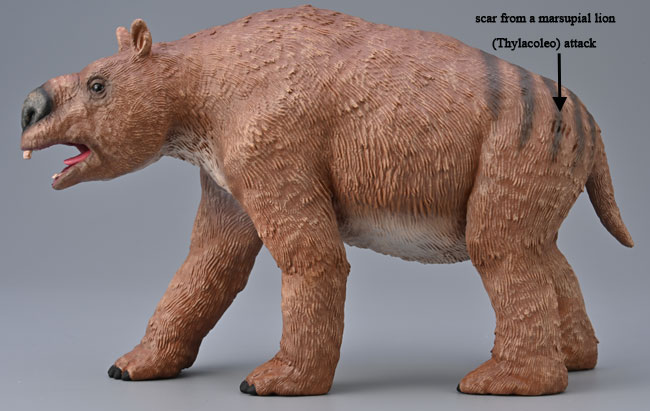
The CollectA Diprotodon model has an old scar from a marsupial lion on its rump.
The relationship between these two iconic marsupials highlights the complexity of prehistoric Australian ecosystems.
To view the CollectA Deluxe model range: CollectA Deluxe Age of Dinosaurs.
Thylacoleo carnifex Anatomy Reveals A Unique Australian Predator
Research into Thylacoleo carnifex anatomy continues to demonstrate how unusual this animal was. It was not simply Australia’s version of a big cat. Instead, evolution produced a completely different type of predator. Indeed, several species have been classified, tracing the origins of these bizarre carnivores back into the Oligocene Epoch.
To read a blog post outlining ideas into Thylacoleo hunting strategy: How the Marsupial Lion Got to Grips with its Prey.
Mike from Everything Dinosaur commented:
“With its powerful front limbs, extraordinary teeth and specialised hunting adaptations, Thylacoleo remains one of the most fascinating mammals to have ever lived. Thylacoleo carnifex died out around 40,000 years ago. Modern humans would have encountered it. Imagine viewing a living Thylacoleo! I am sure this creature would have had a special status amongst those hunter gatherers that shared its environment.”
The award-winning Everything Dinosaur website: Dinosaur Toys and Prehistoric Animal Models.