

New Colonial Collections Research Project Examines Museum Specimens from Togo and Ghana
A new colonial collections research project has been launched involving several leading Berlin museums. Researchers will investigate the origins and histories of important natural history and cultural collections gathered during the German colonial period.
For the first time, Berlin institutions are working together to study collections linked to the former German colony of Togo. At that time, the colony included areas that are now part of Ghana. The two-year project will combine expertise from different scientific disciplines.
The project is entitled “Interconnected Stories: Colonial Collections from Togo and Ghana in Berlin’s Museums”. It is funded by the German Centre for Lost Cultural Property.
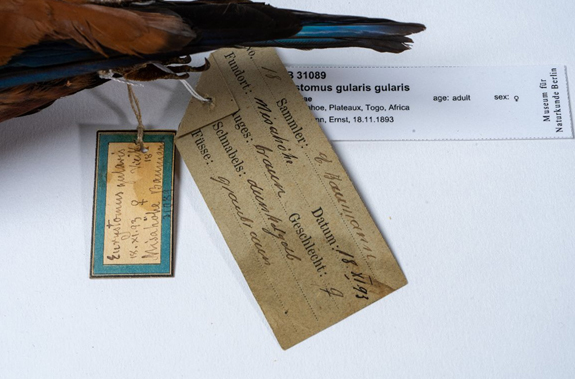
Bird skin with labels representing a blue-throated roller (Eurystomus gularis), sent by Ernst Baumann from the German colony of Togo. Picture credit: Schurian/Museum für Naturkunde Berlin.
Picture credit: Schurian/Museum für Naturkunde Berlin
Berlin Museums Collaborate on Colonial Collections Research Project
The research brings together the Museum für Naturkunde Berlin, the Botanical Garden and Botanical Museum at Freie Universität Berlin, as well as the Ethnological Museum and the Central Archive of the Staatliche Museen zu Berlin.
In addition, researchers are collaborating with the Archives Nationales du Togo and the University of Ghana. Traditional knowledge holders and local communities will also contribute to the study.
The project will examine botanical, zoological and cultural-historical collections. Researchers hope to better understand how these items were acquired, documented and interpreted.
Investigating the History of Museum Collections
The collaboration between Berlin’s museums can be traced back to the nineteenth century. In 1889, a Bundesrat resolution designated several Berlin institutions as central collection points for materials obtained from German colonies.
As a result, preserved plants, animal specimens and cultural artefacts were sent to Berlin. Many were collected by colonial officials and military personnel. These historical collections remain extremely important for modern research. However, the circumstances surrounding their acquisition are not always fully understood.
The new colonial collections research project aims to investigate these histories in greater detail.
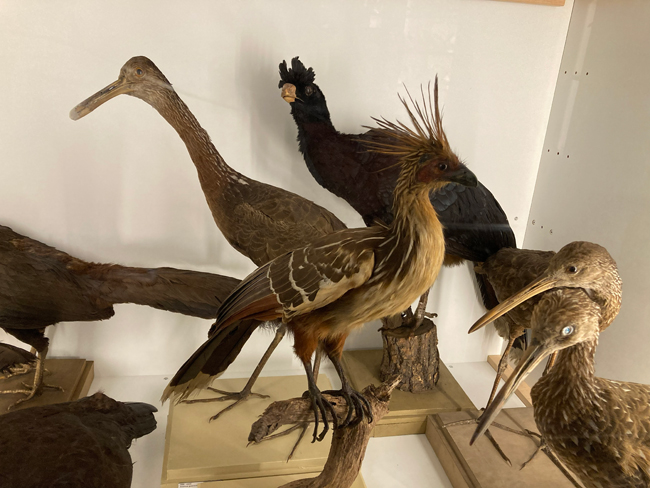
The Museum für Naturkunde Berlin has an enormous collection of stuffed animals including many birds from around the world. Picture credit: Everything Dinosaur.
Picture credit: Everything Dinosaur
Studying Collections from Bismarckburg and Misahöhe
The research will focus on material associated with Bismarckburg and Misahöhe. These were two early colonial outposts established in the interior of Togo.
Scientists and historians will examine how these locations became connected with collecting activities. Furthermore, they will investigate the links between scientific research, economic interests and colonial administration.
The project team will also explore the contribution of local knowledge holders. Their expertise and involvement were often not fully recorded in historical archives.
Combining Different Sources of Knowledge
By bringing together museum records, scientific collections and local perspectives, researchers hope to create a more complete understanding of the past. Importantly, oral traditions and memories from communities in Togo and Ghana will form part of the research. This approach will help include information that may be absent from colonial records.
The project also aims to create a model for future transdisciplinary provenance research. This could help museums around the world investigate collections that have previously been studied separately.
Understanding the History Behind Museum Collections
Natural history museums provide vital resources for scientific research. Specimens collected decades or even centuries ago can help scientists study biodiversity, extinction, evolution and environmental change.
However, understanding where specimens came from and how they were obtained is also important. Provenance research helps museums build a more detailed picture of their collections and their connections with people and places.
The “Interconnected Stories” project demonstrates how international collaboration can provide fresh insights into historic collections.
Everything Dinosaur acknowledges the assistance of a media release from the Museum für Naturkunde Berlin in the compilation of this article.
The Everything Dinosaur website: Dinosaur and Prehistoric Animal Models and Toys.