

Could Sauropod Dinosaurs Rear Up on their Hind Legs?
The largest land animals to have ever walked the Earth were the sauropod dinosaurs. Some of these giants exceeded thirty metres in length and were many times heavier than an African elephant. Famous sauropods such as Diplodocus, Brontosaurus and Brachiosaurus are usually depicted moving slowly on all four limbs. However, could sauropods stand on their hind legs? It is a question that has fascinated palaeontologists for decades. Recent research using advanced computer modelling has added fresh evidence to the debate, but scientists have been studying this remarkable behaviour for many years.
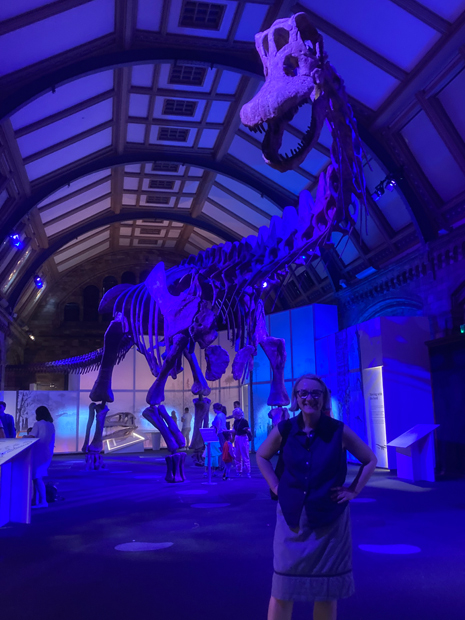
Sue from Everything Dinosaur poses in front of an enormous Patagotitan skeleton. Could giant sauropods stand on their hind legs? Picture credit: Everything Dinosaur.
Picture credit: Everything Dinosaur
This article follows our recent report on a newly published biomechanical study investigating sauropod rearing behaviour. Instead of focusing solely on the latest research, we explore the wider scientific evidence and examine whether these colossal dinosaurs really could lift themselves into an upright posture.
To read our article highlighting the recent research examining sauropod rearing postures: Sauropod Rearing Behaviour Study.
Looking Back at the Ancestors of Giants
To understand why some sauropods may have been capable of rearing, it helps to look back at their evolutionary history.
The first sauropodomorph dinosaurs appeared during the Triassic. These early relatives of the sauropods were much smaller than their gigantic descendants. Many were capable of walking on two legs, although some probably alternated between bipedal and quadrupedal locomotion.
One of the best-known examples is Plateosaurus. This dinosaur lived around 214 million years ago and measured up to ten metres in length. Although smaller than later sauropods, Plateosaurus possessed powerful hind limbs and is generally regarded as a facultative biped. It probably walked on all fours at times but could also rear up or move around on its hind legs.
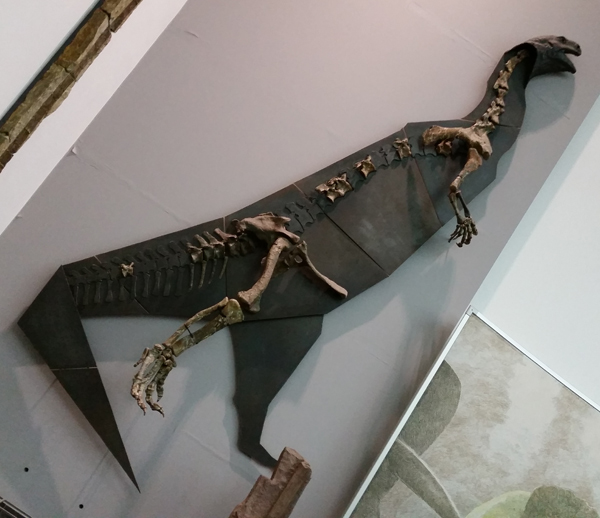
A specimen of a Plateosaurus with fossil material mounted in life position. This is part of a display at the Senckenberg Nature Museum (Frankfurt, Germany). The dinosaur is depicted standing on its hind legs. Picture credit: Everything Dinosaur.
Picture credit: Everything Dinosaur
Over millions of years, sauropodomorphs became larger and heavier. Their forelimbs evolved into strong, weight-bearing columns capable of supporting enormous bodies, while their necks became longer and their tails acted as counterbalances. Eventually, true sauropods evolved. Although these dinosaurs became obligate quadrupeds for everyday movement, their ancestry suggests that the ability to lift the front of the body may never have disappeared completely.
Why Would a Sauropod Rear Up?
Standing on two legs would have required a great deal of energy. Therefore, palaeontologists think sauropods would only have adopted this posture when there was a clear advantage.
One of the most obvious reasons was feeding. By rearing into a tripodal stance, with the tail acting as a third point of support, a sauropod could browse vegetation several metres higher than normal. This would have allowed it to exploit food sources unavailable to many other herbivorous dinosaurs.
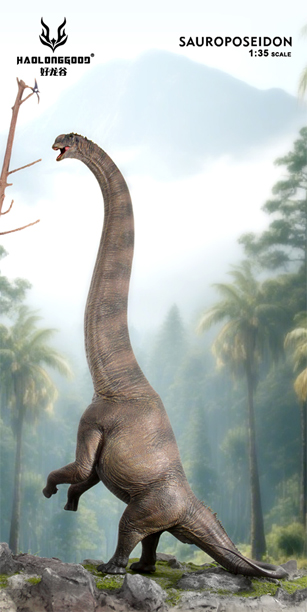
The HLG 185c Sauroposeidon Heterochromatic version rearing up to reach the top of the tree.
The image (above) shows a Sauroposeidon model depicted in a rearing pose. The dinosaur is rearing up supporting its great weight on its hind legs and muscular tail. The figure is from the Haolonggood range.
To view the range of Haolonggood prehistoric animal models: Haolonggood Prehistoric Animal Figures.
In addition, to rearing up to increase their range of feeding, sauropods may have stood on their hind legs for other reasons. For example, scientists have also suggested that rearing may have been useful during courtship displays, contests between rivals or even as a defensive posture when confronted by theropod predators. While these ideas remain difficult to test directly, they are consistent with the biomechanics of several sauropod species.
Fossil Evidence and Computer Models
Bones alone cannot reveal exactly how an extinct animal behaved. Consequently, palaeontologists increasingly combine fossil evidence with engineering techniques to investigate dinosaur locomotion.
Earlier studies concluded that Diplodocus was particularly well suited to rearing. Its centre of mass lay relatively close to the hips, reducing the effort needed to lift the forequarters. The long, muscular tail could then act as a third support, creating a stable tripodal posture. Research published in 2011 (Mallinson), inspired the manufacturer CollectA to introduce a rearing Diplodocus model into their Age of Dinosaurs range. It has proved popular with dinosaur fans and model collectors.
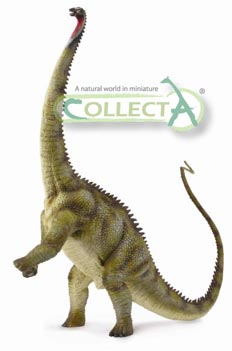
The original CollectA Age of Dinosaurs Rearing Diplodocus figure was introduced in 2013.
More recently, scientists have used finite element analysis, an engineering method widely employed in the design of aircraft, bridges and vehicles, to examine the stresses acting on sauropod femora during rearing. This digital approach enables researchers to compare how different species responded to the forces generated while standing on their hind limbs.
Not All Sauropods Were The Same
One important conclusion emerging from recent studies is that sauropods should not all be considered alike. The latest biomechanical research indicates that body size had a significant influence on rearing ability. Smaller sauropods generally experienced lower stresses within their hind limbs than the largest titanosaurs.
Interestingly, the study found that the relatively small titanosaur Neuquensaurus was especially well adapted to rearing. Its robust femur and favourable muscle attachments suggest that it may have been capable of maintaining an upright posture for longer than many larger relatives.
The situation was rather different for enormous titanosaurs such as Dreadnoughtus. Their immense size placed much greater stresses on the hind limbs, making prolonged rearing less likely.

A scale drawing of the huge sauropod Dreadnoughtus schrani. Picture credit: Everything Dinosaur.
Picture credit: Everything Dinosaur
The researchers also examined Diplodocus. Their results broadly support earlier work suggesting that Diplodocus could rear more easily than Giraffatitan, thanks largely to its body proportions and centre of mass. However, the new study found no evidence that rearing was a frequent behaviour. Instead, it may have been an occasional activity undertaken only when circumstances required. In addition, many species of sauropod may have been able to rear up when they were juveniles. However, as these animals matured and became heavier, standing on their hind legs would have required more effort and would have been more challenging. This suggests that younger sauropods may have behaved differently compared to the older and heavier adults.
So, Could Sauropods Stand on Their Hind Legs?
The answer appears to be yes—but not all of them, and probably not very often.
Current scientific evidence suggests that several sauropods were physically capable of rearing into a tripodal stance. However, their ability depended on factors such as body size, skeletal proportions, muscle arrangement and the position of the centre of mass.
Rather than asking whether sauropods could rear at all, palaeontologists are now asking which species could do it most effectively and under what circumstances.
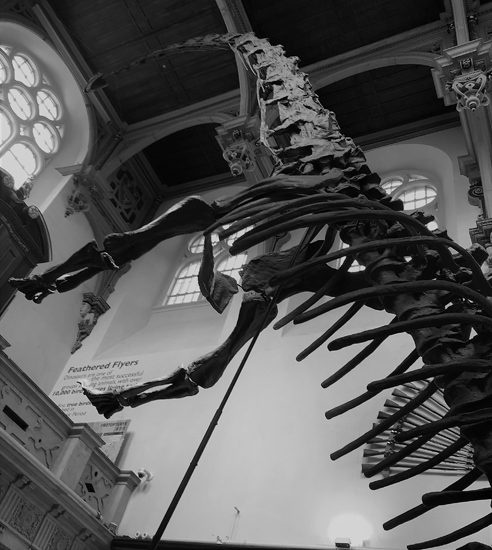
The rearing Mamenchisaurus dinosaur exhibit on display at the Dinosaurs of China exhibition (Nottingham). Picture credit: Thomas Clarke-Williams.
Picture credit: Thomas Clarke-Williams
A Window into Dinosaur Evolution
The question of whether sauropods could stand on their hind legs highlights just how much palaeontology has advanced. Researchers no longer rely solely on fossil bones. Instead, they combine anatomy, computer modelling, engineering and biomechanics to reconstruct how extinct animals moved and behaved.
At the same time, the evolutionary story remains just as fascinating. More than two hundred million years ago, relatively modest basal sauropodomorphs walked across the Late Triassic landscape. Over tens of millions of years, their descendants evolved into the largest terrestrial animals the world has ever seen. Although these giants became specialised quadrupeds, it seems that some retained the remarkable ability to rear up when the need arose.
Commenting on the research, Mike from Everything Dinosaur said:
“Sauropods continue to surprise us. They were not simply enormous, slow-moving herbivores. Modern biomechanical studies are revealing that different species behaved in different ways, and their evolutionary history helps explain why some of these giants may have retained the ability to stand on their hind legs.”
As new computer models become increasingly sophisticated, palaeontologists will continue to test ideas about dinosaur behaviour. For now, the evidence suggests that while standing upright was probably not an everyday occurrence, at least some sauropods could rise onto their hind limbs, giving them an impressive reach and providing another glimpse into the extraordinary biology of these prehistoric giants.
The multi-award-winning Everything Dinosaur website: Sauropod and Other Prehistoric Animal Models.