All about dinosaurs, fossils and prehistoric animals by Everything Dinosaur team members.
23 07, 2026

Celebrating 7,500 Everything Dinosaur Blog Posts – A Remarkable Journey of Discovery

By |2026-07-23T07:35:57+01:00July 23rd, 2026|Categories: Everything Dinosaur News and Updates|0 Comments

Today marks a very special milestone for us. Everything Dinosaur has now published 7,500 blog posts. We would like to celebrate this achievement by thanking everyone who has supported our blog over the years. We have been writing Everything Dinosaur blog posts for nearly twenty years.

Our first blog article was published on 27th May 2007. Since then, we have tried to share a new post every single day. That commitment has never changed. Every article reflects our passion for dinosaurs, prehistoric animals, fossils and the remarkable story of life on Earth.

Celebrating 7,500 Everything Dinosaur blog posts.

Celebrating the landmark of publishing 7,500 blog posts. Picture credit: Everything Dinosaur.

Picture credit: Everything Dinosaur

From the beginning, our aim has been simple. We wanted to make palaeontology accessible to everyone. Therefore, we write using clear language and avoid unnecessary scientific jargon whenever possible. We want our articles to be useful to teachers, students, families, collectors and anyone with an interest in prehistoric life.

Our first weblog post (we were a lot younger): The Everything Dinosaur Blog – An Introduction.

Celebrating 7,500 Everything Dinosaur Blog Posts

Over the last nineteen years, we have covered thousands of fossil discoveries. We have reported on newly named species. We have explained scientific research. In addition, we have shared museum visits, school projects, model reviews and behind-the-scenes stories from Everything Dinosaur.

As palaeontology has evolved, so has our blog. New technologies have transformed research. Fresh discoveries continue to reshape our understanding of prehistoric animals. Consequently, there has never been a better time to write about this fascinating subject.

However, none of this would have been possible without our readers.

Every comment, email and question has encouraged us to keep writing. Furthermore, many of our articles have been inspired by the curiosity of our readers and customers. We greatly value every suggestion and every conversation.

Ironically, one of our first blog posts in May 2007 concerned our thoughts on whether we should manufacturer our own range of dinosaur models.  Today, the Everything Dinosaur Evolution brand goes from strength to strength.  We have introduced a scientifically accurate, 1:33 scale Tyrannosaurus rex, and we are currently working on a Hell Creek Triceratops.

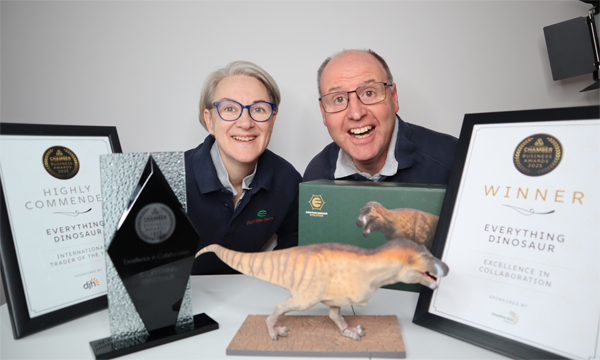
Mike and Sue with the first awards for the Everything Dinosaur Evolution T. rex figure.

Sue and Mike from Everything Dinosaur with their numerous awards. The company won the Excellence in Collaboration award and received Highly Commended for their international sales. Picture credit: Everything Dinosaur.

Picture credit: Everything Dinosaur

To view the award-winning Everything Dinosaur Evolution T. rex figure: Everything Dinosaur Evolution Tyrannosaurus.

Sharing our Enthusiasm for Dinosaurs and Fossils

We are proud of our Everything Dinosaur blog posts.  Each article is crafted with care.  In addition, we would like to thank all those people who have contributed to our blog posts.

Sue from Everything Dinosaur commented:

“When we started our blog in 2007, we simply wanted to share our enthusiasm for dinosaurs and fossils. Reaching 7,500 blog posts is a wonderful achievement, but what makes it truly special is knowing that so many readers around the world have joined us on this journey. Thank you for reading, supporting and encouraging us every step of the way.”

The blog has always been much more than a company news page. It has become a free educational resource that anyone can access. Whether you are looking for the latest dinosaur discovery, information about a prehistoric animal model or an explanation of new scientific research, we hope our articles help to inform and inspire.

Everything Dinosaur Blog Posts – A Personal Journey

Mike explained that writing the article and posts is a personal journey.  Each new fossil discovery, scientific paper or prehistoric animal model provides another opportunity to share the excitement of palaeontology with a global audience.

Mike from Everything Dinosaur added:

“Publishing a new blog article every day since May 2007 has required dedication, curiosity and a genuine love of learning. We are incredibly grateful to everyone who visits our blog, shares our articles and sends us questions. Your support motivates us to keep exploring, learning and writing. Here’s to the next 7,500 blog posts!”

Looking back, we are proud of what has been achieved. Even so, we are even more excited about the future. New fossils are discovered every day. New research continues to challenge old ideas. Moreover, remarkable prehistoric animal models keep arriving, giving us even more opportunities to share our passion.

So, as we celebrate our 7,500th blog post, we would simply like to say thank you.

Our thanks to every reader. Thank you to every supporter. Thank you to everyone who has shared our enthusiasm for prehistoric life.

We look forward to continuing our journey together, one blog post at a time.

The award-winning Everything Dinosaur website: Dinosaur and Prehistoric Animal Models.
22 07, 2026

New Research Examines Sauropod Rearing Behaviour

By |2026-07-22T18:05:47+01:00July 22nd, 2026|Categories: Palaeontological articles|0 Comments

Could giant sauropod dinosaurs stand up on their hind legs? A newly published study has explored this long-debated question using advanced digital biomechanical modelling. The research suggests that although many sauropods were capable of rearing up, the largest species probably found it much more difficult to maintain this posture.  The paper published as an open-access article in the journal “Palaeontology”, is the first to use finite element analysis (FEA) to examine sauropod rearing behaviour.

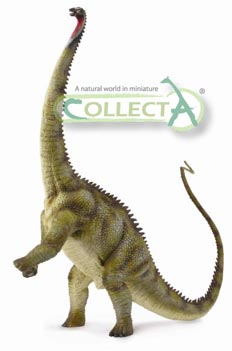
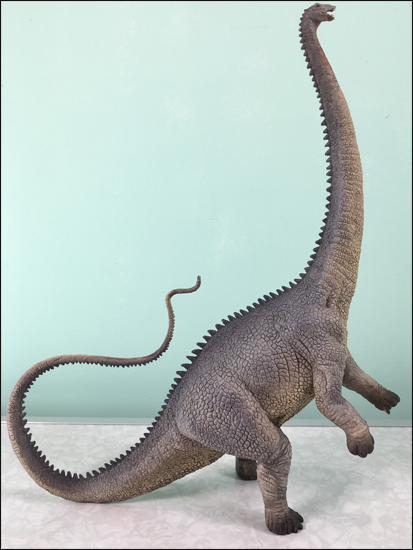
CollectA rearing Diplodocus (grey). Research into Diplodocus feeding habits.

A model depicting a rearing Diplodocus.  This is the 2020 CollectA Age of Dinosaurs rearing Diplodocus model. Previous studies (Mallison, 2011) had proposed that Diplodocus with its centre of mass located posteriorly may have been able to rear up more easily than other taxa. However, these results provide no strong evidence to indicate that rearing was a frequent behaviour for Diplodocus. Picture credit: Everything Dinosaur.

Picture credit: Everything Dinosaur

Sauropods, such as Diplodocus, Giraffatitan, Dreadnoughtus and Patagotitan, were the some of the largest terrestrial animals to have ever lived. Their immense size, long necks and pillar-like limbs have fascinated palaeontologists for more than a century. One of the enduring questions surrounding these giants is whether they could raise themselves into a bipedal or tripodal stance. Sauropod rearing behaviour may have occurred to permit them to reach higher branches in trees to feed. In addition, adopting a rearing pose may have helped to intimidate rivals or to defend themselves from carnivorous theropods. Perhaps rearing behaviour could have played role in social display, courtship or mating.

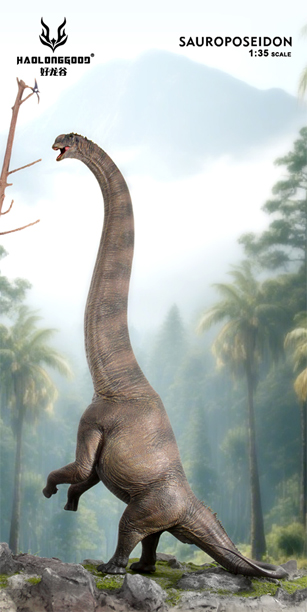
Haolonggood HLG 185c Sauroposeidon Heterochromatic version.

A Haolonggood Sauroposeidon figure depicted in a tripodal rearing pose.  The dinosaur’s huge weight is supported by its massive hind legs and muscular tail.  However, the new study concludes that larger sauropods were probably less capable of maintaining a rearing pose for sustained periods.

Testing Sauropod Rearing Behaviour

The new study, published in the journal Palaeontology, examined the hind limb biomechanics of seven sauropod genera representing a range of sizes and evolutionary groups. Rather than relying solely on skeletal anatomy, the researchers created detailed three-dimensional digital models of the femora (thigh bones) and subjected them to finite element analysis (FEA). This engineering technique predicts how a structure responds to forces and stresses and is widely used in the design of buildings, aircraft and vehicles.

The seven sauropod genera included in the study:

  1. Amargasaurus – a dicraeosaurid known from the Early Cretaceous of Argentina estimated to have reached a length of 12 metres and weighing 5 tonnes.
  2. Australotitan – of the Somphospondyli clade from the Late Cretaceous of Australia with some estimates suggesting a body length around 30 metres and weighing more than 50 tonnes.
  3. Diplodocus – a diplodocid from the Late Jurassic of North America reaching a length of around 27 metres and weighing an estimated 10-20 tonnes.
  4. Dreadnoughtus – a lithostrotian titanosaur from the Late Cretaceous of Argentina approximately 26 metres long and weighing 48-49 tonnes.
  5. Giraffatitan – a brachiosaurid from the Late Jurassic of Tanzania estimated to reach a length of 23 metres and to weigh over 40 tonnes.
  6. Neuquensaurus – a saltasaurid from the Late Cretaceous of Argentina estimated to reach a length of around 9 metres and to weigh 3.5 tonnes.
  7. Uberabatitan – a lithostrotian titanosaur known from the Late Cretaceous of Brazil around 26 metres in length and weighing more than 30 tonnes.

Our detailed guide explaining whether sauropods could stand on their hind legs will be published shortly.

Two Different Femora Load Scenarios

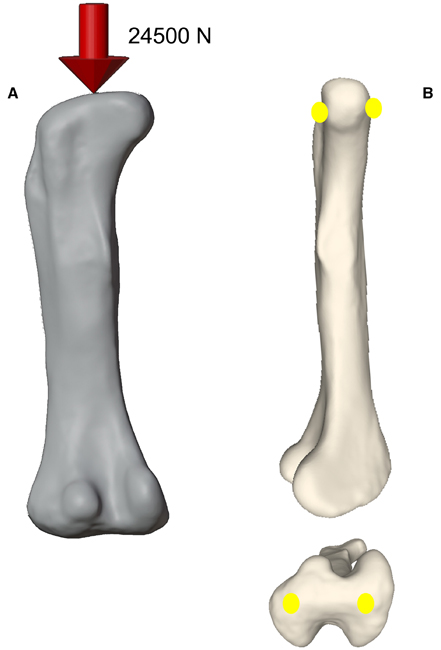
The scientists modelled two different loading scenarios. One simulated how the femora would respond to the animal’s body weight during a rearing posture. The second incorporated the forces generated by the surrounding muscles. By comparing the stress experienced by each femur, the team assessed how well different sauropods may have coped with standing on their hind limbs.

Extrinsic functional scenario modelled in the study Sauropoda rearing study.

Extrinsic functional scenario modelled in the study. A, 3D rendering of the femur of Uberabatitan (CPPLIP-1238) in posterior view, with the red arrow showing the position of the applied loads. B, representation of the constraints (yellow circles) applied to all models for the extrinsic scenarios. Picture credit: Silva Junior et al. (2025), Palaeontology. Reproduced under the terms of the applicable Creative Commons licence.

Picture credit: Silva Junior et al. (2025), Palaeontology. Reproduced under the terms of the applicable Creative Commons licence.

Smaller Sauropods Had an Advantage

The results indicate that body size played a major role in determining how effectively a sauropod could rear up. Smaller species generally experienced lower levels of stress within their femora. In particular, the saltasaurid titanosaur Neuquensaurus performed exceptionally well in the simulations. Its relatively robust femur and favourable muscle attachment sites suggest that it may have been capable of maintaining a rearing posture for longer periods.

In contrast, enormous titanosaurs such as Dreadnoughtus experienced much higher levels of stress within their hind limbs. This finding suggests that although these giants may have been able to rear briefly, maintaining such a posture would have placed considerable demands on their skeleton.

Juveniles may have been more capable of rearing than adults.  This opens up the intriguing possibility of sauropod rearing behaviour permitting ontogenetic niche partitioning. Sauropods may have changed their rearing behaviour as they grew and matured.

Interestingly, the study also compared Diplodocus and Giraffatitan, two sauropods that have featured prominently in previous discussions about rearing behaviour. The new biomechanical analysis broadly supports earlier research suggesting that differences in body shape and centre of mass influenced how easily these dinosaurs could adopt an upright stance. For example, the researchers conclude that Diplodocus was more capable of rearing than a brachiosaur such as Giraffatitan. However, the stress forces in the femur were still relatively high. Therefore, the study authors postulate that rearing for a Diplodocus was not a routine or frequent behaviour.

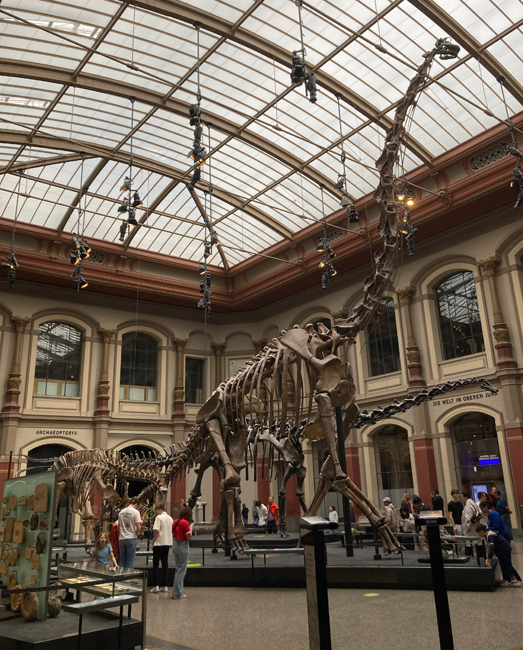
Giraffatitan brancai on display at the Museum für Naturkunde Berlin.

The giant Giraffatitan brancai skeleton on display at the Museum für Naturkunde Berlin. Picture credit: Everything Dinosaur.

Picture credit: Everything Dinosaur

Sauropod Rearing Behaviour Probably More Than Just Feeding

For many years, palaeontologists have suggested that rearing allowed sauropods to browse vegetation beyond the reach of other herbivores. However, the researchers point out that this behaviour may also have served several other important functions.

Standing upright could have helped during defensive displays, combat between rivals or mating. Furthermore, the authors note that sauropods may not always have reared unsupported. Leaning against a tree while feeding, or using a mate for additional support during courtship, would have reduced the stresses acting on the hind limbs.

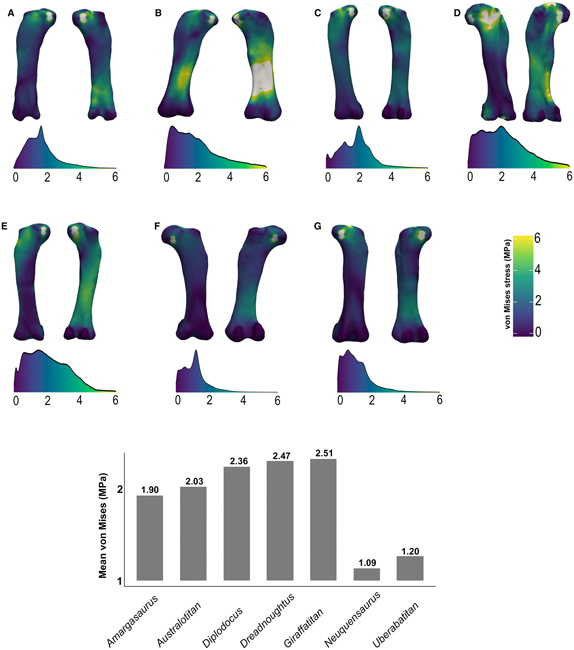
Femora stress results of genera from sauropod rearing study.

Finite element analysis of stress on femora with applied load of 24,500 N to sauropod femora in anterior (left) and posterior (right) views of: Amargasaurus (A); (B), Australotitan; (C), Diplodocus; (D), Dreadnoughtus; (E), Giraffatitan; (F), Neuquensaurus and Uberabatitan (G). Regions displayed in white indicate stress value that exceed the upper limit of the defined scale. Picture credit: Silva Junior et al. (2025), Palaeontology. Reproduced under the terms of the applicable Creative Commons licence.

Picture credit: Silva Junior et al. (2025), Palaeontology. Reproduced under the terms of the applicable Creative Commons licence.

A New Perspective

This is the first study to use finite element analysis specifically to investigate sauropod rearing behaviour. As with any computer model, there are limitations. The digital reconstructions do not include the complex internal structure of bone or the cushioning effects of cartilage. Consequently, the stress values should be viewed as comparative rather than absolute.

Nevertheless, the research provides fresh insight into the lives of the largest terrestrial animals known to science. Rather than treating all sauropods alike, the study demonstrates that anatomy, body size and muscle configuration all influenced their ability to rear up. The findings suggest that some smaller sauropods may have been surprisingly agile, while the largest species were constrained by the sheer scale of their bodies.

Commenting on the research, Mike from Everything Dinosaur explained:

“Sauropods have always challenged our understanding of biomechanics. After all, there are no extant animals analogous to them. This study shows how modern digital techniques can test ideas that were once based largely on educated guesswork. It demonstrates that even among the giant sauropods, anatomy mattered, and not every species would have behaved in exactly the same way.”

The study provides another excellent example of how engineering, computer modelling and palaeontology are working together to answer questions about dinosaur behaviour that would have seemed impossible to investigate just a few decades ago.

The scientific paper: “Standing giants: a digital biomechanical model for bipedal postures in sauropod dinosaurs” by Julian C. G. Silva Junior, Gabriel S. Ferreira, Agustín G. Martinelli, Thiago S. Marinho, Felipe C. Montefeltro published in the journal Palaeontology.

Models of sauropods and other prehistoric animals: Sauropod and Other Dinosaur Models.

21 07, 2026

DinoCon 2026 Dinosaur Models – Reserve Yours with Everything Dinosaur

By |2026-07-21T08:53:55+01:00July 21st, 2026|Categories: Everything Dinosaur News and Updates|0 Comments

Everything Dinosaur is looking forward to attending DinoCon 2026 this weekend. Mike and Sue will once again be exhibiting in the Vendors Hall (Table 7), where they will be meeting customers, collectors and prehistoric animal enthusiasts from across the UK. We will be giving collectors the opportunity to reserve DinoCon 2026 dinosaur models.

Mike and Sue from Everything Dinosaur will be attending DinoCon 2025.

Mike and Sue from Everything Dinosaur will be attending DinoCon 2026. Picture credit: Everything Dinosaur.

Picture credit: Everything Dinosaur

DinoCon 2026 Dinosaur Models

If you are planning to visit DinoCon and have a particular prehistoric animal figure in mind, why not let us know before the event? We will be happy to bring your requested model for you to purchase and collect from our stand.

Just let us know what model(s) you want, and we will sort this out for you.

Contact Everything Dinosaur: Email Everything Dinosaur.

We stock an extensive range of prehistoric animal models from many of the world’s leading manufacturers. For example, we can bring figures from PNSO, Haolonggood, CollectA, Mojo Fun, Safari Ltd and Rebor. In addition, visitors will have the opportunity to see our own award-winning Everything Dinosaur Evolution Tyrannosaurus rex, the first model in our premium museum-quality range.  The Everything Dinosaur Evolution T. rex is a 1:33 scale model.

The Everything Dinosaur Evolution T. rex model is a multi-award-winning dinosaur figure.

The Everything Dinosaur Evolution Tyrannosaurus rex figure. Picture credit: Everything Dinosaur.

Picture credit: Everything Dinosaur

Whether you are searching for the latest releases or trying to add a hard-to-find figure to your collection, simply contact us before the weekend with your request. We will do our very best to make sure your chosen model is waiting for you when you visit Table 7.

Mike from Everything Dinosaur commented:

“One of the best parts of attending DinoCon is meeting customers in person. Every year we receive requests to bring specific models to the show, and we’re always happy to help. If there’s a figure you’ve been hoping to add to your collection, just let us know before the weekend and we’ll do our best to have it ready for you.”

See the Award-winning Everything Dinosaur Evolution Tyrannosaurus rex

Collectors visiting our stand will also be able to take a closer look at the Everything Dinosaur Evolution T. rex. This scientifically informed, museum-quality replica has been developed in collaboration with leading experts, including palaeontologist Dr Dean Lomax, palaeoartist Bob Nicholls and digital sculptor Glen Southern. The figure has already received industry recognition and represents the first release in our exciting Everything Dinosaur Evolution series.

If you would like to purchase one of these award-winning models at DinoCon, simply include it in your request and we will reserve one for you.

Visit Everything Dinosaur at Table 7.

Everything Dinosaur at DinoCon 2026.

Everything Dinosaur at DinoCon (2026). Find Sue and Mike from Everything Dinosaur in the Vendors Hall at DinoCon. Find us on table 7. Picture credit: Everything Dinosaur.

Picture credit: Everything Dinosaur

Mike and Sue are looking forward to another fantastic DinoCon and to catching up with customers old and new. If you would like us to bring a particular prehistoric animal model to the event, please get in touch before the weekend.

We look forward to welcoming you to Table 7 in the Vendors Hall and helping you find the perfect addition to your collection.

Don’t forget to contact us to reserve your DinoCon 2026 dinosaur models.

The award-winning Everything Dinosaur website: Dinosaur and Prehistoric Animal Models.
20 07, 2026

Earliest Synapsid Cloaca Revealed by 294-Million-Year-Old Fossil

By |2026-07-15T16:30:00+01:00July 20th, 2026|Categories: Palaeontological articles|0 Comments

A remarkable trace fossil from Germany has provided the oldest known evidence of a cloaca in the mammalian lineage. The discovery helps palaeontologists better understand the evolution of early terrestrial vertebrates and fills an important gap in the fossil record. The fossil comes from the famous Bromacker fossil locality in Thuringia (Germany). Among footprints and other trace fossils the scientists identified a tail impression. The anterior portion of this tail impression preserves evidence of the earliest synapsid cloaca.

The international team of researchers, led by scientists from the Museum für Naturkunde Berlin, published their findings in the journal “iScience”. The trace fossils are approximately 294 million years old (Early Permian). This represents the first occurrence of a cloaca in the fossil record of stem mammals.

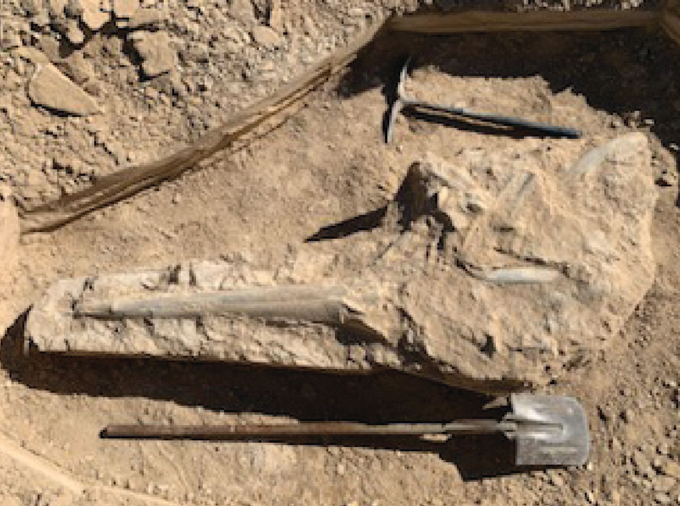
Earliest synapsid cloaca identified in Bromacker locality trace fossil.

The trace fossil specimen MNG 13490 with the preserved underside of the tail impression. Note scale bar equals 10 cm. Picture credit: Marchetti et al.

Picture credit: Marchetti et al

A Rare Glimpse of Soft Tissue Preservation

Fossils usually preserve bones and teeth. Soft tissues, however, almost always decay before fossilisation can occur. Consequently, direct evidence of anatomical features such as the cloaca is exceptionally rare. The newly described specimen includes a beautifully preserved impression of the tail together with fossil footprints. Near the base of the tail, the researchers identified two rows of raised scales separated by a narrow vertical slit. They interpret these features as the lips and opening of a cloaca.

This fossil provides the first direct evidence of an earliest synapsid cloaca, offering scientists an unprecedented look at the anatomy of an animal closely related to the ancestors of mammals.

Caseid synapsid tail impression.

The caseid synapsid tail impression. Note scale bar equals 5 cm. Picture credit: Marchetti et al.

Picture credit: Marchetti et al

What is a Cloaca?

A cloaca is a single external opening used by the digestive, urinary and reproductive systems. Today, amphibians, reptiles and birds possess a cloaca. Among mammals, however, only monotremes such as the platypus and echidnas have retained this feature. Most extant mammals (placentals and marsupials) have separate openings for these bodily functions. Until now, scientists had little direct fossil evidence showing how this important anatomical structure appeared in the mammalian lineage.

An Early Relative of Mammals

The fossil traces have been linked to a caseid synapsid. Caseids were large-bodied, herbivorous members of the Synapsida, the evolutionary group that eventually gave rise to the Mammalia. Researchers matched the fossil impression with the distinctive Dimetropus footprints found at the Bromacker locality. Comparisons with skeletal fossils collected from the same site strengthened this interpretation.

Although caseids looked very different from mammals today, they belonged to the same broad evolutionary lineage. Therefore, this discovery provides valuable information about the early stages of mammalian evolution.

A close view of the earliest synapsid cloaca.

The cloacal area in the anterior part of the tail impression. Note scale bar equals 5 cm. Picture credit: Marchetti et al.

Picture credit: Marchetti et al

New study highlights the growth rates of diminutive Dimetrodon species from the Bromacker locality: Bromacker Dimetrodon Growth Study.

Why Did the Cloaca Evolve?

The study also explores why the cloaca changed during vertebrate evolution. Although the answer remains uncertain, the researchers suggest several possible explanations.

For example, changes in reproductive anatomy may have played a role. Likewise, increasingly dry environments could have influenced the evolution of different body structures. The scientists also propose that evaporative cooling through the cloacal opening may have helped animals regulate their body temperature. Furthermore, changes in body shape, including shorter tails and modified limbs, may have contributed to these evolutionary developments.

In squamates and birds, the cloaca tends to have a horizontal orientation. Cloacal evaporation for thermoregulation purposes has been observed in squamates and birds. In contrast, the Crocodylomorpha and the Caudata (salamanders and their extinct relatives), have a vertical cloaca. These animals are associated with aquatic environments. Intriguingly, the fossilised tail impression is clearly impressed in a water-saturated sediment.

The fossil specimen shows swimming traces associated with Dimetropus footprints. Therefore, it is possible that a transition from a vertical to a horizontal cloaca occurred as an adaptation to drier environments. The horizontal orientation of the cloacal orifice could favour more efficient cloacal evaporation to help maintain body temperature. This would be in agreement with the vent orientation change in stem reptiles between the Carboniferous and the Permian, in a time of global warming and increasing aridity and seasonality. Nevertheless, the causes of this correlation should be further investigated in modern taxa.

The Significance of the Bromacker Fossil Site

The Bromacker fossil locality is recognised as one of the world’s most important Late Palaeozoic fossil sites. It has produced an exceptional record of terrestrial animals and plants that lived during the Early Permian. This latest discovery also demonstrates the value of revisiting historic museum collections. Modern imaging techniques and careful re-examination can reveal important anatomical details that earlier researchers could not detect.

False-colour depth map of the cloacal area.

A false-colour depth map of the cloacal area taken from the photogrammetric 3D model. Picture credit: Marchetti et al.

Picture credit: Marchetti et al

Understanding the Evolution of Mammals

The discovery of the earliest synapsid cloaca provides much more than an anatomical curiosity. It offers scientists a rare opportunity to investigate the evolution of reproductive and excretory systems in one of the most important vertebrate lineages. As new discoveries emerge from the Bromacker site and other fossil localities, researchers will continue to refine our understanding of how the ancestors of mammals adapted to life on land hundreds of millions of years ago.

Commenting on the importance of this research, Mike from Everything Dinosaur stated:

“Soft tissue fossils are incredibly rare, so discoveries like this earliest synapsid cloaca impression are exceptionally important. The specimen shows that trace fossils can preserve anatomical details that skeletal remains alone cannot reveal. It also reminds us that remarkable scientific discoveries can still be made by re-examining specimens already held in museum collections.”

This remarkable discovery demonstrates how exceptional fossil preservation continues to reveal new chapters in the evolutionary history of the Mammalia.

Everything Dinosaur acknowledges the assistance of a media release from the Museum für Naturkunde Berlin in the compilation of this article.

The scientific paper: “The evolutionary significance of the earliest cloacal opening in Synapsida” by Lorenzo Marchetti, Antoine Logghe, Arnaud Rebillard, Mark J. MacDougall and Jörg Fröbisch published in IScience.

The multi-award-winning Everything Dinosaur website: Models of Prehistoric Life.

19 07, 2026

Amazing Five-star Customer Feedback Helps Everything Dinosaur Maintain Exceptional Service Record

By |2026-07-14T15:20:18+01:00July 19th, 2026|Categories: Everything Dinosaur News and Updates|0 Comments

Receiving five-star customer feedback is always a wonderful way to start a day of ecommerce selling dinosaurs. Sue and I receive an amazing number of five-star reviews. At Everything Dinosaur, we are delighted to share another excellent review from one of our valued customers. Independent customer feedback helps us measure and maintain our performance. Moreover, it motivates us to keep improving every aspect of our business.

The latest review has helped us reach another impressive milestone. We have now received more than seven hundred independent product and service reviews this year through Feefo. Better still, ninety-seven percent of those reviews have awarded us five stars. The remaining three percent have given us four stars. Furthermore, Feefo has rated our customer service as “Exceptional”.

Five-star customer feedback for Everything Dinosaur.

Mike and Sue from Everything Dinosaur receive another 5-star customer review. The dinosaur toy retailer is “run by enthusiasts for enthusiasts”. Picture credit: Feefo.

Picture credit: Feefo

Five-star Customer Feedback Reflects Our Values

One sentence from the latest review particularly caught our attention. The customer described Everything Dinosaur as “run by enthusiasts for enthusiasts.”

Those few words perfectly capture Everything Dinosaur’s philosophy.

We have always aimed to be more than a retailer. Instead, we strive to share our enthusiasm for prehistoric animals with collectors, families, schools and museums. Consequently, every order receives the same care and attention, regardless of its size.

Sue and I enjoy helping customers choose models, answer questions and discover the latest scientific research. We also provide free fact sheets, educational resources, videos and lots of advice. As a result, we hope every customer gains more than simply a parcel through the post.

Sue from Everything Dinosaur pointing out that the Cheshire based business is rated as "Exceptional" for customer service by the independent rating company Feefo.

Sue from Everything Dinosaur pointing out that the Cheshire based business is rated as “Exceptional” for customer service by the independent rating company Feefo. The company regularly receives five-star customer feedback. Picture credit: Everything Dinosaur.

Picture credit: Everything Dinosaur

Every Review is Important to Us

Customer feedback plays an important role in our business. Every review is read. Moreover, we value both compliments and constructive suggestions. Listening to our customers helps us refine our service and maintain the high standards that collectors expect.

We never take positive feedback for granted. Therefore, every five-star review means a great deal to us. It reminds us that our commitment to excellent customer service continues to make a difference.

Thank You from Everything Dinosaur

Sue from Everything Dinosaur explained:

“Every review represents a customer who has taken time out of their day to share their experience. We genuinely appreciate every comment we receive. Positive feedback inspires us to keep improving and to continue providing the service that our customers deserve.”

Finally, we would like to thank everyone who has supported Everything Dinosaur over the years. Your reviews, encouragement and loyalty have helped us build a business that is proudly run by enthusiasts for enthusiasts. We look forward to helping many more customers in the future.

Our award-winning and highly rated website: Dinosaur and Prehistoric Animal Models.

18 07, 2026

Impressive Prehistoric Animal Sand Art

By |2026-07-09T15:31:43+01:00July 18th, 2026|Categories: Dinosaur Fans|0 Comments

At Everything Dinosaur, we are always delighted to see how prehistoric animals inspire creativity. Recently, we received some amazing prehistoric animal sand art created by a talented young artist Caldey.

Caldey used sand to create two wonderful prehistoric-themed sculptures. The artwork featured a graceful plesiosaur and a spectacular Spinosaurus. These fantastic creations demonstrate how dinosaurs and other ancient animals can encourage imagination, learning and artistic expression.  We praise the subject matter, as both plesiosaurs and Spinosaurus are associated with water dominated environments.  It’s appropriate to display them on a beach.

Prehistoric animal sand art.

A sand art plesiosaur, getting creative on the beach with marine reptiles. Picture credit: Caldey.

Picture credit: Caldey

Dinosaur bone found on a beach: Dinosaur Bone found on Whitehaven Beach.

Encouraging Creativity with Prehistoric Animal Sand Art

Dinosaurs and prehistoric creatures fascinate people of all ages. However, for many fans and model collectors, their interest goes far beyond reading books or adding to their collection. They use their enthusiasm as a starting point for expressing creativity.

Drawing, painting, model making and sculpting can all provide opportunities to explore the amazing story of life on Earth. Creative activities also encourage patience, concentration and problem-solving skills. In addition, reflecting on a piece of original art encourages mindfulness and contributes to wellbeing.

Caldey’s prehistoric animal sand art shows careful planning and attention to detail. Working with sand is not easy. The artist must think about shape, form and structure while creating a recognisable prehistoric animal.  We note the use of seaweed and shells to add further details to the sculptures.

Spinosaurus sand art.

Spinosaurus sand art. It was a great idea to mark the top of the sail and the eye of the Spinosaurus using small, sun-bleached shells. Picture credit: Caldey.

Picture credit: Caldey

Sue from Everything Dinosaur praised Caldey’s wonderful creations:

“We were absolutely thrilled to receive pictures of Caldey’s prehistoric animal sand art. A great deal of thought, care and effort has gone into creating these sculptures. The plesiosaur and Spinosaurus are instantly recognisable, and Caldey should be extremely proud. It is fantastic to see young people using their love of prehistoric animals to express themselves creatively.”

Dinosaurs Inspiring the Next Generation

The team at Everything Dinosaur enjoys hearing from customers and young palaeontology fans. Every drawing, story, model and piece of artwork shared with us demonstrates the positive impact that an interest in prehistoric life can have. Science and creativity often go hand in hand. After all, palaeontologists also need to think outside the box when studying unique fossils and trying to understand extinct animals.  Palaeoartists reconstruct long extinct creatures, and this requires imagination.

Caldey’s sculptures remind us that everyone can explore the prehistoric world in their own unique way.

A huge thank you to Caldey for sharing this brilliant prehistoric animal sand art with us. Keep creating and keep exploring the amazing creatures from Earth’s ancient past!

17 07, 2026

New Haolonggood Woolly Mammoth Models Coming into Stock

By |2026-07-15T17:40:12+01:00July 17th, 2026|Categories: Haolonggood Prehistoric Animal Models|0 Comments

Two new Haolonggood Woolly Mammoth models will be arriving at Everything Dinosaur shortly. These impressive prehistoric mammal figures are the latest additions to the popular Ancient Witness range and will be available in two attractive colour variants.

Haolonggood Woolly Mammoth models.

Two colour versions of the new Haolonggood Woolly Mammoth model will be available. There will be a reddish-brown (dark) colour version (right) and (left) a lighter yellowish-brown colour variant.

To view the range of Haolonggood prehistoric animal models in stock: Haolonggood Prehistoric Animal Figures.

New Haolonggood Woolly Mammoth Models

Collectors can choose between a rich reddish-brown version and a lighter yellowish-brown edition. Both figures share the same brown base colour, but each has its own distinctive finish. The subtle differences are much more noticeable when the models are viewed in person. These figures will be in stock at Everything Dinosaur soon.

Haolonggood Woolly Mammoth models

The two colour variants of the Haolonggood 1:35 scale Woolly Mammoth model (light and dark).

Each 1:35 scale Mammuthus primigenius model measures approximately twenty centimetres in length and stands around ten and a half centimetres tall. The figures have been carefully sculpted to capture the appearance of one of the most iconic Ice Age mammals.  Remains extracted from thawing permafrost have provided palaeontologists with samples of hair.  From these samples, scientists have been able to determine the colour of these prehistoric elephants.  In our view, both colour variants are perfectly acceptable.

Exploring Mammuthus primigenius colour variations: Woolly Mammoth Colour Variations – Exploring the Science.

Mike from Everything Dinosaur commented:

“Haolonggood continues to expand its Ancient Witness series with beautifully detailed prehistoric animal models. These new Woolly Mammoth figures are excellent additions to the range, and we are sure collectors will appreciate having two distinctive colour versions to choose from.”

Everything Dinosaur expects both Haolonggood Woolly Mammoth models to be in stock very soon. Customers can look forward to adding these beautifully crafted Ice Age replicas to their collections in the near future.

The award-winning Everything Dinosaur website: Prehistoric Animal Models and Dinosaurs.

16 07, 2026

Seal Underwater Hearing Explained by New Research

By |2026-07-15T11:40:13+01:00July 16th, 2026|Categories: Palaeontological articles|0 Comments

A team of international scientists has uncovered the remarkable mechanism behind seal underwater hearing. A new study, led by researchers from the London Natural History Museum reveals how extant seals hear equally well in air and underwater. The findings help to explain a long-standing evolutionary mystery and could support future conservation efforts.

The research, published as an open-access paper in the “Royal Society Proceedings B”, examined more than two hundred living and fossil seal specimens. By combining advanced CT scanning with evolutionary analysis, the researchers identified the specialised tissue that makes this extraordinary ability possible.

Blood-Filled Tissue Helps Seals Hear Underwater

Unlike humans and most other land mammals, seals can hear efficiently in two very different environments. Normally, mammalian hearing relies on an air-filled middle ear. However, this arrangement performs poorly underwater because the air pocket behind the eardrum reflects almost all sound. The researchers discovered that seals overcome this problem with specialised cavernous tissue inside the middle ear. During a dive, this tissue fills with blood. As blood has a density similar to seawater, sound passes more efficiently through the ear and reaches the cochlea. As a result, seals continue to hear clearly beneath the waves.

Lead and corresponding author Dr James Rule (London Natural History Museum/Monash University) explained that scientists have puzzled over this adaptation for decades. The new research finally identifies the anatomical feature responsible for amphibious hearing.

New study helps to explain seal underwater hearing.

A 3D rendering of the skull of a Southern Elephant seal showing the underwater hearing adaptations. Picture credit: James Rule.

Picture credit: James Rule

Fossils Reveal the Evolution of Seal Underwater Hearing

The team’s analysis included both living species and fossil relatives of modern seals. Consequently, the researchers could trace when this remarkable adaptation first evolved. Evidence suggests that the ancestors of seals initially heard well only in air. Ancient species such as Potamotherium (Oligocene to Miocene) and the stem pinniped Puijila (late Oligocene to early Miocene) probably lacked effective underwater hearing. However, later marine relatives, including Enaliarctos, appear to have evolved the first form of amphibious hearing approximately 26.7 million years ago.

Puijila (seal ancestor) life reconstruction.

The earliest relatives of pinnipeds, such as the 23-million-year-old Puijila darwini, could only hear in-air. Like most mammals, their ears did not function properly underwater. Picture credit: Jaime Bran.

Picture credit: Jaime Bran

From this point onwards, different seal groups continued to refine their hearing. For example, true seals (phocids) developed enhanced underwater hearing. In contrast, the earliest eared seals retained adaptations that favoured hearing in air.

The study indicates that these improvements evolved independently after the earliest marine pinnipeds had already acquired the basic mechanism for hearing in both environments.

Rare Acoustic Abilities

The scientists also suggest that improved underwater hearing opened new evolutionary opportunities. Over millions of years, seals developed an impressive range of acoustic behaviours.

Today, some species produce haunting underwater vocalisations. Others can learn new sounds, keep a rhythmic beat and even imitate aspects of human speech. These unusual abilities may have become possible because their ancestors first evolved an ear capable of functioning effectively both above and below the water’s surface.

Life reconstruction of Enaliarctos mealsi.

Life reconstruction of Enaliarctos mealsi, one of the earliest marine seals from around 23 million years ago, being chased by a cetacean. It was capable of hearing both in-air and underwater (amphibious hearing), thanks to a specialised tissue in their ears (called a cavernous tissue). However, their hearing ranges in both environments were quite limited. Picture credit: Jaime Bran.

Picture credit: Jaime Bran

Museum Collections Unlock New Discoveries

The research depended upon the Natural History Museum’s extensive collections. Scientists examined more than two hundred specimens representing a hundred and nineteen living and extinct species of Carnivora.

By studying fossil skulls alongside modern seals, the researchers reconstructed the evolutionary history of the middle ear. This work demonstrates the continuing scientific value of museum collections assembled over many generations.

Dr Natalie Cooper, Merit Researcher at the London Natural History Museum, London stated:

“The Natural History Museum has some of the best seal collections in the world, and this study really shows its value. This research simply wouldn’t have been possible without these specimens,
which have been collected across hundreds of years from all over the world. It’s important that we know how seals hear because noise pollution in the ocean is growing. As the seas get louder, it’s harder for seals to find mates and communicate with each other putting their survival at risk. By understanding how these animals hear, we can start to put solutions in place.”

To read an article from 2020 but the discovery of a prehistoric pinniped in New Zealand that re-writes seal evolution: Sealing the Fate of Pinniped Evolution.

Understanding Hearing Function Can Help Protect Seals

The discovery has important conservation implications. Oceans are becoming increasingly noisy because of shipping, offshore construction and other human activities. Consequently, underwater noise can interfere with how seals communicate, locate mates and navigate.

Understanding seal underwater hearing provides researchers with valuable information about how these animals perceive their environment. In turn, this knowledge could help shape future conservation measures designed to reduce the impact of underwater noise pollution.

Mike from Everything Dinosaur commented:

“This fascinating study shows how fossils continue to answer important questions about the evolution of living animals. By combining evidence from extinct and modern seals, the researchers have explained one of the most remarkable hearing adaptations found in any mammal.”

Everything Dinosaur acknowledges the assistance of a media release from the London Natural History Museum in the compilation of this article.

The scientific paper: “The origin and evolution of amphibious hearing in pinnipeds” by James P. Rule, Travis Park, Moganavalli Kattan, Camille Grohé, Roxana Taszus, Stephanie M. Palmer, David P. Hocking, Justin W. Adams, Alistair R. Evans, Ian G. Brennan, Tahlia I. Pollock, Daniela Sanfelice, Felix G. Marx, Naoki Kohno, Martin Sabol, Alexander Stoessel, John J. Flynn and Natalie Cooper published in the Proceedings of the Royal Society B.

The award-winning Everything Dinosaur website: Models of Prehistoric Mammals.

15 07, 2026

Uragasaurus – A New Mamenchisaurid Sauropod from Thailand

By |2026-07-13T14:07:35+01:00July 15th, 2026|Categories: Palaeontological articles|2 Comments

A team of international researchers has named a remarkable new species of long-necked dinosaur from Thailand. Uragasaurus kalasinensis is the first formally described member of the Mamenchisauridae from Thailand. Although the fossil evidence consists of a single vertebra, the bone preserves a unique combination of anatomical features that enabled scientists to identify an entirely new dinosaur.  It is the fifteenth dinosaur to be named from fossils discovered in Thailand.

The research, published as an open-access paper in the journal “Scientific Reports”, highlights the growing importance of Thailand in helping palaeontologists understand the evolution and distribution of giant sauropod dinosaurs during the Late Jurassic.

Uragasaurus kalasinensis and the Mamenchisauridae

The newly described dinosaur lived approximately 145–150 million years ago during the Late Jurassic. Its fossil was recovered from the Phu Noi locality in Kalasin Province, north-eastern Thailand, within the Phu Kradung Formation.

Mamenchisaurids are famous for their extraordinarily long necks. Most known mamenchisaurids have been discovered in China, so the identification of Uragasaurus kalasinensis (pronounced You-rah-ga-sore-us cal-ah-sin-en-sis), considerably extends the confirmed geographical distribution of this distinctive group.

Scientists estimate that Uragasaurus measured around twenty metres in length and was a huge plant-eater that browsed vegetation growing high above the ground. Its neck has been described as being as long as a cricket pitch.

Uragasaurus kalasinensis life reconstruction.

A herd of Uragasaurus kalasinensis feeding in a Late Jurassic forest in Thailand. A metriacanthosaurid theropod can be seen in the background along with a pair of rhamphorhynchoid pterosaurs. Picture credit: Pakorn Chotchaiyaporn.

Picture credit: Pakorn Chotchaiyaporn. Licensed under a Creative Commons Attribution 4.0 International License.

A Single Vertebra Tells an Extraordinary Story

The fossil consists of an anterior dorsal vertebra. At first glance, naming a dinosaur from just one bone might seem surprising. However, vertebrae contain numerous anatomical characteristics that are extremely useful for identifying different dinosaur groups. Individual sauropod vertebrae often preserve unique anatomical characteristics that enable researchers to recognise and describe new species.

The researchers carefully compared the fossil with vertebrae belonging to many other Asian sauropods. They found a unique arrangement of bony ridges, cavities and supporting structures, known as laminae, which had not previously been documented in any recognised species. This distinctive combination of features justified the establishment of the new genus Uragasaurus.

Uragasaurus kalasinensis (PRC 460) vertebra.

The holotype anterior dorsal vertebra of Uragasaurus kalasinensis (PRC 460) in anterior (a) and posterior (b) views. Digital rendering of the specimen in anterior (c), posterior (d), right lateral (e), left lateral (f), dorsal (g), and ventral (h) views. Asterisk refers to an autapomorphic character. The blue highlight indicates the pneumatic fossa and pleurocoel. Picture credit: Nilpanapan et al.

Picture credit: Nilpanapan et al. Licensed under a Creative Commons Attribution 4.0 International License.

A Growing Picture of Thailand’s Dinosaur Fauna

Thailand has become increasingly important for dinosaur research over the last three decades. Numerous excavations have revealed an impressive diversity of prehistoric animals, including theropods, ornithopods and several species of sauropod.

To read an article from 2019 highlighting the discovery of two new theropod species from north-eastern Thailand: Two New Theropod Dinosaurs from Thailand.

The discovery of Uragasaurus kalasinensis demonstrates that north-eastern Thailand preserves fossils of dinosaur groups previously thought to be largely restricted to China. It also suggests that mamenchisaurids dispersed more widely across eastern Asia than palaeontologists had previously appreciated. The researchers propose that continued exploration of the Phu Kradung Formation is likely to reveal additional fossils that will help clarify the evolutionary history of these spectacular long-necked dinosaurs.

The giant Nagatitan chaiyaphumensis, the fourteenth dinosaur to be described from Thailand: The Last Titan from Thailand.

A Single Vertebra Can Rewrite Dinosaur History

While complete dinosaur skeletons understandably capture the public imagination, they are extremely rare. Discoveries such as Uragasaurus kalasinensis remind us that experienced palaeontologists can extract an enormous amount of scientific information from isolated bones. Careful anatomical comparisons often reveal evolutionary relationships that would otherwise remain hidden.

Uragasaurus kalasinensis anterior dorsal vertebra compared to the vertebrae of other mamenchisaurids.

A comparison of the anterior dorsal vertebrae of Uragasaurus kalasinensis with other Late Jurassic mamenchisaurids. Mamenchisaurus youngi (Upper Shaximiao Formation of Sichuan, China) and Mamenchisaurus hochuanensis (Upper Shaximiao Formation of the Chongqing municipality, China). Abbreviations lprdl, lower prezygodiapophyseal lamina; uprdl, upper prezygodiapophyseal lamina. Other abbreviations can be found in the second image in this article.  Asterisk refers to an autapomorphic character. The blue highlight indicates the pneumatic fossa and pleurocoel. Note images are not to scale. Picture credit: Nilpanapan et al.

Picture credit: Nilpanapan et al. Licensed under a Creative Commons Attribution 4.0 International License.

A Significant Discovery

The description of Uragasaurus kalasinensis represents another important milestone for Southeast Asian palaeontology. The discovery strengthens evidence that Thailand preserves an exceptionally important record of Jurassic dinosaurs and demonstrates that many new species remain to be discovered.

As fieldwork continues across the region, further fossil discoveries are likely to improve our understanding of how giant sauropods evolved and dispersed across Asia during the Jurassic.

Commenting on the research, Mike from Everything Dinosaur said:

“This fascinating study demonstrates how even a single fossil bone can significantly improve our understanding of dinosaur evolution. Thailand continues to produce scientifically important discoveries, and Uragasaurus kalasinensis adds another impressive dinosaur to the country’s growing fossil record.”

The scientific paper: “A new mamenchisaurid sauropod from the Lower Phu Kradung Formation, Upper Jurassic of northeastern Thailand” by Apirut Nilpanapan, Sita Manitkoon, Varavudh Suteethorn and Komsorn Lauprasert an open-access paper published in Scientific Reports.

14 07, 2026

New Schleich Woolly Mammoth Figure Arrives at Everything Dinosaur

By |2026-07-10T14:54:41+01:00July 14th, 2026|Categories: Schleich|0 Comments

The new Schleich Woolly Mammoth figure has arrived at Everything Dinosaur. Team members have been busy checking and booking in the latest prehistoric animal model from Schleich. This impressive Ice Age animal is now available from Everything Dinosaur.  The Woolly Mammoth (Mammuthus primigenius) is an iconic Pleistocene mammal. They are firm favourites among model collectors.

Schleich Woolly Mammoth figure.

The new Schleich Woolly Mammoth figure.

Schleich Woolly Mammoth Figure Available

The new Schleich model depicts this iconic proboscidean with its characteristic curved tusks and thick, shaggy coat. This is not the first Woolly Mammoth model made by Schleich.  When Everything Dinosaur first started more than twenty years ago, Schleich sold two Woolly Mammoth models.  They were the adult figure and a model of a baby Woolly Mammoth.  These days, the two figures are rare, and high prices are paid for models in collecting forums that are in good condition.

Schleich Woolly Mammoth adult and baby.

The Schleich Woolly Mammoth and baby figures. This photograph was taken in 2008. These figures are now exceedingly rare. Picture credit: Everything Dinosaur.

Picture credit: Everything Dinosaur

Everything Dinosaur supplies a free Woolly Mammoth fact sheet with sales of this figure.

To view the range of Schleich prehistoric animal figures in stock: Schleich Dinosaur and Prehistoric Animal Figures.

A spokesperson from Everything Dinosaur commented:

“We are delighted to welcome the new Schleich Woolly Mammoth figure into our warehouse. Woolly Mammoths are instantly recognisable prehistoric animals and remain extremely popular with collectors and fans. It is great to see Ice Age animals added to the Schleich model range.”

New Packaging Introduced

The arrival of this model has also highlighted changes in packaging presentation. The new Schleich Woolly Mammoth figure is supplied with updated protective packaging. The model is wrapped in bubble wrap and placed inside an outer plastic bag. The packaging includes labelling and recycling information to help meet new European packaging requirements, including preparations linked to the Packaging and Packaging Waste Regulation (PPWR).  We don’t recall Schleich models being supplied wrapped in bubble wrap previously.

Schleich Woolly Mammoth product packaging.

The produce packaging for the Schleich Woolly Mammoth model. The figure is wrapped in bubble wrap, and it is enclosed in a plastic bag. Picture credit: Everything Dinosaur.

Picture credit: Everything Dinosaur

The PPWR aims to improve packaging sustainability, support recycling and provide clearer information about packaging materials.  The Everything Dinosaur Evolution product packaging leads the way in terms of PPWR compliance.

We continue to monitor changes in packaging regulations and work closely with our stakeholders to ensure our model range continues to be compliant.

The Woolly Mammoth remains one of the best-known prehistoric creatures. Fossils, frozen remains and ancient cave art have provided scientists with remarkable insights into these magnificent prehistoric elephants.

The arrival of the Schleich Woolly Mammoth figure provides collectors with another opportunity to add a representation of this remarkable Ice Age giant to their prehistoric animal collections.

The award-winning Everything Dinosaur website: Prehistoric Animal Models and Toys.

Go to Top