

An extraordinary fossil from Queensland, Australia has provided evidence of a prehistoric food chain. Scientists have identified the first definitive evidence that an ichthyosaur consumed a pterosaur. Furthermore, the marine reptile later became prey for one of the largest predators in the ancient Eromanga Sea.
The spectacular fossil comes from the Lower Cretaceous Toolebuc Formation of Queensland. It provides an exceptionally rare glimpse into predator-prey relationships that occurred more than 100 million years ago. The research has been published in the journal “Gondwana Research”.
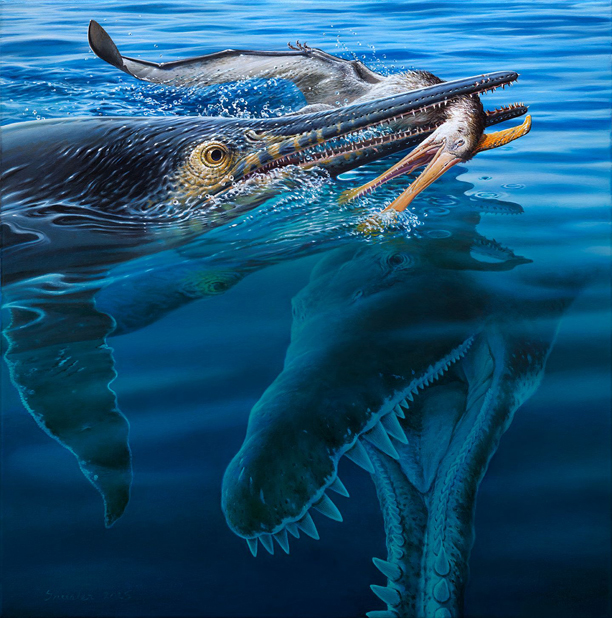
A life reconstruction showing the ichthyosaur with a pterosaur in its jaws with a Kronosaurus attacking from below. Picture credit: Peter Trusler.
Peter credit: Peter Trusler
An Ichthyosaur with an Extraordinary Tale to Tell
The specimen represents an adult Platypterygius australis. This ichthyosaur measured around six to seven metres in length. Although ichthyosaurs are often compared to modern dolphins because of their streamlined bodies, they were reptiles and not mammals. Their similarity to cetaceans is an example of convergent evolution.
Scientists recovered the fossil from the famous marine deposits near Richmond (Queensland). Nicknamed “B.O.B.” (Bag of Bones), the fossil was first discovered by amateur fossil hunters during a public fossicking trip in 2019. Later excavations uncovered much more of the skeleton, and museum staff invested hundreds of hours preparing the remarkable specimen.
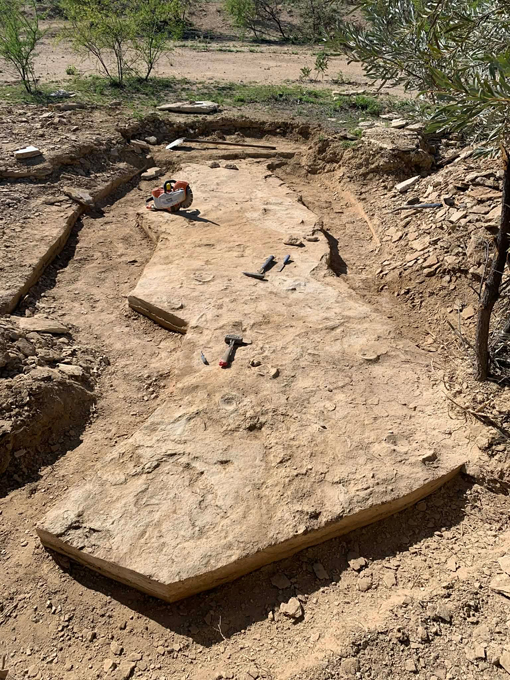
The ichthyosaur specimen block in situ. Picture credit: White et al.
Picture credit: White et al
Examining the Gut Contents
The real surprise came from several unusual rock concretions preserved immediately behind the skull. Rather than breaking them open, researchers used neutron tomography to examine their contents without damaging the fossils. This advanced imaging technique revealed fragments of fish, cephalopods and two pterosaur bones, including part of a lower jaw.
Careful comparisons showed that the jaw belonged to a member of the Ornithocheiroidae, a group of large flying reptiles. This represents the first definitive fossil evidence that an ichthyosaur had eaten a pterosaur or at least part of one.
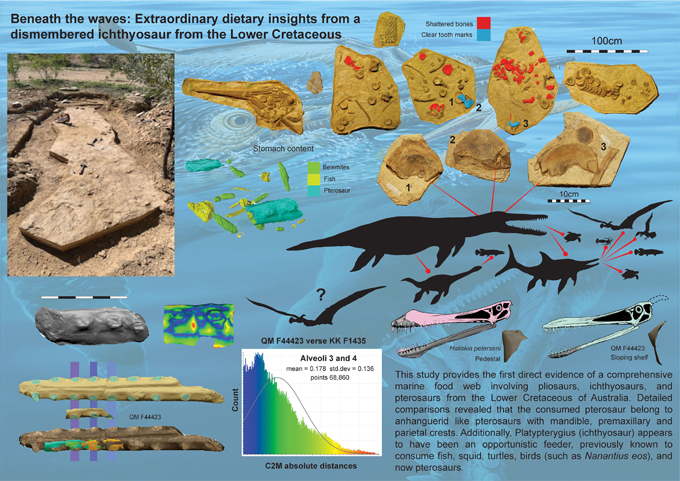
Dietary insights from a dismembered Platypterygius from the Lower Cretaceous of Queensland. Picture credit: White et al.
Picture credit: White et al
The Ichthyosaur Predator Becomes Prey
However, the story did not end there.
The ichthyosaur’s skeleton preserves numerous massive bite marks. Several vertebrae are crushed or split apart, while other bones show signs of powerful jaw action. Some damaged vertebrae even have missing sections, suggesting that the carcass was actively processed rather than simply bitten.
Based on the size and spacing of the bite marks, the researchers conclude that the giant pliosaur Kronosaurus queenslandicus was almost certainly responsible. At around ten metres in length, Kronosaurus was one of the largest marine predators living in Australia’s inland sea during the Early Cretaceous. It was an apex predator.
An Ichthyosaur Ate a Pterosaur Then Became a Meal For a Larger Marine Reptile
Fossils usually tell palaeontologists what extinct animals looked like. Direct evidence of behaviour is much harder to find in the fossil record.
However, this amazing marine reptile specimen preserves evidence of a sequence of ecological interactions:
- Ornithocheiroidae pterosaur.
- Platypterygius australis consumed the pterosaur.
- Subsequently the ichthyosaur was predated upon by a much larger animal (Kronosaurus queenslandicus).
In other words, the flying reptile became food for the ichthyosaur. Subsequently, the ichthyosaur itself became food for a giant pliosaur (most likely). Therefore, this fossil provides one of the clearest examples yet discovered of a three-tier marine food web from the Mesozoic.
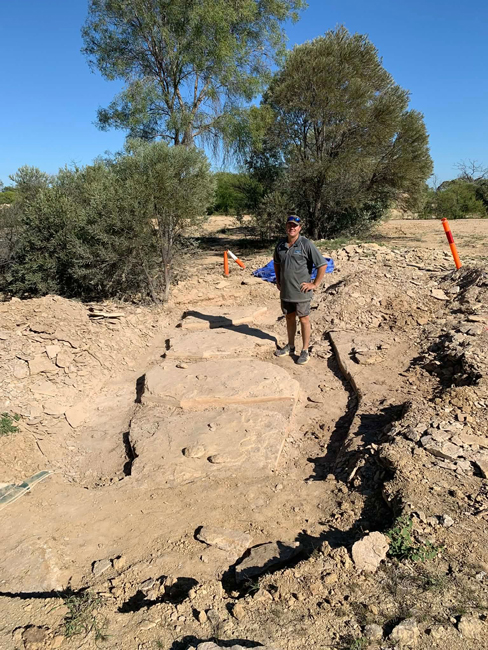
Co-author of the paper Kevin Petersen (Kronosaurus Korner) stands next to the cut slabs containing the ichthyosaur fossil. Picture credit: White et al.
Picture credit: White et al
Rare Evidence of Ancient Behaviour and Interactions
Commenting on the discovery, Dr Dean Lomax, a world-renowned expert on the Ichthyosauria and a chum of Everything Dinosaur explained that fossils preserving behaviour are exceptionally uncommon.
Dr Lomax added:
“It’s one of the clearest examples ever discovered of a three-tier predator interaction and offers an unprecedented snapshot of behaviour in Australia’s Cretaceous seas. This extraordinary fossil records a trophic interaction between a pterosaur eaten by an ichthyosaur that was then partly consumed by a giant pliosaur. It gives us direct evidence of behaviour in the Eromanga Sea.”
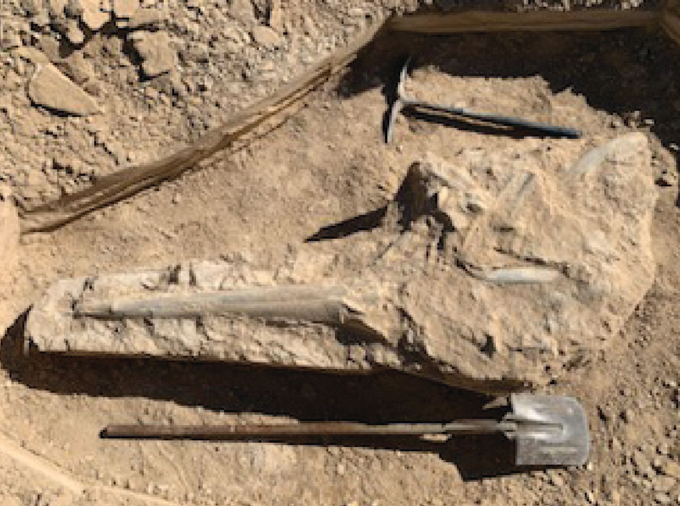
Platypterygius skull in situ. Picture credit: White et al.
Picture credit: White et al
Ichthyosaur Ate a Pterosaur
During the Early Cretaceous, much of inland Queensland lay beneath the vast Eromanga Sea. This warm inland sea supported sharks, turtles, marine reptiles and numerous other predators. The new discovery shows that these ancient ecosystems were far more complex than scientists once appreciated. Instead of simple predator-prey relationships, the fossil captures a dynamic food web in which even successful hunters could quickly become victims themselves. In this instance, an ichthyosaur ate a pterosaur only for a larger animal to attack and partially consume the marine reptile.
In addition, the discovery highlights the scientific importance of public fossil collecting sites. Thanks to the curiosity of four fossil enthusiasts, one of Australia’s most significant marine reptile discoveries has provided a unique insight into life beneath the Cretaceous seas. Indeed, the preserved gut contents of the P. australis specimen indicate that this ichthyosaur consumed fish, cephalopods and ate two pterosaur bones, including a fragment of jaw.
Dr Peter Trusler produced scientific artwork for the paper, updating depictions of Kronosaurus skull proportions and illustrating the ichthyosaur and pterosaur interaction. The prepared specimen (nicknamed “B.O.B.” – after the Bag of Bones epithet) is curated at Kronosaurus Korner Museum.
A Remarkable Snapshot of Prehistoric Marine Life
This exceptional fossil preserves far more than the skeleton of a marine reptile. It captures a sequence of events that unfolded over 100 million years ago and provides direct evidence of feeding behaviour that had never been documented before.
As imaging technology continues to improve, palaeontologists are uncovering increasingly detailed evidence of how extinct animals interacted with one another. Fossils such as this demonstrate that prehistoric ecosystems were every bit as complex as those found in today’s oceans.
Dr Matt White, Research Associate at the University of New England and lead author of the study and a self-funded palaeontologist said the fossil was unlike anything the team had seen before.
He stated:
“I was amazed by the size of the ichthyosaur, and shocked to see it littered with bite marks and partially exposed pterosaur remains behind the skull. The vertebrae were split; ribs were missing and numerous bones displayed large crushing bite marks. One vertebra even preserved a rib jammed against a broken margin, strongly suggesting forceful jaw processing rather than simple post-mortem damage. This discovery enriches our understanding of these ancient marine reptiles and illustrates the complex interactions that shaped their prehistoric aquatic environment. The public fossicking areas near Richmond have yielded thousands of fossils over the years, including dinosaurs, birds, turtles, polycotylid plesiosaurs, pliosaurs, pterosaurs and other marine reptiles.”
Highlighting the Fossil Evidence
The scientific paper documenting an ichthyosaur ate a pterosaur includes a series of helpful graphics that explains how the researchers identified the food web evidence. For example, three-dimensional mesh images highlight the location of damaged ichthyosaur bones and provide images of the pterosaur dentary.
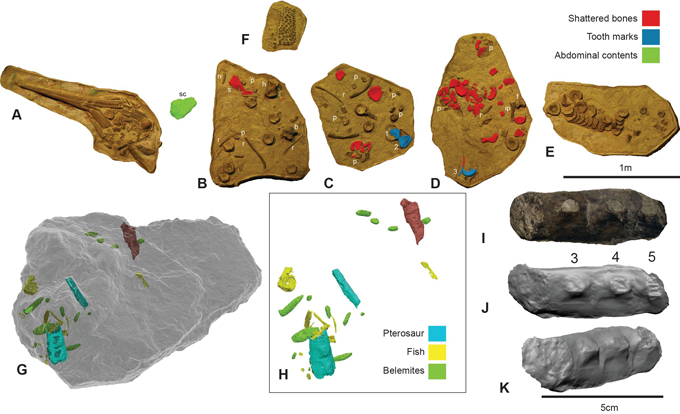
Three-dimensional mesh images of KK F1435 with bite marks and stomach content. (a) Near-complete skull; (b) Stomach content block; (c) articulated autopodium; (d) Basiosphenoid, seven dorsal vertebrae, an isolated neural spine, five partial ribs, left scapula, humerus, and ten isolated digits; (e) Two complete dorsal vertebral centra (one with articulated neural spine) and five partial dorsal vertebral centra that preserve bite marks (v1 and v3), one vertebral centra is shattered; (f) One complete dorsal vertebra, possibly six other shattered dorsal vertebrae along with portions of their neural spines, and one split vertebrae with a rib deformed against the fractured edge (v2); (g) Semi-articulated pre-flexural caudal vertebrae primarily consisting of mostly of pre-flexural vertebrae and a few scattered post-flexural vertebrae; (h) Silhouettes of the approximate in situ position of each block. Abbreviations: b, basisphenoid; f, femur; h, humerus, ip, ischiopubis; n, neural spine; p, phalanx; r, rib; s, scapula, sc stomach content; v1-v3 dorsal vertebral centra with tooth marks. Picture credit: White et al.
Picture credit: White et al
Improving Understanding of Cretaceous Marine Food Webs
As research continues and methodologies advance, each fossil discovery, like this Platypterygius australis, has the potential to reveal more intricate patterns and provide glimpses into the complex food webs that existed beneath the waves during a pivotal time in Earth’s history.
Everything Dinosaur acknowledges the assistance of a Dinosaur Experiences Australia media release in the compilation of this article.
The scientific paper: “Beneath the waves: “Extraordinary dietary insights from a dismembered ichthyosaur from the lower Cretaceous” by Matt Andrew White, Joseph John Bevitt, Mackenzie Jordan Enchelmaier, Kevin William Petersen and Peter William Trusler published in Gondwana Research.
The award-winning Everything Dinosaur website: Models of Marine Reptiles and Other Prehistoric Animals.

Leave A Comment