

What makes a scientifically accurate dinosaur model? This is a question that dinosaur fans and model collectors frequently ask us. Our understanding of the Dinosauria is constantly changing. Therefore, creating an accurate prehistoric animal figure is challenging. For example, until recently anyone making a model of Nanotyrannus could not be certain that their figure represented a valid genus. However, recent research has demonstrated that N. lancensis is probably a valid taxon. Furthermore, there could be two species of mid-sized tyrannosauroids in the North American fossil record.
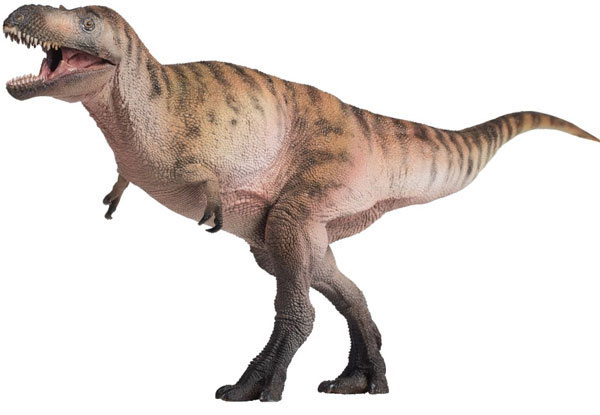
The new for 2021 PNSO Nanotyrannus dinosaur model. When this model was introduced, there were some doubts about the validity of this taxon.
To read Everything Dinosaur’s blog posts about the recent research exploring the validity of Nanotyrannus: Nanotyrannus – A New Chapter in Tyrannosaur Evolution.
A second blog post reaffirming the validity of the Nanotyrannus taxon: New Paper on the Nanotyrannus Genus.
Manufacturers have access to more scientific information than ever before. However, producing a credible dinosaur model involves much more than simply copying a fossil skeleton.
Studying the Dinosaur Fossils
A scientifically accurate dinosaur model should reflect the known fossil evidence. For example, palaeontologists can examine bones to determine body proportions and posture. Fossils can also provide information about muscle attachment. Exceptionally preserved specimens reveal even more. Skin impressions can provide evidence about scales and other integumentary structures. Furthermore, fossilised feathers have transformed our understanding of many theropod dinosaurs. In addition, some remarkable specimens even provide evidence of internal organs.
Even footprints can help. Dinosaur tracks provide information about stance, locomotion and how the feet contacted the ground. Scales preserved on the footprints can provide information on the integument of the foot.
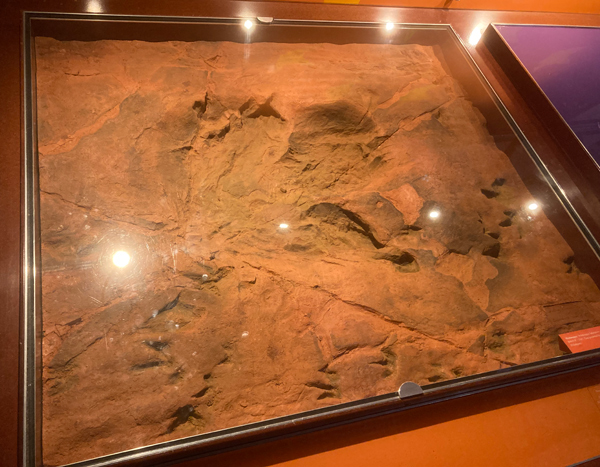
A fossil dinosaur footprint photographed at the London Natural History Museum. The exhibit features a three-toed print from the famous Lark Quarry track site in Australia. Picture credit: Everything Dinosaur.
Picture credit: Everything Dinosaur
Reconstructing the Missing Parts
Unfortunately, dinosaur skeletons are rarely complete. Consequently, palaeoartists and model makers must interpret missing information. Closely related species can provide useful anatomical clues. In addition, living animals such as birds and crocodilians can help scientists understand dinosaur soft tissues. Some types of prehistoric creature such as the sauropods and pterosaurs have no living analogues. Therefore, some features remain speculative.
Colour is an obvious difficulty. Scientists have identified evidence of pigmentation in a small number of exceptionally preserved fossils. For most dinosaurs, their colouration remains unknown. However, research papers can provide hope. For example, a paper was recently published that provided some evidence of the colour of diplodocid dinosaurs.
Evidence of the colour of long-necked dinosaurs: Sauropod Skin Study Reveals Colour Patterning.
Even so, a scientifically accurate dinosaur model can still include an element of artistic interpretation. Indeed, our own Everything Dinosaur Evolution Tyrannosaurus rex model has a highly sophisticated colour scheme. Although the colour of T. rex is unknown, an informed judgement can be made by considering the palaeoenvironment, countershading, visual display behaviours and the need to regulate body temperature.

The Everything Dinosaur Evolution range is now in stock. The Tyrannosaurus rex figure has an extremely sophisticated colour scheme. Picture credit: Everything Dinosaur.
Picture credit: Everything Dinosaur
To view the Everything Dinosaur Evolution range of scientifically accurate models: Everything Dinosaur Evolution Tyrannosaurus Model.
Scientific Research Changes Dinosaur Models
Scientific accuracy is not fixed. New discoveries can change how an extinct animal is reconstructed. For instance, dinosaur models from several decades ago often depicted large theropods standing upright with their tails dragging along the ground. Scientists now know that these dinosaurs held their bodies much more horizontally. Their tails helped to counterbalance the front of the body. Furthermore, we know that many types of dinosaurs were feathered, a concept that many movie franchises have yet to grasp. Moreover, there is growing evidence to support the idea that many archosaurs had lips.
Our understanding of feathers has changed too. Many dinosaurs once depicted with completely scaly bodies are now reconstructed with extensive feather coverings. As the science changes, dinosaur models change with it.
Getting the Details Right
An accurate model should consider the entire animal rather than concentrating solely on the skull. Hands, feet, limbs and body proportions are important too. Small anatomical details can make a considerable difference. The orientation of the hands of a theropod is one example. The number and position of fingers and toes should also reflect the fossil evidence.
Similarly, the arrangement of horns, crests, armour and other structures should be based on the available scientific data. Scale is another consideration. A model described as being in a particular scale should reflect reasonable estimates for the size of the prehistoric animal. In the past, many dinosaurs were thought to have moved like extant lizards. Their limbs were not directly under the body but held to the side. Such old-fashioned depictions can still be seen today.
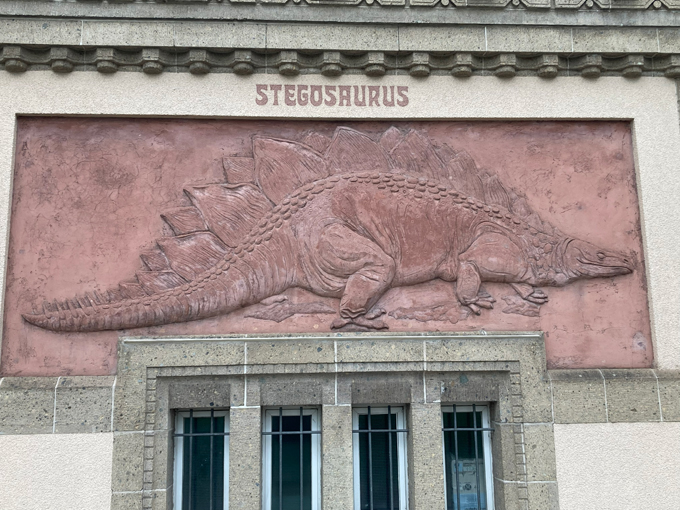
The Stegosaurus motif from the Berlin Aquarium. The aquarium building was built between 1911 and 1913. The dinosaur motifs such as this Stegosaurus relief reflect the scientific knowledge at the time. Picture credit: Everything Dinosaur.
Picture credit: Everything Dinosaur
Working with Scientists and Artists
Many manufacturers consult palaeontologists and specialist palaeoartists when developing prehistoric animal figures. This collaboration can help turn scientific research into a three-dimensional reconstruction. Scientific papers, skeletal drawings and fossil photographs can all contribute to the design process. Museum specimens may also provide valuable reference material.
However, attention to detail remains essential. A beautiful dinosaur model is not necessarily an accurate one.
What Makes a Scientifically Accurate Dinosaur Model?
Ultimately, the best dinosaur reconstructions combine scientific evidence with informed interpretation. They reflect what palaeontologists currently know while acknowledging areas of uncertainty. No dinosaur model can be guaranteed to remain scientifically accurate forever. A new fossil discovery could change our understanding tomorrow. Palaeontology has a long history of correcting previously held hypotheses. For example, the Iguanodon statues on display at Crystal Palace have horns on their snouts that we now know to be a thumb spike.
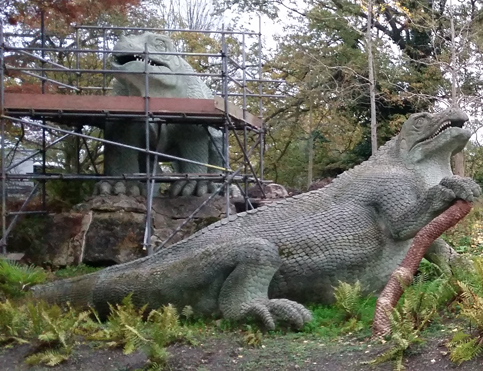
A pair of Iguanodons study the Crystal Palace landscape. Picture credit: Everything Dinosaur.
Picture credit: Everything Dinosaur
At Everything Dinosaur, we welcome these changes. New discoveries give scientists, palaeoartists, model makers and dinosaur enthusiasts fresh opportunities to reconsider what these extraordinary animals might have looked like.
Mike commented:
“Perhaps that is part of the appeal of prehistoric animal model collecting. Dinosaur models provide a snapshot of scientific knowledge at a particular moment in time. As palaeontology advances, our models of these remarkable prehistoric animals evolve as well.”
At Everything Dinosaur, we welcome these changes. New discoveries give scientists, palaeoartists, model makers and dinosaur enthusiasts fresh opportunities to reconsider what these extraordinary animals might have looked like.
The award-winning Everything Dinosaur website: Scientifically Accurate Dinosaur Models.

Leave A Comment