

Remarkable Eoceras shaanxiense Fossils Rewrite Cephalopod Evolution
Researchers have identified tiny fossils from the Shuijingtuo Formation (Cambrian Stage 3) of South China that could transform our understanding of cephalopod evolution. The newly described species, Eoceras shaanxiense, provides the oldest known evidence of a primordial siphuncle, a crucial anatomical feature that enabled cephalopods to regulate buoyancy and eventually become some of the oceans’ most successful predators.
Measuring only a few millimetres in length, Eoceras shaanxiense possessed a straight (orthoconic) shell divided into a series of chambers. Researchers also identified a segmented tube running through these chambers. This structure is interpreted as an early form of the siphuncle seen in later cephalopods such as nautiloids and ammonites.
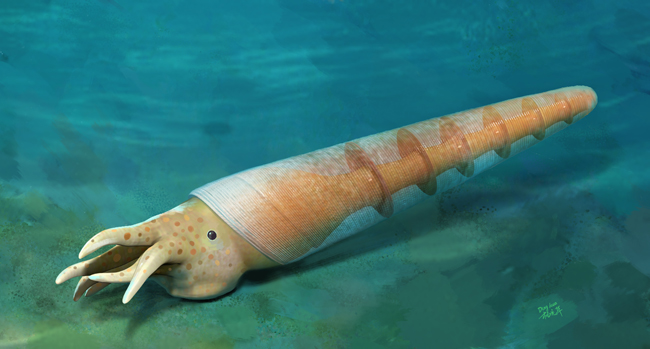
Eoceras shaanxiense life reconstruction. The earliest evidence of a siphuncle structure within a cephalopod. The siphuncle enables cephalopods to become active swimmers (nektonic) and helped establish a predatory habit through long-term regulation of the animal’s buoyancy. Picture credit: Dinghua Yang.
Picture credit: Dinghua Yang
The Significance of Eoceras shaanxiense
The siphuncle is one of the defining characteristics of the Cephalopoda. Cephalopods are members of the Mollusca phylum and include extant animals such as squid, octopi, nautiloids and cuttlefish.

CollectA Nautilus pompilius sometimes referred to as the “Emperor nautilus” because of its large size. This is a model of an extant nautiloid.
The image (above) shows a replica of an extant cephalopod (Nautilus pompilius). This model is part of a series of invertebrate figures created by CollectA.
To view the CollectA model range: CollectA Invertebrate Models.
Extinct cephalopods include the extremely diverse ammonites and the belemnites which play important roles in the relative dating of rocks. The siphuncle links the shell chambers. It allows gas and fluid to be regulated, enabling the animal to control its buoyancy. Combined with jet propulsion, this remarkable adaptation helped cephalopods leave the sea floor and adopt an active swimming lifestyle (nektonic). Until now, the evolutionary origin of this important feature had remained a mystery because of a substantial gap in the fossil record between molecular evidence and the earliest accepted cephalopod fossils. The discovery of Eoceras shaanxiense helps close that gap.
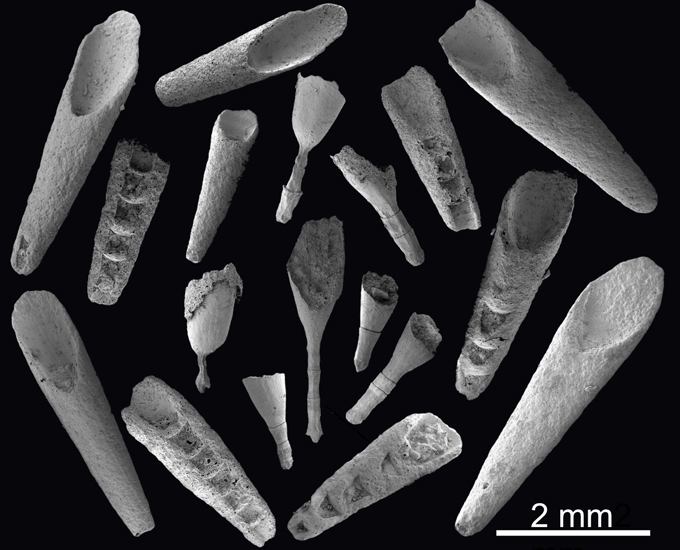
Magnified images showing Eoceras fossil material used in the study. Note scale bar equals 2 mm. The fossils are approximately 520 million years old. Picture credit: Song Zuchen and Jakob Vinther.
Picture credit: Song Zuchen and Jakob Vinther
Documenting an Early Stage in the Evolution of a Chambered Shell
The research team concluded that the fossil documents an early stage in the evolution of the chambered shell, known as the phragmocone. As the animal grew, it formed new chambers while maintaining a connection with older ones through the segmented tube. This evolutionary innovation laid the foundations for the extraordinary success of cephalopods over the next 500 million years.
Commenting on the discovery, Mike from Everything Dinosaur said:
“Even the smallest fossils can have an enormous scientific impact. Eoceras shaanxiense provides an exciting glimpse into how one of nature’s most sophisticated marine adaptations first evolved.”
This important fossil demonstrates that the evolutionary history of cephalopods began earlier than previously recognised. Furthermore, it provides valuable new evidence explaining how these iconic marine invertebrates developed the buoyancy-control system that helped them dominate ancient seas for hundreds of millions of years.
Everything Dinosaur acknowledges the assistance of one of the study’s authors in the compilation of this article.
The scientific paper: “Earliest siphuncle-bearing cephalopod from the early Cambrian” by Zuchen Song, Bing Pan, Junfeng Guo, Jakob Vinther, Guoxiang Li, Jian Han, Heyo Van Iten, Xiaofang Zhao, Xianzhi Pei, Jiaxin Peng, Yaqin Qiang, Boyao Zhang and Hanjie Wen published in the journal Nature.