

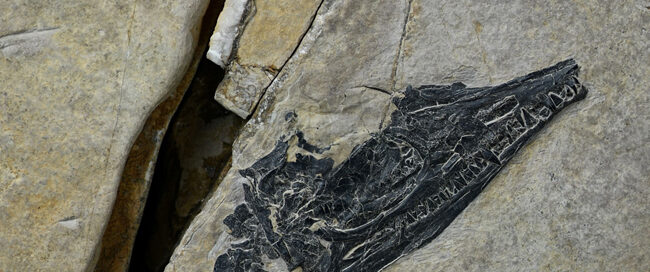
Remarkable Triassic Marine Reptile Fossil Preserves Internal Organs
Scientists have described an exceptional fossil of the long-necked, Triassic marine reptile Austronaga minuta. The specimen comes from China and is around 245 million years old. Remarkably, much of the animal’s digestive system has been preserved. The almost complete fossil provides scientists with an unprecedented view of the skeleton and internal anatomy of an archosauromorph. Researchers identified traces of several organs, including the stomach, liver and intestines.
Furthermore, the specimen represents the oldest known example of a largely complete reptile digestive system.
The study has been published in the scientific journal “Science Advances”.
An Early Marine Reptile Adapted to Life in Water
Named and described in 2023 (Wang, Lei and Li), from a single but beautifully preserved fossil specimen, Austronaga demonstrates significant adaptations to a fully marine existence. For example, it had elongated, flipper-like forelimbs and a long tail that probably provided locomotion. The rear limbs were reduced and probably played little role in locomotion. The long neck helped it to catch prey. The teeth were sharp and interlocking, an adaptation for catching fish. It measured around sixty centimetres in length.
This small reptile evolved not long after the end-Permian mass extinction event, which led to the extinction of around ninety-five percent of all life on Earth. The discovery of Austronaga and other vertebrates from the Guanling Formation of China hints at the recovery of ecosystems following this dramatic chapter in our planet’s history.
The adaptations are particularly interesting because Austronaga taxonomically is close to the evolutionary lineage leading to archosaurs. This important reptile group includes crocodilians, pterosaurs and dinosaurs. Most marine reptiles displaying comparable swimming adaptations belonged to very different evolutionary lineages. Examples include ichthyosaurs and the much later Mosasauridae.
Co-author of the study, Dr Spiekman (Staatliches Museum für Naturkunde, Stuttgart), explained that archosaurs and their ancestors became extremely diverse on land. However, scientists had generally considered their adaptations for marine life to have been relatively limited. The discovery of Austronaga challenges this view. Early members of this evolutionary lineage developed sophisticated adaptations for living in the sea.
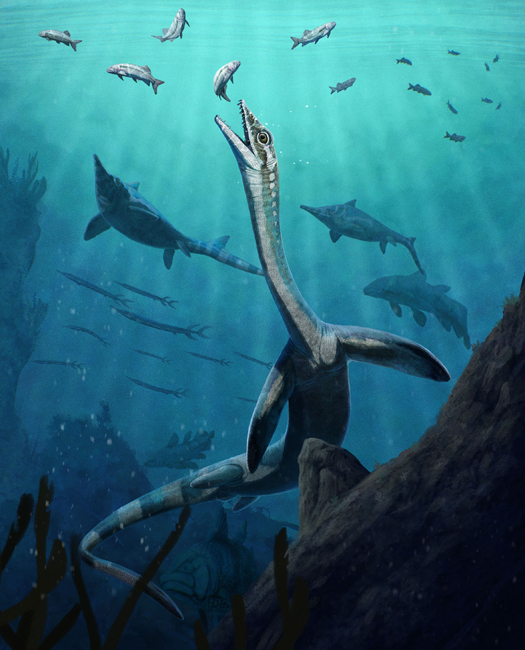
A life reconstruction of Austronaga minuta, a dinocephalosaurid archosauromorph marine reptile from the Middle Triassic of China. Picture credit: Gabriel Ugueto.
Picture credit: Gabriel Ugueto
A Remarkable Look Inside Austronaga minuta
The researchers noticed dark patches preserved between the fossil’s ribs. Further investigation revealed something extraordinary. These patches represented remnants of the digestive tract. The team used several analytical techniques to examine them. These included ultraviolet-light photography and mass spectrometry. As a result, scientists could confidently identify several internal organs. For example, a substantial, sack-like stomach occupied the front portion of the digestive system. Behind it lay the liver, which has a distinctive reddish colour in the fossil.
Remarkably, analysis of the liver revealed chemical traces associated with haemoglobin, the oxygen-carrying pigment found in blood. Behind the liver, the researchers identified a long and relatively simple intestinal tract. This structure represented the small and large intestines.
The evidence suggests that Austronaga possessed a comparatively unsophisticated digestive system.
Lead author of the research Dr Wei Wang of the Institute of Vertebrate Paleontology and Paleoanthropology in Beijing, described the specimen as the oldest known reptile fossil preserving a largely complete digestive system.
Austronaga has been classified as the sister taxon to the coeval Dinocephalosaurus. Dinocephalosaurus also demonstrates some remarkable marine adaptations, including viviparity.
To read our blog post from 2017 about viviparity in Dinocephalosaurus: Dinocephalosaurus – The Only Known Viviparous Archosauromorph.
Constructing the long neck of Dinocephalosaurus: Dinocephalosaurus and the Year of the Dragon.
Clues to the Evolution of the Archosaur Digestive System
The fossil also provides evidence concerning digestive evolution. Living birds and crocodilians have a stomach divided into two specialised regions. However, Austronaga possessed only a single stomach chamber. This difference could provide an important evolutionary clue.
Co-author Dr Nick Fraser (National Museums Scotland) explained that early archosaur relatives probably possessed relatively simple stomachs. More complex arrangements subsequently evolved within the lineage. In addition, Austronaga had a comparatively short and uncomplicated digestive tract.
Interestingly, similar digestive systems occur in living reptiles that primarily eat fish. Therefore, its internal anatomy could provide additional evidence about the animal’s diet and ecology.
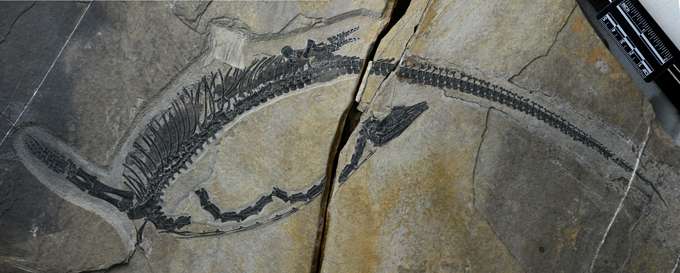
The stunning Austronaga minuta fossil specimen (IVPP V18579) from the Middle Triassic sediments of the Guanling Formation (Member II) Yunnan Province, China. Picture credit: Wei Wang.
Picture credit: Wei Wang
An Exceptional Middle Triassic Fossil from Yunnan Province
The discovery highlights how exceptional fossil preservation can reveal much more than bones. Soft tissues and internal organs normally decompose rapidly after death. Consequently, their preservation requires unusual environmental and chemical conditions. The Austronaga minuta specimen provides palaeontologists with a rare opportunity to examine both skeletal and internal anatomy in a Triassic marine reptile.
Researchers from several institutions collaborated on the study. These included the Institute of Vertebrate Paleontology and Paleoanthropology in Beijing and National Museums Scotland. Scientists from the State Museum of Natural History Stuttgart and the University of Hohenheim also participated. Furthermore, researchers from the Field Museum in Chicago, Luoping Biota National Geopark and the University of Zurich contributed.
The research forms part of a wider investigation into the early evolutionary history of modern reptile groups. Scientists are also examining their remarkable diversity in Triassic marine ecosystems.
Further discoveries could reveal more about the transition from terrestrial ancestors to highly specialised marine reptiles. The extraordinary Austronaga minuta fossil specimen is housed in Beijing.
Commenting on this recent study, Mike from Everything Dinosaur stated:
“Austronaga is one of the earliest stem archosauromorphs to evolve adaptations to a marine existence. Moreover, the remarkable fossil preserves the oldest known liver, stomach and intestines in the Reptilia. This discovery provides evidence of the transition from terrestrial to marine forms within the Triassic Archosauromorpha.”
Everything Dinosaur acknowledges the assistance of a media release from the Staatliches Museum für Naturkunde, Stuttgart in the compilation of this article. Permission to write an article about this research was granted by the Communications Department at the Staatliches Museum für Naturkunde, Stuttgart.
The scientific paper: “Highly aquatic marine stem archosaur with soft tissue preservation” by Wei Wang, Nicholas C. Fraser, Stephan N.F. Spiekman, Zhiheng Li, Olivier Rieppel, Hong Lei, Torsten M. Scheyer and Chun Li published in Science Advances.
For models of marine reptiles and other prehistoric animal figures: Marine Reptile Figures and Other Prehistoric Animal Models.