

Remarkable Carboniferous Coelacanth Fossil Discovery in Yorkshire
A remarkable Roundhay Park coelacanth fossil has been discovered in Leeds. The fossil is around 320 million years old. It dates from the Carboniferous. Furthermore, experts believe it represents the oldest fossil coelacanth yet found in Yorkshire. Geologist Ru Smith of the Yorkshire Geological Society made the discovery earlier this year. He found a well-preserved skull bone during a reconnaissance walk in Roundhay Park.
Smith was preparing for a planned geological field excursion when he spotted the unusual fossil.
The important specimen has now been donated to Leeds Museums and Galleries. It will form part of the extensive natural sciences collection housed at Leeds Discovery Centre.
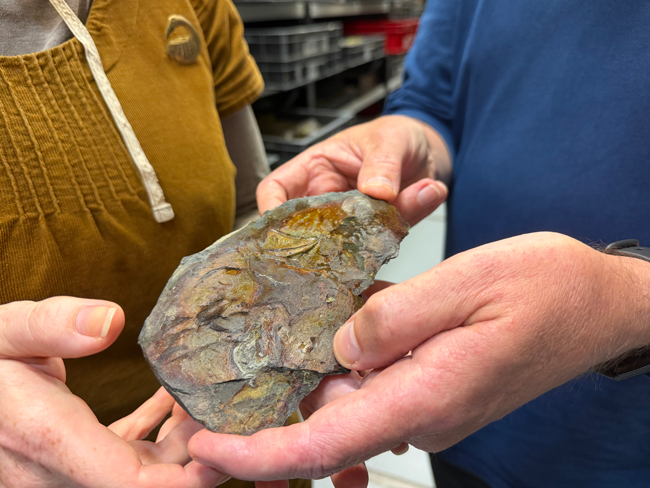
A close view of the skull of a Carboniferous coelacanth fossil discovered in Roundhay Park (Leeds). Picture credit: Leeds City Council.
Picture credit: Leeds City Council
A Stunning Roundhay Park Coelacanth Fossil
The fossil dates from the Carboniferous Period (early Pennsylvanian sub-period), approximately 320 million years ago. At that time, the geography and climate of Britain looked very different.
Roundhay Park lay close to the Equator. Moreover, warm tropical waters covered the area.
Ru Smith explained:
“There’s a layer of rock in the park which dates from around 320 million years ago, from a time before the breakup of the continents, when what is now the park would have been situated close the Equator and under the warm waters of a tropical lagoon. West Central Africa would be a good place to find similar environments in the present.”
He added:
“There’s a bed of freshwater mussels called Carbonicola at one level in the rock, and opening a piece of shale from this bed in my hands I saw something unusual – a distinctive skull bone of a large fish. I knew straight away this was something different and very rare.”
Other experts subsequently examined the fossil and confirmed its identity. The skull bone belonged to a coelacanth. Significantly, the fossil predates other coelacanth specimens discovered elsewhere in Yorkshire.
Carboniferous Yorkshire
The Roundhay Park coelacanth fossil provides another glimpse into Yorkshire’s distant past. During the Carboniferous, the continents were gradually assembling into the immense supercontinent Pangaea. Extensive tropical environments existed around the Equator. Fish flourished in the waterways. Sharks and numerous other aquatic animals also inhabited Carboniferous ecosystems.
Meanwhile, vastly different animals lived on land. Early tetrapods shared their environments with a remarkable diversity of arthropods. Higher atmospheric oxygen levels during parts of the Carboniferous helped some arthropods attain impressive sizes.
Ru Smith commented:
“Coelacanths are pretty amazing fish and it’s just very cool to think that at one time, you could have been standing in Leeds and watching them swim around above a bed of mussels in Roundhay Park. That’s really the wonder of geology, looking at the rock and time travelling in the imagination to what was a very different world.”
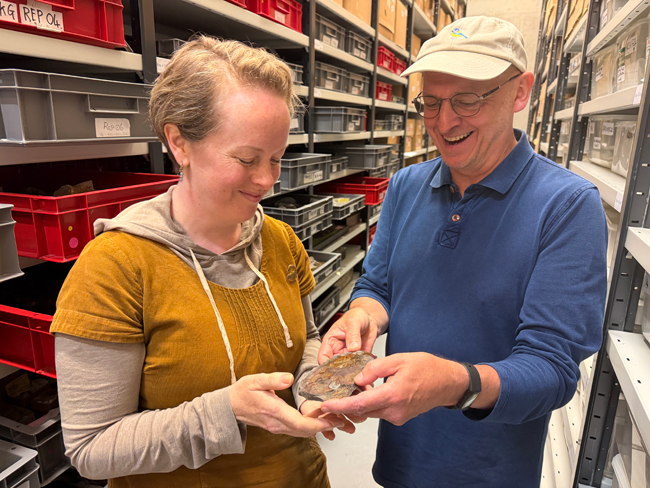
Ru Smith (right) from the Yorkshire Geological Society handing the rare fossil to Clare Brown, Leeds Museums and Galleries’ curator of natural sciences (left). Picture credit: Leeds City Council.
Picture credit: Leeds City Council
Coelacanths – “Living Fossils”
Coelacanths have a particularly fascinating evolutionary history. They belong to the Sarcopterygii, the lobe-finned fishes. Scientists knew coelacanths from an extensive fossil record. However, for many years researchers thought the group had become extinct during the Late Cretaceous. That assumption changed dramatically in 1938.
A living coelacanth was discovered among the catch of fishermen off the eastern coast of South Africa. Museum curator Marjorie Courtenay-Latimer recognised the unusual fish after seeing the specimen. The discovery caused an international scientific sensation.
Living coelacanths belong to the genus Latimeria. Two extant species are currently recognised, one associated with the western Indian Ocean and another from Indonesia.
The term “living fossil” is often applied to coelacanths. This description can be misleading. However, extant coelacanths closely resemble fossils of coelacanths.
Expedition to study coelacanths: Scientists in Search of Elusive Coelacanths.
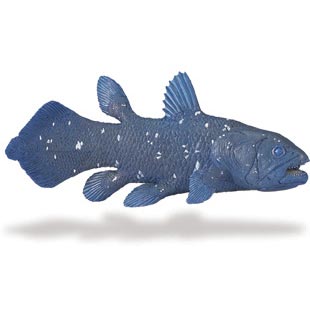
A model of a coelacanth.
The image (above) shows a model of a coelacanth. This is the Wild Safari Prehistoric World coelacanth figure.
To view the Wild Safari Prehistoric World model range: Wild Safari Prehistoric World Figures.
An Important Addition to a Museum Collection
The newly discovered fossil joins several important prehistoric fish specimens held at Leeds Discovery Centre. For example, the collection contains an exceptional specimen of the large Carboniferous fish Megalichthys. It was discovered near Leeds in 1883. In addition, the collection contains fossils from geologically much younger marine reptiles. These include ichthyosaurs and long-necked plesiosaurs from the Jurassic.
Clare Brown, Leeds Museums and Galleries’ curator of natural sciences, welcomed the donation exclaiming:
“This is a remarkable find and we’re extremely grateful to Ru for donating his discovery to our collection. Responsible and ethical fossil hunting and geology can yield some incredible results and really help us to build a picture of life in prehistoric Leeds and the history that’s resting beneath our feet no matter where we may be. We’re always keen to work with local organisations and would encourage anyone interested to join a group.”
The precise location where the fossil was discovered has not been disclosed. This decision will help protect the geology and parkland.
Furthermore, it helps ensure that geological fieldwork takes place responsibly.
Protecting and Preserving Britain’s Fossil Heritage
The discovery demonstrates the important contribution made by experienced amateur and professional geologists. Careful fieldwork can reveal scientifically significant fossils, even in familiar urban landscapes.
Mike from Everything Dinosaur commented:
“This discovery highlights the remarkable geology that can be found beneath our towns and cities. A fossil fish from Roundhay Park helps us imagine Leeds 320 million years ago, when this landscape formed part of an extremely different world. We congratulate Ru Smith on this important discovery and commend the decision to donate the specimen to Leeds Museums and Galleries. It can now be conserved, studied and enjoyed by future generations.”
Everything Dinosaur receives a rare Coelacanth fossil specimen: An Amazing Coelacanth Specimen.
The fossil will be preserved alongside thousands of other natural history specimens at Leeds Discovery Centre. The facility supports exhibitions, education and scientific research. In addition, members of the public can see its collections through pre-booked tours.
The Roundhay Park coelacanth fossil might consist of just part of a skull. Nevertheless, this small piece of bone tells an extraordinary story. Around 320 million years ago, a coelacanth swam through tropical waters where the city of Leeds stands today.
Everything Dinosaur acknowledges the assistance of Leeds Museums and Galleries in the compilation of this article.