

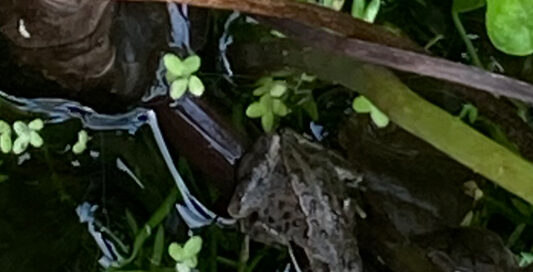
Berlin Amphibian Populations Plummet by 76% in Alarming Study
A new study has revealed a dramatic decline in Berlin amphibian populations. Researchers report that frogs, toads and newts have declined by more than three-quarters since 1981. Furthermore, scientists found a substantial decline in the city’s dragonflies. Their populations have fallen by more than half since 1963. Much of Europe has been gripped by an unprecedented series of heatwaves this summer. Here in the UK, we too have endured record-breaking temperatures. Indeed, more parts of England were declared as being in a drought this week. Extremes of weather have an enormous impact on wildlife. For example, animals and plants that depend on small ponds and lakes to survive have been particularly hard hit.
More importantly, studies are revealing that many animals and plants are in long-term decline.
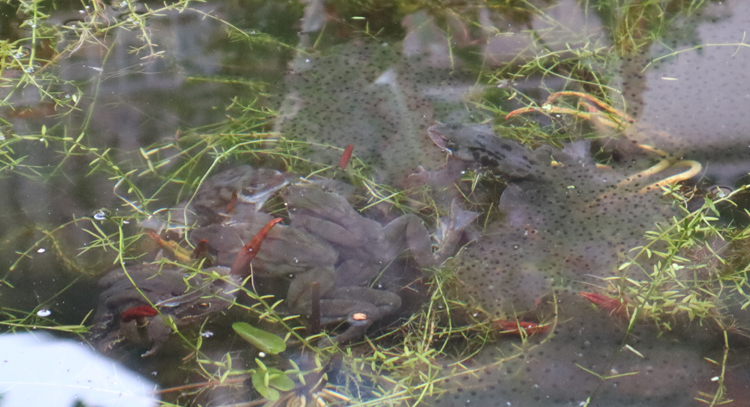
Several frogs (Rana temporaria) in the office pond. Six batches of frogspawn have been laid to date. At least two pairs are in amplexus, so perhaps more eggs will be laid over the next 24-hours or so. Unfortunately, many ponds have dried up, and amphibian populations are becomingly increasingly isolated. Picture credit: Everything Dinosaur.
Picture credit: Everything Dinosaur
Researchers from the Museum für Naturkunde Berlin led the study into the state of nature in Germany’s capital. For the first time, the team analysed decades of Berlin monitoring data using the internationally established Living Planet Index (LPI). The World Wildlife Fund (WWF) also uses this indicator to assess trends in wildlife populations around the world.
Berlin experts Falk Petzold and Klaus-Detlef Kühnel also participated in the research. They coordinate the long-term datasets used in the study. The researchers published their findings in the scientific journal “Global Change Biology Communications”.
Dragonflies and Amphibians Depend on Two Habitats
Dragonflies and amphibians share an important characteristic. Both groups depend on aquatic and terrestrial habitats during their lives. Their larvae or immature stages develop in water. However, adults also depend on terrestrial environments. Consequently, environmental changes affecting either habitat can threaten their populations.
The researchers examined two extensive datasets that had not previously been published. The Berlin dragonfly database contains almost 24,000 observations dating back to 1850. In addition, the Berlin amphibian dataset contains more than 16,000 records dating from 1970. Conservation organisations and local volunteers from specialist societies helped compile these valuable records.
The scientists focused on sixteen bodies of water. Researchers had surveyed these sites regularly and consistently over many decades.
The locations included forest lakes in Grunewald and bog pools in Köpenick. They also studied ponds in Marienfelde and Tegel.
Berlin Amphibian Populations Fall by 76%
The results reveal a disturbing picture. Between 1963 and 2023, Berlin’s dragonfly populations declined by an average of 51%. However, the researchers documented an even greater decline among amphibians. Berlin amphibian populations fell by 76% between 1981 and 2022.
Silvia Keinath, the study’s lead author and a scientist at the Museum für Naturkunde Berlin, commented on the findings.
“Given the general trend of species decline, it is unfortunately no surprise that both groups are in decline. What is striking, however, is how much more severely amphibians are affected.”
Sadly, the analysis was unsurprising given the wider loss of biodiversity. However, the much greater decline among amphibians is extremely concerning.
Frogs, toads and newts have considerably less mobility than dragonflies. Therefore, changes to the landscape can isolate their populations. Roads and development can interrupt migration routes between breeding ponds and terrestrial habitats. Furthermore, small ponds may dry out and disappear.
Dragonflies have an advantage because they can fly considerable distances. As a result, they can colonise new bodies of water more easily. Nevertheless, environmental change also threatens dragonflies. For example, ponds may dry out before their larvae complete their development. Habitat loss is a serious threat to these insects.

A Large Red Damselfly (Pyrrhosoma nymphula) at rest. New research highlights the decline in Berlin’s damselfly and dragonfly population. Picture credit: Jörg Freyhof, Museum für Naturkunde Berlin.
Picture credit: Jörg Freyhof, Museum für Naturkunde Berlin
Concerningly, no evidence of dragonflies emerging from our office pond have been found this year.
A beautiful dragonfly emerges from the office pond: A Spectacular Resting Dragonfly.
A New Way to Examine Urban Biodiversity
The scientists used the Living Planet Index to investigate long-term population trends. Essentially, the LPI combines changes in many individual populations into a single trend value. In this respect, it works rather like a stock market index.
Importantly, the index does not simply count the total number of animals. Instead, it measures the average change in populations over time. Therefore, scientists can examine long-term trends involving numerous species. This method also has another advantage. Researchers can use it when historical datasets contain gaps or were collected using different methods.
Consequently, the LPI provides scientists with a powerful tool for studying changes in urban biodiversity.
Berlin’s Drying Ponds Provide a Warning
The disappearance of small bodies of water could help explain the dramatic population declines. The researchers compared their findings with recent reports about Berlin’s small ponds and other water bodies. Alarmingly, they discovered that thirty-six previously studied sites have now completely dried out. Falling groundwater levels and reduced rainfall could have contributed to these losses. Moreover, these vanished water bodies could not contribute to the Living Planet Index calculations. Researchers no longer had continuous datasets for them. Therefore, the actual decline in Berlin’s amphibians and dragonflies could be even greater than the study indicates.
A similar pattern is being seen in the UK. Even the small office pond looked after by Everything Dinosaur team members is under threat. However, steps have been taken to conserve water. For example, a water butt has enabled the water in the small pond to be topped up.
Long-term Monitoring of a City’s Wildlife
The new research forms part of a growing effort to understand and conserve Berlin’s urban wildlife. In 2024, Museum für Naturkunde Berlin researchers calculated another sobering statistic. Around 16% of the species once native to Berlin have disappeared since 1700. The latest study provides a much more detailed view of this biodiversity crisis. Crucially, scientists can now examine how populations change over decades. They do not have to wait until a species disappears completely from the city.
The research demonstrates that scientists can measure meaningful population trends at the level of an individual city. However, this approach depends on continuous and well-documented long-term datasets. In addition, researchers must have access to those records. At present, Berlin lacks a structured and permanent biodiversity monitoring programme. Therefore, valuable long-term datasets remain relatively rare.
Commenting on the publication of this study, Mike from Everything Dinosaur stated:
“Hopefully, the Museum für Naturkunde Berlin will establish a comprehensive wildlife monitoring programme. However, the issue of declining wildlife populations is not confined to Berlin. Citizen science programmes can provide valuable data, and we all have a responsibility to do what we can to help conserve nature. Even our tiny pond can be a lifeline for so many animals.”
Everything Dinosaur acknowledges the assistance of a media release from the Museum für Naturkunde Berlin in the compilation of this article.
The scientific paper: “Long-Term Population Declines of Habitat-Shifting Species in the City: A Living Planet Index Approach for Berlin, Germany” by Silvia Keinath, Frederic Griesbaum, Nike Sommerwerk, Falk Petzold, Klaus-Detlef Kühnel and Jörg Freyhof published in Global Change Biology Communications.