

Amazing Armoured Dinosaur Discovery – Japan’s First Definitive Ankylosaur
A new genus and species of armoured dinosaur has been named from fossils found in Japan. Nipponopelta yezoensis represents the first formally named Japanese ankylosaur. Furthermore, this discovery provides important information about the dispersal of nodosaurids during the Cretaceous Period.
The new dinosaur was named and described by an international team of palaeontologists. The research was published in the scientific journal Cretaceous Research, (the dinosaur’s name is pronounced Nip-pon-oh-pel-tah yea-zoe-en-sis).
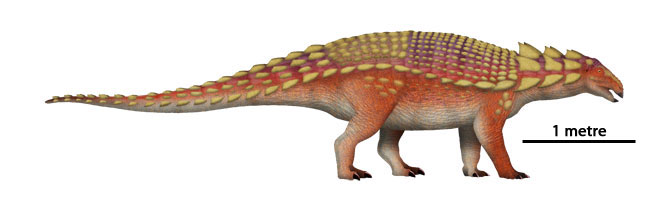
Although only known from fragmentary fossil material, palaeontologists estimate that Nipponopelta was approximately 5 metres in length. Picture credit: Tim Bollinger (Total Dino) with additional annotation by Everything Dinosaur.
Picture credit: Tim Bollinger (Total Dino) with additional annotation by Everything Dinosaur
Introducing Nipponopelta yezoensis
The fossils come from the upper part of the Hikagenosawa Formation of Hokkaido. These rocks date from the Late Cretaceous, specifically the late Cenomanian faunal stage. Therefore, Nipponopelta lived approximately 96 to 94 million years ago.
The genus name combines “Nippon”, referring to Japan, with the Greek word “pelta”, meaning shield. Therefore, Nipponopelta can be translated as “Japanese shield”. The species name “yezoensis” refers to Yezo (Ezo), an old name associated with Hokkaido prefecture. Nipponopelta yezoensis has been classified as a nodosaurid. Nodosaurids were heavily armoured, quadrupedal herbivorous dinosaurs. However, they did not possess a large bony tail club.
There have been several new dinosaur taxa named from fossil discoveries in Japan. For example, in 2023 we wrote about a deinocheirid dinosaur from the famous Kitadani Dinosaur Quarry (Fukui prefecture).
To read more about this discovery: Tyrannomimus – A Deinocheirid Dinosaur from Japan.
A Partial Ankylosaur Skull from Hokkaido
The fossil material includes a partial skull, a cervical vertebra and several teeth. The fossils were found inside a concretion. Scientists had previously recognised the specimen as representing a nodosaurid. However, its precise taxonomic status remained unresolved. Researchers have now used three-dimensional computed tomography (CT) to examine the specimen in greater detail. Consequently, structures hidden inside the rock could be studied without damaging the fossil.
The scans revealed previously inaccessible anatomical features. These included parts of the lower jaw, two complete teeth and the left inner ear.
Importantly, researchers also identified a unique combination of characteristics in the back of the skull. These anatomical features helped justify the erection of the new genus and species.
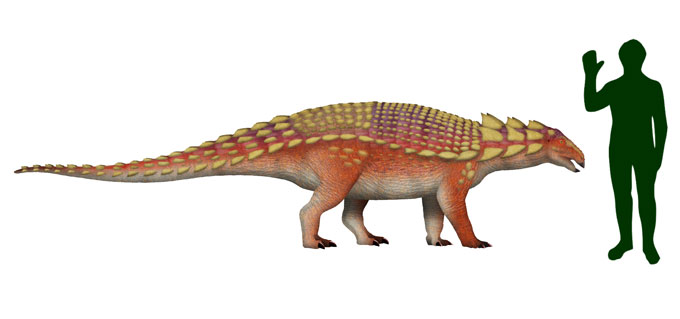
A scale drawing showing the newly described ankylosaur Nipponopelta. Picture credit: Tim Bollinger (Total Dino).
Picture credit: Tim Bollinger (Total Dino)
To visit the extremely informative website of Tim Bollinger: Total Dino Website.
Links with North American Nodosaurids
The evolutionary relationships of Nipponopelta yezoensis produced some intriguing results. Phylogenetic analysis indicates that this Japanese dinosaur was not closely related to other known Asian nodosaurids. Instead, it was nested among more derived nodosaurids known from North America and Europe.
For example, its relatives include Pawpawsaurus, Panoplosaurus, Edmontonia and Denversaurus, all of which are known from North America. Phylogenetic analysis indicates that this taxon is more closely related to North American nodosaurids than Asian taxa. Therefore, this ancestral geographic analysis suggests that N. yezoensis and its close relatives originated in Laramidia, Appalachia, and Asia, indicating a wide ancestral area.
- Pawpawsaurus – Late Cretaceous (Albian faunal stage) of the USA (Texas).
- Denversaurus – Late Cretaceous (Maastrichtian faunal stage) of western North America.
- Panoplosaurus – Late Cretaceous (Campanian faunal stage) of Canada.
- Edmontonia – Late Cretaceous (Campanian faunal stage) of western North America.
Subsequently, Nipponopelta provides valuable evidence about the geographical distribution of armoured dinosaurs.
A Coastal Armoured Dinosaur
The scientists also examined the environments preferred by different ankylosaurs. Interestingly, nodosaurid fossils occur relatively frequently in rocks deposited under marine influence. Several studies have therefore suggested links between nodosaurids and coastal or estuarine habitats. The researchers concluded that Nipponopelta yezoensis probably inhabited a marine-influenced environment. However, this does not mean that this dinosaur was aquatic. Instead, it probably lived on land close to the coast or around estuaries.
Furthermore, a preference for coastal or estuarine environments may have played a significant role in its dispersal patterns across different regions.
Mike from Everything Dinosaur commented:
“The description of Nipponopelta yezoensis represents an important addition to Japan’s remarkable dinosaur record. Moreover, its unexpected relationship with North American and European nodosaurids provides new evidence about how these armoured dinosaurs dispersed during the Cretaceous. It demonstrates how modern scanning technology can reveal important anatomical information from fossils that have been known about for decades.”
For armoured dinosaur models and other prehistoric animal figures: Armoured Dinosaur Figures and Prehistoric Animals.
The description of Nipponopelta yezoensis highlights the importance of re-examining previously discovered fossils. New technologies can reveal details that earlier researchers could not study.
As a result, an enigmatic Japanese fossil has helped scientists explore the global history of the Nodosauridae.
The scientific paper: “A new nodosaurid ankylosaur (Dinosauria: Ornithischia) from the Upper Cretaceous Hikagenosawa Formation in Japan reveals dispersal pattern of Asian nodosaurid ankylosaurs” by Shumpei Oyabu, Yoshitsugu Kobayashi, Darla K. Zelenitsky, Anthony R. Fiorillo, Manabu Kano published in Cretaceous Research.