

Important New Guidelines for Colonial Natural History Collections
The Museum für Naturkunde Berlin has published new guidelines concerning colonial natural history collections. The publication examines how museums and other institutions can work responsibly with specimens and objects originating from former colonial territories. Natural history collections provide an invaluable resource for scientists. However, specimens acquired during colonial periods can also reflect historical inequalities, power structures and the use of force. Consequently, museums are increasingly examining the circumstances in which parts of their collections were assembled.
The new publication represents an important contribution to this developing area of museum research.

The mammalian collection at the Museum für Naturkunde Berlin. New guidelines have been published for the management of colonial natural history collections. Picture credit: Verena Brüning.
Picture credit: Verena Brüning
Colonial Natural History Collections
The publication is entitled “Dealing with Colonial Natural History Objects: Recommendations, Research, Reflections”. The German title is: “Umgang mit kolonialen Objekten der Naturkunde. Empfehlungen, Forschung, Reflexionen”.
It brings together practical recommendations, recent research and contributions from international museum experts. The Museum für Naturkunde Berlin explained that the guide should not be regarded as the final word on the subject. Instead, it is intended to be a living document that can evolve as research progresses and different perspectives are incorporated.
The aim is to combine scientific excellence with historical responsibility and cultural respect.
Professor Johannes Vogel, Director-General of the Museum für Naturkunde Berlin, commented:
“This guide represents an interim assessment of a journey we began over ten years ago and which we intend to continue. We share our knowledge and learn from our experiences – including our mistakes. We are an open research museum that seeks to continually learn through dialogue with others.”
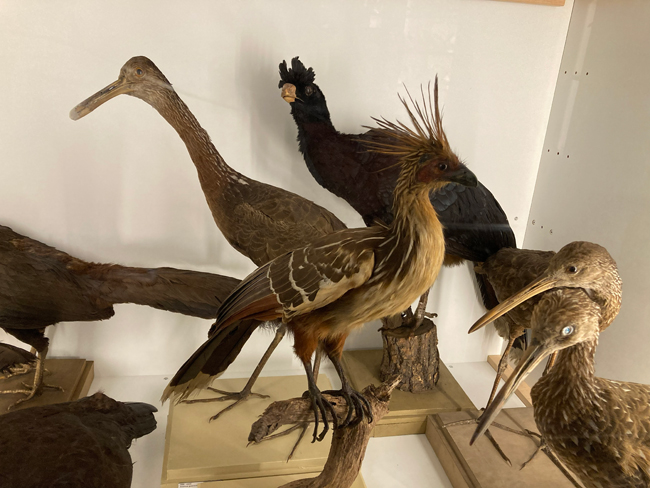
The Museum für Naturkunde Berlin has an enormous collection of stuffed animals including many birds from around the world. Picture credit: Everything Dinosaur.
Picture credit: Everything Dinosaur
Opening Up a Collection of Thirty Million Objects
The Berlin museum houses an enormous natural history collection comprising around thirty million objects. Ongoing cataloguing work is intended to create new ways for people around the world to access these collections. Furthermore, the project aims to democratise access to existing knowledge. It also seeks to encourage participation in the creation of new knowledge about museum specimens and their histories.
The guidelines have emerged from more than a decade of research and collaboration. Participatory projects, workshops and international exchange programmes have brought together researchers representing different academic disciplines and cultural backgrounds.
Many of the amazing dinosaur fossil specimens on display at the Museum für Naturkunde Berlin come from Tanzania. They were collected during Germany’s colonial past. These specimens including the enormous Giraffatitan mounted fossil skeleton will also come under these guidelines.
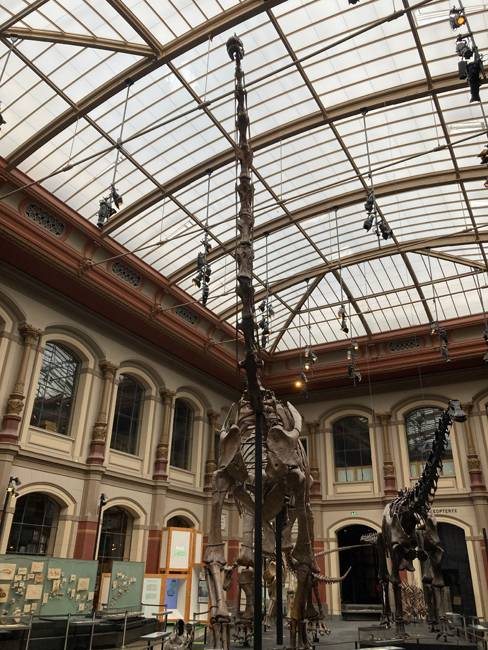
The spectacular dinosaur gallery at the Museum für Naturkunde Berlin. Picture credit: Everything Dinosaur.
Picture credit: Everything Dinosaur
The Museum für Naturkunde Berlin has recently been praised for its work on conservation and documenting the biota of the German capital.
To learn more about this work: Berlin Amphibian Population Falls According to New Study.
International Collaboration and Co-curation
Recent developments at the museum demonstrate how these principles can be applied in practice. New galleries focusing on deer and horned animals and mammal skulls were developed through an international co-curation programme. Nine co-curators from Tanzania, Rwanda, Burundi, Zambia, Togo, Cameroon, Kenya, Namibia and Egypt participated in the project. Their contributions enabled scientific research to be considered alongside local knowledge systems, cultural experiences and historical perspectives. The resulting displays demonstrate how natural history collections can be interpreted through dialogue involving different communities and areas of expertise.
Such an approach can provide additional context for specimens that might otherwise be viewed solely from a biological or taxonomic perspective.
A Resource for Museums and Researchers
The guidelines are intended for anyone working with natural history objects. This includes staff and researchers associated with museums, universities, archives, research institutions and other collections.
Importantly, the publication is available in both German and English. It has also been made freely available as an open-access resource.
The Museum für Naturkunde Berlin regards the publication as a starting point rather than an end point. As research into colonial natural history collections continues, the recommendations can be developed and adapted to suit different institutions and circumstances.
The publication highlights an increasingly important aspect of modern museum practice. Natural history specimens can provide remarkable insights into biodiversity and the history of life. However, understanding how specimens entered collections, who collected them and under what circumstances can add another important dimension to their scientific and cultural significance.
Publication Details
Kaiser, Katja and Heumann, Ina (eds.). Dealing with Colonial Natural History Objects: Recommendations, Research, Reflections. Heidelberg: arthistoricum.net, 2026.
The publication is available open access.
Everything Dinosaur acknowledges the assistance of a media release from the Museum für Naturkunde Berlin in the compilation of this article.
The award-winning Everything Dinosaur website: Dinosaur and Prehistoric Animal Models.