

One of the highlights of reporting on new scientific discoveries is seeing the remarkable artwork that accompanies many research papers. While fossils provide the evidence, it often takes the skill of a talented palaeoartist to transform bones and impressions into vivid scenes from deep time. For example, we recently wrote about a remarkable ichthyosaur fossil discovery. The scientific paper and the subsequent media release featured Peter Trusler palaeoart.
The research paper examined the fossil evidence for predator/prey interactions in the Eromanga Sea around a 100 million years ago. The paper was accompanied by stunning illustrations created by renowned Australian palaeoartist Peter Trusler. His artwork helped readers visualise an extraordinary moment from the Cretaceous, making this important discovery even more accessible to scientists and the public alike.
In addition to the images supplied showing the fossil excavation and research, the media release contained two behind-the-scenes photographs showing Peter at work as he prepared the artwork used in the publication. These images provide a rare glimpse into the creative process behind scientific illustration and demonstrate the incredible attention to detail required when reconstructing extinct animals.
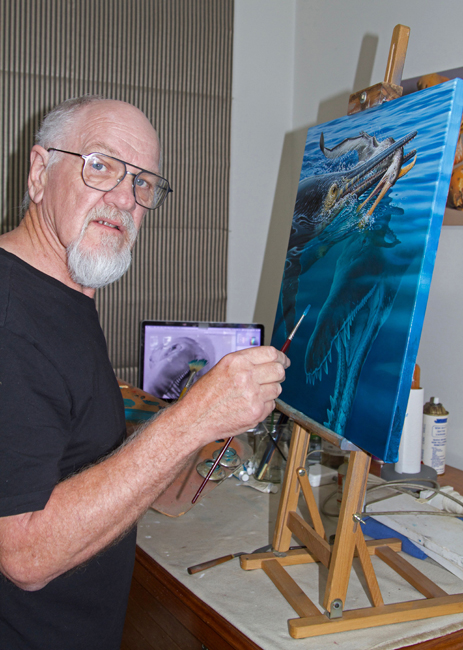
Renowned palaeoartist Peter Trusler working on the scientific illustration. Picture credit: Gael Trusler.
Picture credit: Gael Trusler
Where Science Meets Art
Palaeoartists occupy a unique position between science and art. Every reconstruction begins with careful study of the available fossil evidence. Anatomical features, muscle placement, posture, skin texture and the surrounding environment all have to be considered. Scientific papers, discussions with researchers and comparisons with living animals help guide every stage of the reconstruction. However, there is much more involved than simply drawing prehistoric animals. Great palaeoart communicates scientific ideas visually. It enables readers to understand behaviour, ecology and anatomy in ways that photographs of fossils alone cannot achieve.
For this reason, many scientific papers rely upon skilled artists to illustrate newly described species or reconstruct remarkable prehistoric events.
Bringing an Ancient Ecosystem to Life
The recently published ichthyosaur study described compelling fossil evidence suggesting that a large Platypterygius (Platypterygius australis) had consumed a pterosaur shortly before it died. The ichthyosaur subsequently was attacked by another predator. This remarkable discovery provides fresh insights into the diets of marine reptiles living more than 100 million years ago.
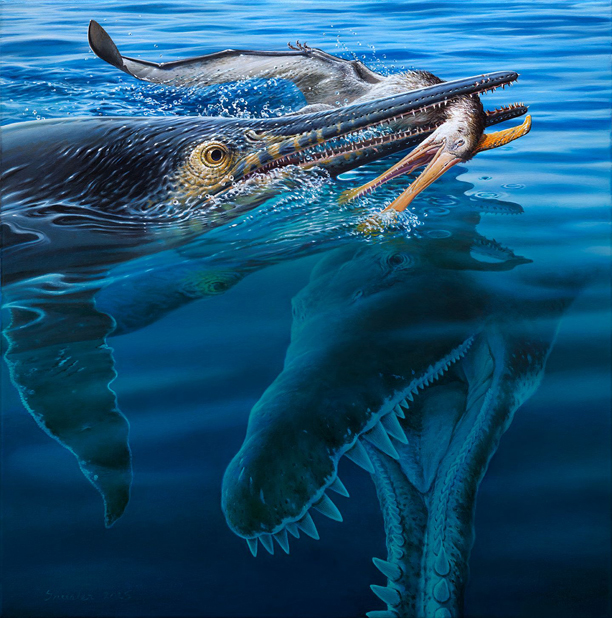
A life reconstruction showing the ichthyosaur with a pterosaur in its jaws with a Kronosaurus attacking from below. Picture credit: Peter Trusler.
Picture credit: Peter Trusler
Peter Trusler’s reconstruction captures this dramatic encounter with exceptional realism. His careful attention to anatomy, lighting and composition allows readers to imagine a scene that no human has ever witnessed. For many people, artwork such as this becomes the most memorable part of a scientific discovery. It helps bridge the gap between technical research and public understanding.
To read Everything Dinosaur’s recent article about the ichthyosaur fossil discovery: Ichthyosaur Ate a Pterosaur Demonstrated in New Study.
Everything Dinosaur Supporting Palaeoartists
At Everything Dinosaur, we have always believed that palaeoartists play an essential role in helping people appreciate prehistoric life. Their work inspires curiosity, supports scientific communication and encourages future generations to develop an interest in natural history.
Mike from Everything Dinosaur explained:
“Every scientific illustration begins with evidence, but it takes a talented artist to transform that evidence into something that informs, inspires and captures the imagination. Palaeoartists help all of us see prehistoric life in a completely different way.”
This commitment extends beyond celebrating established artists. At DinoCon last weekend we were delighted to meet the talented young artist Zain, whose dinosaur illustrations impressed everyone who saw them. We recently highlighted his work as an example of the creativity and enthusiasm that continues to flourish within the palaeoart community.
To read our recent article celebrating the young artist’s illustrations: A Young Artist at DinoCon.
By celebrating Peter Trusler palaeoart and encouraging emerging talent, we hope to help ensure that this unique blend of science and artistic skill continues to thrive.
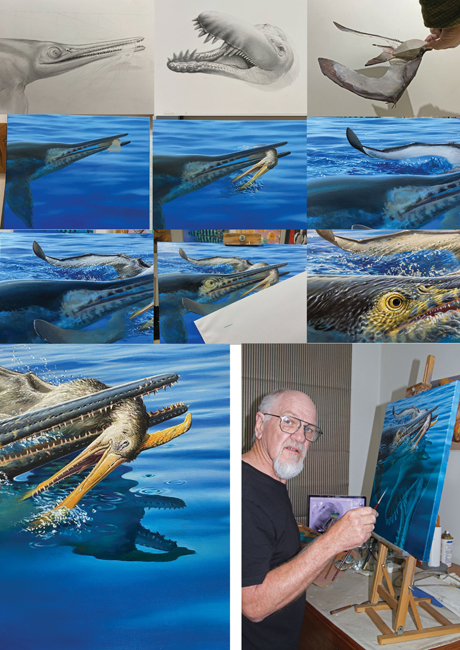
Developing the scientific illustration. Picture credit: Gael Trusler.
Picture credit: Gael Trusler
The Human Touch – Celebrating Peter Trusler Palaeoart
As artificial intelligence (AI) becomes increasingly capable of generating images, the work of professional palaeoartists has never been more important. Scientific illustration is built upon close collaboration between scientists and artists. Every brushstroke, every colour choice and every anatomical decision reflects careful interpretation of the available evidence.
Peter Trusler’s illustrations remind us that great palaeoart is far more than an attractive image to illustrate a scientific paper. It is a carefully researched interpretation that helps scientists communicate their discoveries and allows all of us to better understand the extraordinary history of life on Earth.
At Everything Dinosaur, we remain proud to champion the work of professional palaeoartists and to encourage the next generation of talented illustrators who will continue bringing prehistoric worlds vividly back to life. We look forward to reading the next scientific paper that features Peter Trusler palaeoart.
The award-winning Everything Dinosaur website: Prehistoric Animal Models and Figures.

Leave A Comment