

New Study Suggests Juvenile Maiasaura Ate Different Food to Adults
A newly published scientific paper has provided fresh insights into the feeding habits of the famous hadrosaur Maiasaura peeblesorum. Analysis of tooth wear in juvenile Maiasaura compared to adult hadrosaurs suggests that young Maiasaura fed differently from fully grown animals. Researchers examined dental wear associated with Maiasaura peeblesorum fossil teeth. Dietary insights may help to explain the remarkable success of these ornithischian dinosaurs.
The study focused on the microscopic wear patterns preserved in the dental batteries. Hadrosaurs possessed hundreds of tightly packed teeth. These teeth formed highly efficient grinding surfaces. However, the new research indicates that juveniles used their teeth differently when compared to adult duck-billed dinosaurs.

Haolonggood Maiasaura models. Each adult figure is supplied with a juvenile. The green coloured adult Maiasaura (left) is called Chun Hui. Whereas the model with the tail tinged purple is known as Hua Di. Research suggests that young Maiasaura may have had a different diet compared to the adults.
The image (above) shows the adult and juvenile Maiasaura models available from Haolonggood. These figures have been praised for their scientific accuracy.
To view the range of Haolonggood figures available: Haolonggood Prehistoric Animal Models.
A Different Diet for Young Hadrosaurs?
The researchers identified different proportions of wear types in juvenile jaws. This evidence suggests that young Maiasaura processed softer vegetation. In contrast, adults probably consumed tougher and more fibrous plants. Consequently, the study supports the idea of an ontogenetic dietary shift. In simple terms, the diet changed as the dinosaur matured. This feeding strategy may have reduced competition between younger and older herd members. Therefore, juveniles and adults could share the same environment whilst exploiting different food resources. In addition, a less fibrous and more nutritious diet could have facilitated rapid growth. Growing quickly is an effective way to avoid predation.
Duck-billed dinosaurs grew fast to avoid being eaten: Hadrosaurs Grew Fast to Avoid Predation.
The researchers postulated that the more nutritious diet probably consisted of new buds and protein-rich berries. The extra calories consumed, especially the greater proportion of carbohydrates, fuelled their rapid growth and development.
Maiasaura peeblesorum “Good Mother Lizard”
Maiasaura peeblesorum ranks amongst the most famous dinosaurs discovered in North America. Palaeontologists uncovered extensive nesting colonies in the Upper Cretaceous deposits of Montana. These fossil sites included nests, eggs and juvenile skeletons. As a result, scientists proposed that Maiasaura cared for its young. It was named and scientifically described in 1979 (Horner and Makela). The genus name translates as “good mother lizard”. This duck-billed dinosaur measured around eight to nine metres in length when fully grown. The jaws analysed in this study came from very young Maiasaura which measured around a metre in length. Maiasaura lived approximately 76 million years ago during the Late Cretaceous (Campanian faunal stage).
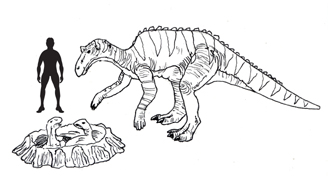
“Good Mother Lizard” A Maiasaura and nest. The human silhouette provides a scale. Picture credit: Everything Dinosaur.
Picture credit: Everything Dinosaur
Like other hadrosaurs, Maiasaura possessed a broad beak and sophisticated dental batteries adapted for processing plant material. Scientists also think these herbivores lived in large herds.
Studying Tooth Wear
The authors of the study are John P. Hunter (Ohio State University) and Christine M. Janis who is part of the Bristol Palaeobiology Group at the University of Bristol. They analysed wear facets preserved on the teeth. Different types of scratches and polished surfaces can reveal how animals processed their food. Furthermore, these microscopic traces help scientists infer diet and feeding behaviour. The authors concluded that juvenile Maiasaura displayed wear patterns distinct from adults. This difference probably reflects changes in feeding mechanics as the skull and jaws developed.
Understanding Dinosaur Growth and Behaviour
Scientists have studied Maiasaura extensively for decades. Previous research examined growth rates, nesting behaviour and herd structure. This new paper adds another important piece to the puzzle. Moreover, it demonstrates how dinosaur feeding strategies changed throughout life. Studies like this help palaeontologists reconstruct ancient ecosystems more accurately. They also show that dinosaur populations may have divided food resources according to age. Modern animals often display similar ecological separation. For example, birds with altricial young and an extended nesting period often have different diets depending on their age. Juveniles grow fast on a more nutritious diet of proteins, sugars and fat compared to the less nutritious diet consumed by the adult.
A Caveat
The researchers highlight that adult dental batteries of Maiasaura were not available for this study. However, as all other saurolophines examined have similarly large proportions of vertical wear on the dental batteries, while lambeosaurines appear to have a greater proportion of horizontal wear, they assume that the dental wear of adult specimens of Maiasaura would resemble that of these related saurolophine taxa.
The paper’s authors acknowledge this to be a weakness in their argument, and that their conclusions would be falsified if the dental batteries of adult Maiasaura were to resemble those of the juveniles. However, the researchers consider that, as with many other cases in paleobiology, it is still worthwhile proceeding with analysis on partial data if there are appropriate caveats placed on the limitations.
Commenting on the significance of this new Maiasaura peeblesorum fossil study, Mike from Everything Dinosaur stated:
“Hadrosaurs dominated many Late Cretaceous ecosystems. Their advanced chewing mechanisms helped them process huge quantities of vegetation. The new Maiasaura peeblesorum fossil teeth study highlights just how adaptable these herbivores may have been”.
The scientific paper: “Tooth wear in juvenile and adult hadrosaurs: implications for parental care in Maiasaura” by John P. Hunter and Christine M. Janis published in Palaeogeography, Palaeoclimatology, Palaeoecology.
The award-winning Everything Dinosaur website: Hadrosaur and Dinosaur Models.